Stave 4: delayed recognition, contrasting grief and possible futures
By UK GCSE English Literature · independent study · myAudience
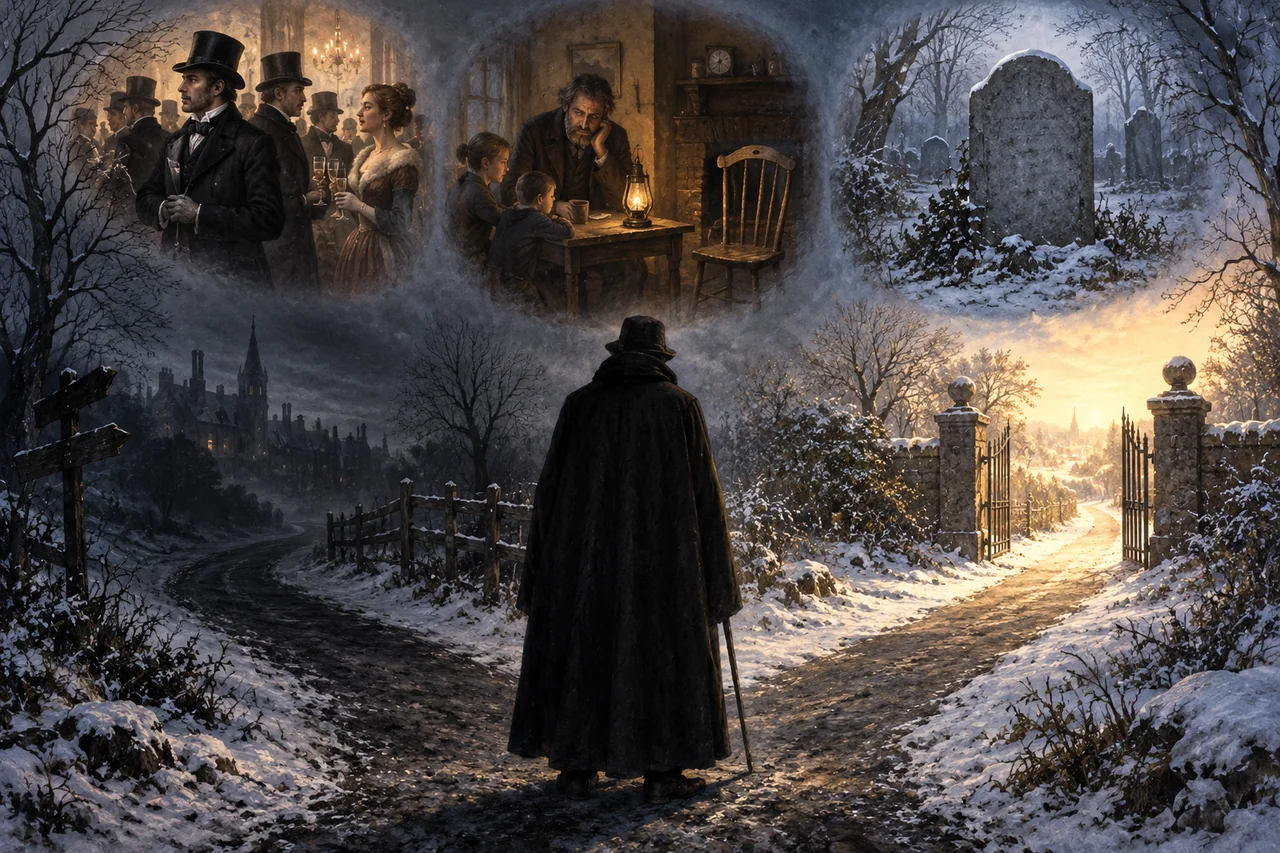
Image: illustration, not a documentary photograph. · Original generated conceptual literature illustration; independently reviewed original artwork.
Stave 4: delayed recognition, contrasting grief and possible futures
The final Spirit differs sharply from the earlier visitors. Its silence and pointing hand give Scrooge less conversational guidance, so he has to interpret what he sees. The reader also works through partial information, often recognising implications that he resists or does not yet grasp. This is not a simple chronological report of one known future. The scenes are arranged to disclose a connection gradually, and Scrooge himself notices uncertainty about their order. A response should distinguish the order of narration from the order in which fictional events might occur. The Spirit’s silence is important because it denies him the familiar defence of arguing against an explanation; he is forced to confront a sequence whose meaning he must piece together.
Businessmen discuss a death with indifference or casual humour. Their conversation turns attention towards practical details, including whether attending a funeral will offer any advantage. This echoes the opening’s connection between death and commerce, but the similarity should be explained rather than simply announced. Earlier, Scrooge could make a bargain on the day of his partner’s funeral; now a dead man’s social value is measured through convenience and possible benefit. The scene presents relationships thinned by calculation. It does not prove that every person engaged in business is incapable of grief. Dickens selects a particular conversation to make the absence of affection noticeable and to prepare a disturbing recognition that Scrooge has not yet completed.
The sale of stolen belongings turns the dead man’s possessions into goods for others. Objects that might seem to secure ownership no longer protect their owner, and the group’s laughter makes the reversal harshly comic. Their argument that he should have behaved differently does not automatically make theft a moral remedy. A careful interpretation can recognise both the criticism of his isolation and the disturbing conduct through which it is expressed. The scene should not become an approving lesson that cruelty entitles anyone to steal. Its narrative function is to expose a world in which the person’s value has collapsed into the value of things left behind, making Scrooge watch what a life without care could leave as its social aftermath.
The indebted household supplies an emotion connected with the death, but not the tenderness Scrooge seeks. Its relief reveals how a creditor’s power can make another person’s continued life feel threatening. The family does not say that the debt has vanished. They expect a transfer, hope to gather the money before it and believe a successor is unlikely to be equally merciless. This distinction matters when writing about consequences. The dead man’s loss gives breathing space rather than legal cancellation. Their pleasure is also uneasy: the wife prays forgiveness for her first response. Dickens creates a morally uncomfortable reaction that can be understood through pressure without being celebrated as a general principle that somebody’s death should be welcomed.
The Cratchits’ grief offers a different account of what is lost when a person dies. Quietness replaces the bustle of the earlier visit, and ordinary domestic acts become difficult to complete. Bob’s recollection and the family’s efforts to protect one another give the absence a relational meaning. The contrast is not simply that one death is sad and another is not. It shows how a person’s place in others’ lives determines what memory can hold. Tiny Tim is remembered through care rather than through goods that can be sold. Do not assign a clinical cause of death or assume a documentary household. The scene is part of the Spirit’s conditional instruction, designed to place different possible consequences of the present beside one another.
Scrooge struggles to find his future self and initially interprets the absence optimistically, imagining that his resolutions may already have changed his life. This is a useful piece of counterevidence against calling him fully informed throughout the sequence. His hopes can help him resist an unwelcome inference, even while he believes the scenes contain a moral for him. The grave finally brings the fragments together through his name. Delayed identification gives the revelation structural force: the reader has watched responses to an unnamed death before Scrooge is made to own their implication. An answer should describe this process without claiming that every reader will reach the inference at exactly the same moment. The effect depends on an uneven distribution of knowledge and willingness to recognise it.
At the grave, Scrooge asks whether the scenes show what will happen or only what may happen. The Spirit does not supply a clear spoken guarantee. Scrooge proposes that changed courses can produce changed ends and pleads for the possibility of altering his life. His reasoning belongs to a frightened character, but the final stave will give it a narrative test. The distinction between certainty and condition is therefore more than a grammatical observation. If the future were simply fixed, the urgent demand to change would lose much of its practical meaning. At the same time, the silence preserves uncertainty within the encounter. A careful response connects the conditional question with the ending without pretending that the grave scene itself delivers a complete theory of time.
Bring the different reactions to death into one argument about relationships and recognition. Commercial indifference, predatory exchange, pressured relief and family grief show consequences that Scrooge cannot adequately explain through possessions alone. The final identification also makes reading part of his moral education: he has to connect scenes instead of accepting a ready-made verdict. A competing interpretation might stress that fear for his own fate drives the change more than concern for others. That reading is worth testing against his request to see tenderness and the later support for Tim and Bob. The strongest conclusion does not need to choose one motive exclusively. It explains how the ordered visions make self-preservation and attention to other lives interact, while leaving the future conditional rather than historically established.
Image: illustration, not a documentary photograph. Imagined contrasting responses to death and a forked possible future. The silent guide and blank stone visualise delayed recognition; the image offers no textual quotation, fixed prophecy or claim about an afterlife. This original conceptual rendering is an interpretation; use the primary text and lesson prose as evidence.
Worked example: Explain how Dickens makes the grave revelation meaningful through the preceding responses to death, rather than relying only on a frightening name on a stone.
Build a thesis about the preparation of recognition. Before Scrooge sees the name, he encounters different social consequences of a death: indifference, sale, relief and grief. These scenes give the final identification an ethical content. It is not only the discovery that he can die, but the discovery of what his relations with others might leave behind. Keep the scenes as a selected narrative arrangement, not a claim about every possible mourner.
Select the business conversation and explain how advantage shapes it. The discussion of attendance and possible benefit suggests a connection weakened by calculation. Relate this to Scrooge’s bargain on Marley’s funeral day without equating the events in every detail. This is a structural echo in which death does not stop commercial assessment. It prepares the later fear that his own passing might carry little relational significance.
Use the indebted family to add a different consequence. Their relief is not casual indifference: it comes from pressure associated with a harsh creditor. Preserve the facts that the debt may pass to somebody else and the family hopes for time to gather the money. The scene criticises power through its effect on others. Do not claim the death forgives the debt or treat the family’s relief as a universally desirable response.
Contrast the Cratchits’ quiet grief with those reactions. The earlier bustle makes the altered domestic rhythm significant, and the family’s memories give Tiny Tim an enduring place in their lives. Explain the relation between this response and the unnamed man’s isolation. The contrast is about the lives affected and the forms of remembrance, not an unsupported hierarchy in which one person is naturally worth more than another.
Read the delayed name as the point at which Scrooge must connect what he has seen. He has searched for his future self and entertained hopeful explanations of the absence. The stone challenges those explanations, making recognition an action rather than a fact he knew all along. Analyse the Spirit’s silence and pointing alongside this delay. The reader may infer sooner, but do not impose one compulsory moment of understanding on every reader.
Conclude with the conditional question and its whole-text test. Scrooge asks whether the scenes must occur, and the ending records altered conduct and Tim’s survival. The grave revelation therefore functions within an opportunity to change, while fear remains a plausible motive. A reasoned answer can acknowledge that motive and still explain why the preceding human consequences give it a scope larger than self-protection. The strongest conclusion retains uncertainty at the grave instead of assigning the Spirit a spoken promise it never makes.
Answer: The grave’s name matters because Dickens has already made Scrooge encounter the human consequences of an unnamed death. Businessmen calculate convenience, while the indebted household experiences relief from a creditor’s pressure without assuming the debt itself has disappeared. The Cratchits’ quiet grief offers a contrasting memory founded on care. These reactions show forms of relationship that possessions alone cannot secure. Delaying identification makes Scrooge connect the scenes, after he has tried more hopeful explanations for his missing future self. Fear is therefore present, but it concerns both death and the life remembered by others. His question about what will or may happen leaves room for the final stave’s test of change, rather than treating the visions as a fixed historical record.
Check your understanding: Changed task: evaluate the claim that the final Spirit shows a fixed future and that Scrooge therefore changes only through fear of unavoidable punishment.
Answer: The visions create fear, and the grave makes self-preservation a plausible motive. However, Scrooge explicitly asks whether they show what will happen or what may happen. The Spirit remains silent rather than giving a spoken guarantee of inevitability. The narrative also has him ask for tenderness connected with death, and the ending links changed conduct with a different outcome for Tim. These details complicate the claim that unavoidable punishment alone explains reform. A reader may still argue that concern for himself is decisive, but must account for the concern directed towards other people and the story’s conditional possibilities. The response should therefore distinguish the force of a warning from proof that its projected outcome cannot be altered.
Why: Worked-method rationale: the first answer explains the information accumulated before the name appears and gives each response to death a different role. It preserves the transfer of debt and does not endorse theft as justice. Changed-method rationale: the second answer concedes fear while examining conditional language, silence and the ending. It avoids treating a character’s frightened inference as an authoritative theory of time. Both responses can be challenged through textual reasoning, but neither depends on invented certainty or an assumed uniform reader response.