Stave 5: actions, comedy and the limits of a happy ending
By UK GCSE English Literature · independent study · myAudience
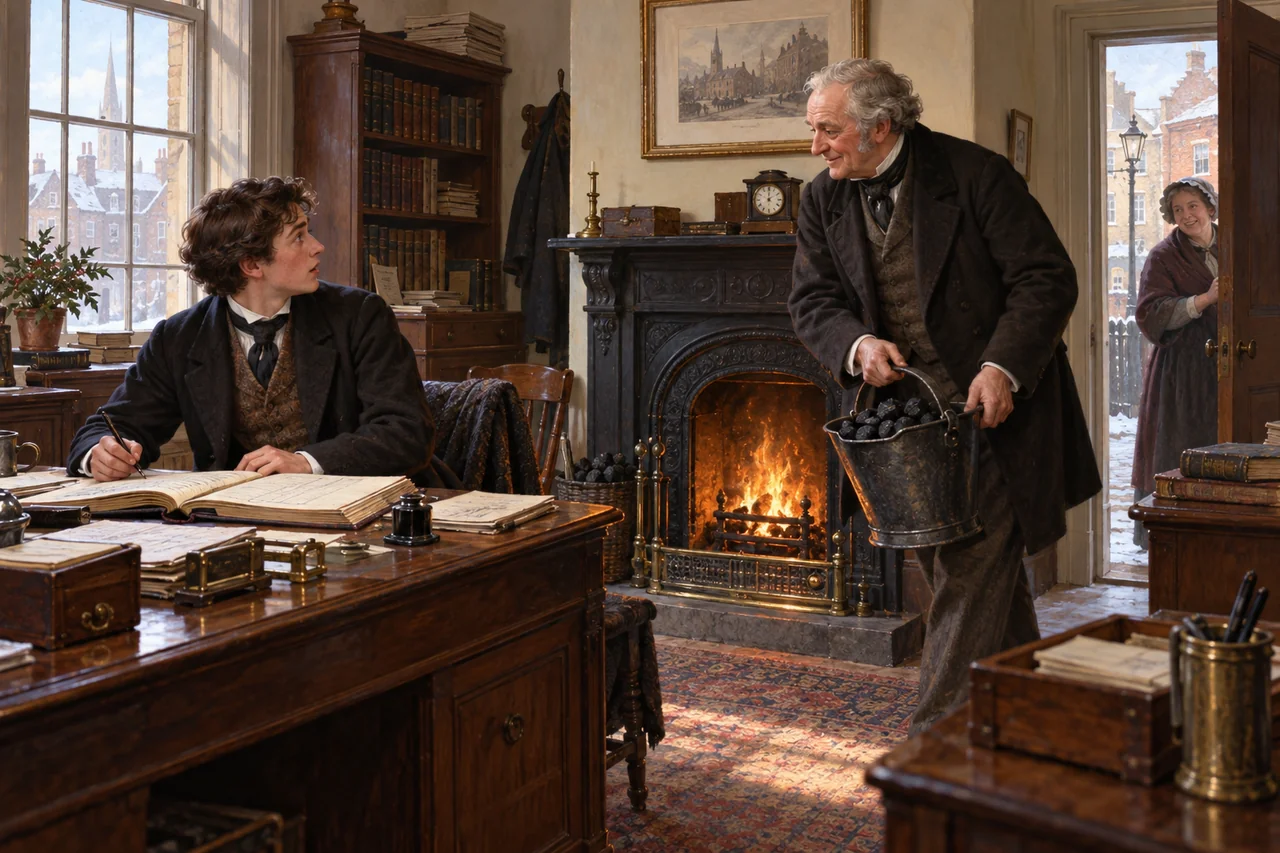
Image: illustration, not a documentary photograph. · Original generated conceptual literature illustration; independently reviewed original artwork.
Stave 5: actions, comedy and the limits of a happy ending
The last stave begins with bodily movement and uncertain excitement rather than with a calm declaration that reform is finished. Scrooge tests what day it is, rejoices that an opportunity remains and struggles to express the intensity of his response. The comedy contrasts with the controlled manner of the opening, but it does not make the transformation only a new mood. A reader should ask what happens to the energy after he leaves the bedroom. The rest of the stave supplies a sequence of encounters through which earlier refusals can be reconsidered. Dickens therefore gives the ending a task beyond announcing happiness: it must show how a changed understanding enters relationships and remains more than the pleasure of having escaped an alarming future.
The turkey sent to the Cratchits redirects a resource towards people whose need Scrooge has encountered. His anonymity makes this different from a public display that demands immediate thanks. However, the gift is not enough by itself to establish a transformed employment relationship. It is a festive act, and a response should not confuse it with a permanent change in conditions. The office scene that follows matters because the narrative does not end at the purchase. This helps to test the claim that the novella offers only an isolated charitable gesture. Dickens allows a dramatic gift to begin the public consequences of the change, then connects them to pay, warmth and continuing support.
The encounter with the collector returns Scrooge to an earlier conversation rather than inventing an entirely new moral test. He now makes a private offer and asks forgiveness for his former refusal. The amount is not given to the reader as an exact sum, so analysis should not manufacture one to measure generosity. What matters is the altered relationship between the speaker, the request and the people for whom it is made. His acknowledgement includes past neglect, making the present act more than an insistence that the previous conversation did not happen. A structural argument can explain how the same situation is revisited with a different response, while preserving the fact that missed opportunities cannot be literally recovered in their original form.
Accepting Fred’s invitation tests a different kind of change. It involves entering a relationship rather than transferring money, and requires Scrooge to make himself visible after rejecting the earlier welcome. Fred’s response also matters: the reform is not created by the uncle alone, since a generous invitation has been kept open by somebody else. The scene answers the reminder of Fan’s son without reducing Fred to an instrument of memory. His own household receives the returning visitor. A response that treats reform only as a set of purchases will miss this reciprocal element. Dickens makes belonging depend on a changed willingness to join other people, as well as on changed uses of resources.
The return to the office uses comedy to reverse a recognisable pattern of authority. Scrooge imitates a threatening manner when Bob arrives late, but the apparent reprimand turns towards a salary increase. The sequence depends on Bob’s expectations, which the earlier employer has helped form. An answer should not assume that the joke is entirely comfortable for the employee: his alarm and bewilderment remain visible. That complication makes the scene worth analysing rather than simply celebrating. The promise of higher pay and assistance changes something material, while the request for more coal revisits the controlled warmth of the opening. The reform is therefore judged through conditions as well as through a friendly voice.
The narrator’s account then extends beyond the immediate day. Scrooge fulfils and exceeds his promises, supports Tim, and becomes a better friend and employer over time. This compressed summary makes a claim of durability that the lively individual scenes cannot establish on their own. Distinguish its form from what has been directly dramatised: the narrator tells us about continuing conduct rather than showing every later occasion. Tim’s survival supplies a changed outcome for the Spirit’s conditional warning, but it must not be used to make a medical rule about generosity curing disability. The ending belongs to the novella’s moral design, not a clinical case. Its assurance works by connecting a revised life with the threatened losses previously made visible.
A reader can still ask what this hopeful ending does not settle. One exceptional employer’s reform does not demonstrate a change in every institution, wage relation or cause of poverty. The allegorical warning about Ignorance and Want had a wider scope than one household, and an answer should remember that when judging the final assurances. This limitation need not make the reform meaningless. Pay, warmth, attention and lasting support matter to particular people, even if they do not constitute a complete social policy. A reasoned critique can therefore acknowledge both the force of the individual change and the pressure placed upon it by the wider warning. Avoid either announcing that Dickens solves poverty or dismissing every act because it does not solve everything.
The ending is strongest as a test of relations introduced earlier: collector and donor, uncle and nephew, employer and worker, observer and vulnerable child. Repetition with alteration allows readers to compare conduct, while the shift from isolated scenes to narrative summary claims its continuation. Motives may remain mixed. Fear of the grave, regret for the past and concern for others have all been part of Scrooge’s education; the text need not supply one purified cause for every act. An analytical conclusion should explain how the novella makes change recognisable, then qualify the scale of what it demonstrates. That keeps the happy ending open to serious judgement without treating either joy or criticism as a failure to understand the story.
Image: illustration, not a documentary photograph. Imagined changed workplace conditions. More warmth and attentive conduct illustrate material reform, while the clerk’s cautious response reminds us that excitement alone is not evidence of sustained change. This original conceptual rendering is an interpretation; use the primary text and lesson prose as evidence.
Worked example: How does Dickens make Scrooge’s reform more than a promise made in fear? Use the collector encounter and the final office scene, and distinguish immediate action from the narrator’s later summary.
Form a thesis that can be checked against conduct: the ending revisits relationships in which Scrooge earlier refused responsibility, then adds a claim of sustained change. Do not begin with an assertion that fear has disappeared completely. The task asks how reform is demonstrated, not whether motives become entirely pure. This distinction allows a response to assess different kinds of evidence without assuming that one emotion explains every scene.
Read the collector’s return as a structural test. The situation resembles the earlier request, but Scrooge now acknowledges neglect and makes an offer. The exact sum is withheld, so the response should analyse the changed stance rather than inventing a monetary measure. His request for forgiveness also recognises that a new act does not erase the earlier refusal. The scene gives responsibility a history rather than treating goodness as a title he can simply claim.
Analyse the office joke through Bob’s expectations. Apparent anger creates suspense because it recalls the employer’s former conduct; the unexpected salary increase changes the direction of that power. Bob’s distress should not be ignored in describing the comedy. Explain why the material promises matter: pay and fuel reach into conditions of work and family need, rather than offering friendliness as their substitute.
Connect the coal to the opening without making every detail identical. Earlier, Scrooge controlled the supply that could warm the clerk; now he orders more. This repeated resource provides a concrete way to recognise altered treatment. A whole-text reference earns its place when it explains this difference, not merely when it adds another scene name. Link the salary and family assistance to the Cratchit household while avoiding a fabricated precise wage or medical outcome.
Distinguish the day’s dramatised actions from the narrator’s broader summary. A gift and a promise cannot alone prove a lasting pattern, whereas the final account states that Scrooge does and exceeds what he said. That summary is a narrative assurance, not a record of every future day. It supports the story’s claim of durable reform while leaving a reader able to question how much an exceptional individual can resolve within a wider social problem.
Conclude by balancing demonstrated change with its scale. The collector and office scenes revise two different relationships, and the summary claims continuation beyond them. Fear may remain one motive, but the conduct now includes attention to particular people and material needs. Check that the response has not replaced this argument with a sentimental slogan, and that its criticism does not dismiss meaningful assistance simply because it is not a complete institutional reform.
Answer: Dickens tests reform through renewed encounters rather than leaving it as a frightened promise. Scrooge revisits the collector’s request, acknowledges previous neglect and makes an offer whose exact sum is withheld. The office scene then turns an apparent reprimand towards improved pay, fuel and assistance, altering the conditions over which he had earlier exercised cold control. Bob’s alarm preserves a complication within the comedy, but the material promises go beyond a friendly manner. The narrator’s final summary also claims that Scrooge fulfils and exceeds them over time, distinguishing durable conduct from one festive day. These changes do not remove every social cause of poverty, and fear can remain part of the motivation. They nevertheless show responsibility entering relationships that the opening had narrowed or refused.
Check your understanding: Changed task: evaluate the claim that Scrooge reforms only to protect himself. Include evidence supporting that reading and evidence that complicates it.
Answer: The grave revelation strongly supports a self-protection reading: Scrooge fears the future associated with his own name and urgently seeks another outcome. The final stave does not require us to pretend that fear vanishes. However, the conduct it records reaches beyond avoiding a lonely death. He recognises past neglect in the collector encounter, enters Fred’s household, changes pay and warmth, and supports Tim over time. Earlier memories and the Cratchit scenes have also directed his attention towards other people. A persuasive judgement can therefore treat self-preservation as one motive without making it the only one. The narrator’s assurance of continuing care complicates a reading based exclusively on one frightened moment, although it does not provide an exhaustive psychological account of every later action.
Why: Worked-method rationale: the first response uses repeated situations and material conditions as tests of conduct, then separates individual scenes from the narrator’s claim of duration. It neither invents amounts nor treats assistance as a medical guarantee. Changed-method rationale: the second concedes the grave’s force before testing an exclusive motive against other scenes. It avoids a false choice between completely selfish and completely pure reform. Both answers permit a reasoned critique of the ending’s social limits while preserving what the text actually changes.