All five staves: structure, context and a defensible extract-to-whole argument
By UK GCSE English Literature · independent study · myAudience
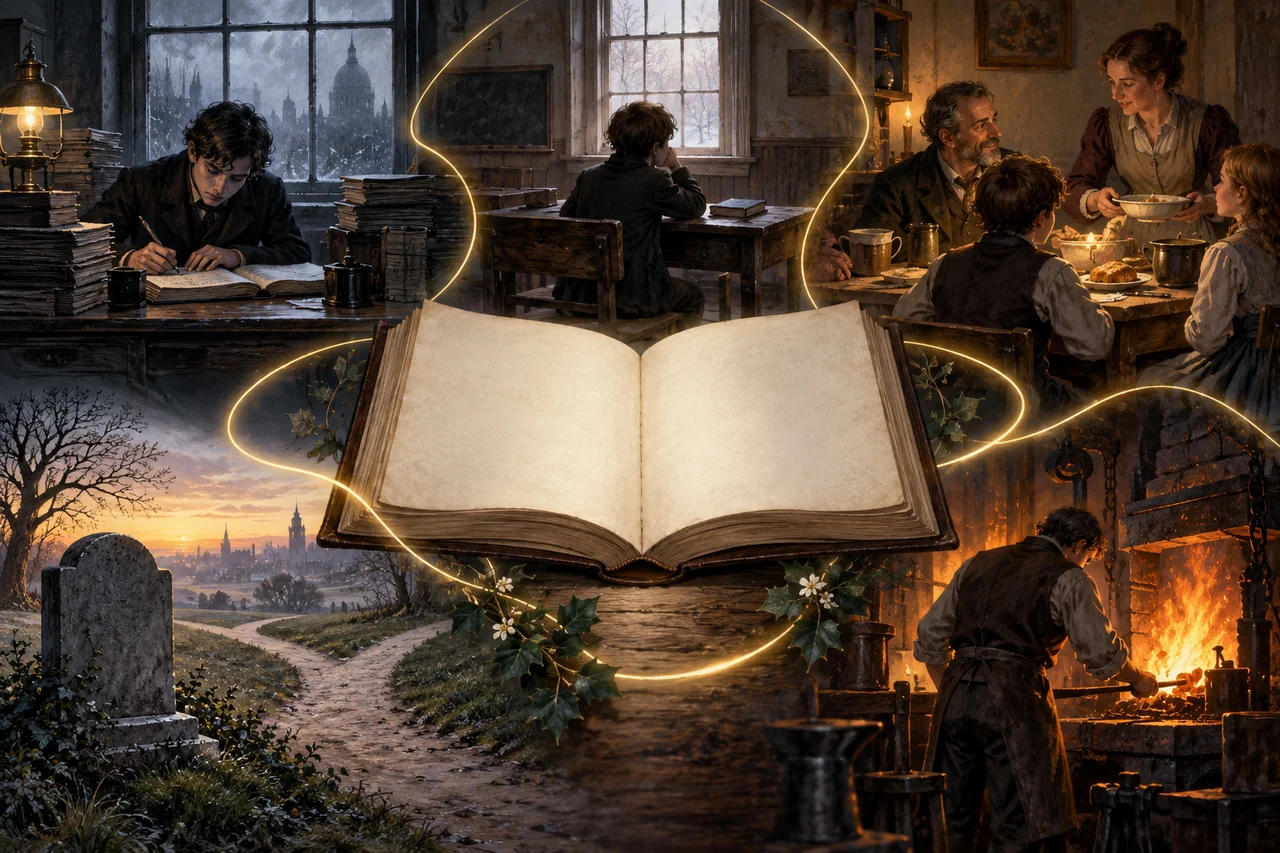
Image: illustration, not a documentary photograph. · Original generated conceptual literature illustration; independently reviewed original artwork.
All five staves: structure, context and a defensible extract-to-whole argument
Full worked essay — paragraph 1 of 4: Dickens presents responsibility as a relationship that Scrooge has narrowed, rather than as a quality he simply lacks by nature. The collector conversation in Stave One makes that narrowing audible. Scrooge invokes prisons and workhouses as though their existence settles his part in another person’s need, then insists that other people’s affairs are outside his business. The repeated concern with business matters because it offers an apparently practical justification: he claims to be attending to what properly belongs to him. Yet the collectors’ account of people who cannot go to those institutions, or would rather die, exposes what his answer leaves out. Provision named at a distance is not the same as adequate care experienced by a person. The surrounding counting-house scene also gives this refusal a material form. Bob’s warmth depends on an employer who controls coal, so responsibility has an effect before it becomes a subject of debate. The narrator’s cold imagery joins disposition and setting, but the argument does not require us to assume that every reader responds identically to it. What can be shown is a pattern of choices through which distance from others is maintained. The novella will challenge that pattern by making neglected relationships difficult for Scrooge to keep outside his attention.
Full worked essay — paragraph 2 of 4: The return to the past complicates the hostile opening portrait without withdrawing its evidence. Seeing the lonely child at school makes Scrooge’s isolation understandable in a new way, and his sudden thought of the rejected carol singer transfers recognition beyond himself. Regret does not yet give the singer anything; the sequence instead shows responsibility beginning as an awareness of a missed connection. Fan’s welcome and the reminder that Fred is her son provide another link between an affection remembered and an invitation refused. Dickens thus makes memory active rather than merely decorative. Fezziwig’s celebration also moves Scrooge between positions within a relationship: the older employer responds with the feeling of a young worker and recognises power to make service pleasurable or burdensome. His explanation of happiness resists the Ghost’s invitation to reduce it to expenditure. Belle’s later judgement reveals the opposite narrowing, in which gain has absorbed other hopes and displaced the commitments of their earlier relationship. Scrooge’s fear of poverty deserves acknowledgement, because the dialogue itself gives it a place, but it does not settle the justice of every choice made through that fear. These memories therefore do more than invite sympathy. They supply standards against which his present relationships can be tested, while preserving the difference between understanding a motive and excusing conduct.
Full worked essay — paragraph 3 of 4: Christmas Present widens the test from remembered relationships to lives continuing around him. The Cratchits’ pleasure is sustained by labour and shared attention, not by the disappearance of material scarcity. Martha’s late return, the preparation of food and Bob’s concern for Tim keep need visible within warmth. The disagreement between Bob’s toast and his wife’s protest also prevents the family from becoming one uncomplicated voice of gratitude. Scrooge’s concern for the child then gives a particular referent to language he had previously used at a distance. When the Spirit returns his population argument, repetition changes its force: a category with which he dismissed suffering now threatens somebody whose place in a household he has seen. The warning remains conditional, so it demands a response rather than establishing an inevitable medical fate. The wider journey and the emergence of Ignorance and Want further challenge any idea that care is exhausted by affection for one family. Calling the children humanity’s redirects attention towards a collective failure, while the repeated institutional questions recall Scrooge’s earlier attempt to close discussion. Parliament’s account of the harsh, deterrent arrangements associated with the 1834 relief reforms helps contextualise that language, but the fictional episode is not a documentary history of every claimant. Its force comes from confronting an evasion with people and consequences that the evasion refused to recognise.
Full worked essay — paragraph 4 of 4: The final Spirit and the ending test whether that recognition can become conduct. Responses to death include indifference, the sale of belongings, an indebted family’s uneasy relief and the Cratchits’ grief. Delaying the dead man’s identification makes Scrooge connect these consequences before the grave supplies his name. Fear for himself is plainly important, but the visions have given that fear a relational content: the question is also what his life has made possible or impossible for others. His distinction between what will and what may occur leaves room for the ending’s revised actions. Dickens then returns him to situations in which responsibility was refused. He acknowledges neglect to the collector, accepts Fred’s welcome and alters Bob’s pay and warmth. The office’s coal is a concrete reversal, not simply an announcement of a nicer personality. Finally, the narrator’s account of continued support gives duration to a change first dramatised through one day. These assurances do not prove that individual goodwill removes every structural cause of poverty, and the broader warning about neglected children leaves that limit visible. Nevertheless, the movement through the five staves makes responsibility recognisable as attention translated into relationships and material choices. Scrooge’s reform is persuasive within that design because it revisits the people and obligations he had tried to exclude from his definition of business.
Full changed essay — paragraph 1 of 4: Generosity in A Christmas Carol cannot be confined to an occasional kind gesture, although Dickens makes individual acts a powerful part of its appeal. The opening tests both resources and authority. Scrooge’s control of Bob’s coal makes withholding care a condition of another person’s working life, while the collector conversation gives refusal a social justification through institutional names. Those details suggest that generosity concerns how a person uses a position, not merely whether he experiences a sympathetic feeling. At the same time, the novella does not supply a complete alternative system of relief. Scrooge’s claim that institutions exist is made inadequate through dialogue, but the collectors do not replace it with a fully explained programme. A response should therefore distinguish the scale of the criticism from the scale of the proposed remedy. The story can expose a failure reaching beyond one household while concentrating its dramatic change upon one man. This tension is not solved by declaring the book either a complete social reform or a merely private moral tale. It needs to be examined through the connections Dickens constructs between acts, relationships and wider neglect, and through the limits that remain when the ending offers its assurances.
Full changed essay — paragraph 2 of 4: Fezziwig’s remembered celebration makes generosity an exercise of power that shapes a shared environment. He can interrupt work and make its place hospitable, while Scrooge explains that an employer’s words and looks can turn service towards pleasure or burden. The memory therefore reaches beyond a sum spent on entertainment. Its immediate consequence is the wish to speak differently to Bob, which points towards a current relationship under Scrooge’s authority. However, this should not be made into a defence of friendly treatment instead of wages or warmth. The ending will include material support as well as a changed manner. The Cratchit celebration offers another useful distinction. Shared attention creates pleasures that financial wealth alone cannot secure, but Martha’s work, limited food and the threat of losing Tim remain visible. Bob and Mrs Cratchit also disagree about the employer, exposing an injustice that gratitude might otherwise conceal. A reading centred on individual kindness can account for the family’s care, but it becomes less adequate if it treats their happiness as evidence that material conditions do not matter. Generosity is valuable here because it attends to people within those conditions, not because it permits the conditions to be ignored.
Full changed essay — paragraph 3 of 4: The warning about Ignorance and Want gives the strongest reason to move beyond a private definition. The children appear beneath the robe of a Spirit associated with abundance, so the narrative places deprivation inside, rather than safely outside, the festive vision. Their allegorical identities connect material need with failures of understanding and recognition. The particular emphasis on ignorance does not prove that education alone will solve poverty, since want remains beside it and both require attention. Calling them humanity’s also resists Scrooge’s attempt to treat need as somebody else’s responsibility. The threatened outcome is conditional, which preserves a demand for action rather than making neglect an unalterable fact. Historical context about relief can illuminate the inadequacy of Scrooge’s repeated institutional questions, but it should not be inserted as proof of a single exhaustive authorial intention. The episode supplies an ethical and social warning, not a policy document. Its scale nevertheless puts pressure on the ending: assistance to the Cratchits matters, but cannot by itself answer every need represented by the paired figures. A generous reading of reform must therefore acknowledge that the novella has made a wider problem visible than the final domestic reassurance alone can settle.
Full changed essay — paragraph 4 of 4: The last stave answers part of that problem through changed conduct and leaves its larger extent unresolved. Scrooge’s offer to the collector recognises earlier neglect; entering Fred’s home responds to an invitation that has remained open; raising pay and increasing coal changes the material use of employer power. The anonymous turkey is only one element within this sequence, so the reform should not be dismissed as a single purchase demanding applause. The narrator’s final assurance that Scrooge exceeds his promises also presents generosity as a continuing relationship rather than a temporary festive emotion. Yet that assurance depends on an exceptional individual whose resources and position enable the change. It does not demonstrate that all employers or institutions have changed, nor that the causes of deprivation have disappeared. This limit supports a reasoned critique of the hopeful ending, without making every act it records meaningless. Dickens’s design joins private attention with a wider warning and invites the reader to confront what refusal of responsibility can do. Generosity is consequently more than individual kindness when kindness names only a feeling or isolated gift. It involves material choices, recognition of dependence and sustained care, while the collective claims of Ignorance and Want remain an unfinished challenge rather than a problem conclusively solved by one reformed life.
Image: illustration, not a documentary photograph. Five imagined motifs organised as a structural reading aid. The sequence suggests opening, memory, community, possible consequences and changed conduct; the complete lesson text supplies the argument, and the motifs are not quotations or historical evidence. This original conceptual rendering is an interpretation; use the primary text and lesson prose as evidence.
Worked example: Original practice task: starting with the collector conversation in Stave One, explain how Dickens connects responsibility with changing relationships across the novella. The complete original model essay is in paragraphs 1–4 above; this is not an official exam question.
Decode the scope before forming a thesis. The prompt asks about a connection between responsibility and relationships, not an isolated list of generous acts. Its starting passage supplies a local problem: Scrooge believes naming institutions and attending to his own business discharges his obligations. The worked essay turns that problem into a proposition that can be tested: responsibility is a relationship he has narrowed. This gives the four full paragraphs an organising argument, while leaving room to qualify the extent of reform. The labelled paragraph sequence is the complete model, not the short synthesis below.
Make the first paragraph earn its whole-text direction through close detail. Analyse the collector exchange’s logic and the office’s controlled coal before jumping to later staves. The connection between language and material power shows what the opening establishes. Avoid a method list in which repetition, metaphor and setting are named without consequences. The paragraph’s account of institutional distance also makes room for a counterargument: the existence of relief does not prove its adequacy. No reader response is treated as uniform, and no unsupported exact wage or temperature is invented.
Select the past episodes according to the thesis rather than chronological completeness. The lonely child and rejected singer establish a movement from self-recognition to another person; Fan and Fred connect affection remembered with an invitation refused. Fezziwig and Belle then test different priorities. The worked essay includes Scrooge’s fear of poverty because acknowledging an awkward motive strengthens judgement. It does not write a separate biography paragraph or use childhood as automatic absolution. Every selected scene develops the question about relationships, so breadth is created through argument rather than a checklist of every event.
Widen the third paragraph without losing the particular. The Cratchits have roles, disagreements and needs; the repeated population language acquires force because a child has been encountered. The outward journey and the allegorical children then put pressure on a merely domestic account of care. Context about relief is attached to a precise interpretive issue and explicitly bounded, not inserted as a claim that every Victorian had identical attitudes. The paragraph distinguishes the conditional warning from a guaranteed medical outcome and collective responsibility from a complete policy programme.
Use the final paragraph to test and qualify the thesis. The future scenes give fear a relational content before the name is revealed, and the ending revisits obligations through concrete actions. Separate what is dramatised on one day from what the narrator later summarises. The essay’s conclusion retains a social limit: reform within one life does not demonstrate that poverty’s structural causes are removed. This is a reasoned qualification, not a detached last-minute objection. Check transitions so that the conclusion follows from the wider warning already analysed rather than introducing an unrelated topic.
Edit by testing each inference and the response’s clarity. Replace an assertion about Dickens’s one certain intention with a supported account of arrangement where needed. Check quoted words against the retained primary edition, maintain consistent present tense for literary analysis and use punctuation to make qualifications clear. The changed essay must answer its different prompt, not merely repeat the worked thesis. Its four complete paragraphs begin with the scale of generosity, evaluate employer and household relations, then test collective warning against the ending. These are original teaching models; no official mark or grade is assigned.
Answer: Concise synthesis, not the full essay: Dickens moves Scrooge from distancing obligations through the language of business towards recognising particular relationships and acting within them. Memories, the Cratchits and the wider warning test the opening’s values; possible future consequences and repeated situations make reform concrete. The ending claims durable pay, warmth and care without proving that individual goodwill resolves every structural cause of poverty. The COMPLETE worked essay, including close analysis, context and qualification, is retained verbatim in the four labelled worked-essay paragraphs 1–4 above.
Check your understanding: Changed original task: evaluate the claim that generosity in the novella is only individual kindness. Develop a different whole-text argument, acknowledging the ending’s social limits. The COMPLETE changed model essay is in the four labelled paragraphs 5–8 above.
Answer: Concise synthesis, not the full essay: generosity becomes more than a feeling or isolated gift through the use of employer power, resources and sustained relationships. Fezziwig, the Cratchits and the final pay-and-coal changes support that reading. Ignorance and Want widen the demand beyond one household, yet one exceptional life’s reform does not demonstrate general institutional change. The COMPLETE changed essay, with its distinct thesis, counterevidence and qualification, remains verbatim in the four labelled changed-essay paragraphs 5–8 above.
Why: Worked-method rationale: the first full essay links the starting exchange to a pattern of narrowed and renewed relationships. Scene selection is governed by that thesis, close detail precedes wider claims, and context stays attached to a specific problem. Its ending distinguishes meaningful individual conduct from a complete social remedy. Changed-method rationale: the second essay begins with the scale of generosity, tests a private account against power and material need, and uses the allegorical children to expose the limit of domestic reassurance. Its conclusion therefore answers a different question, not the same thesis with a new introduction. Both essays are retained in full above; the short answer fields are explicitly synthesis only. Literal evidence, inferential interpretation and contextual history remain distinct. Formal AO achievement, marks and whole-course qualification readiness stay open.