Cells with and without nuclei
By UK GCSE Biology · independent study · myAudience
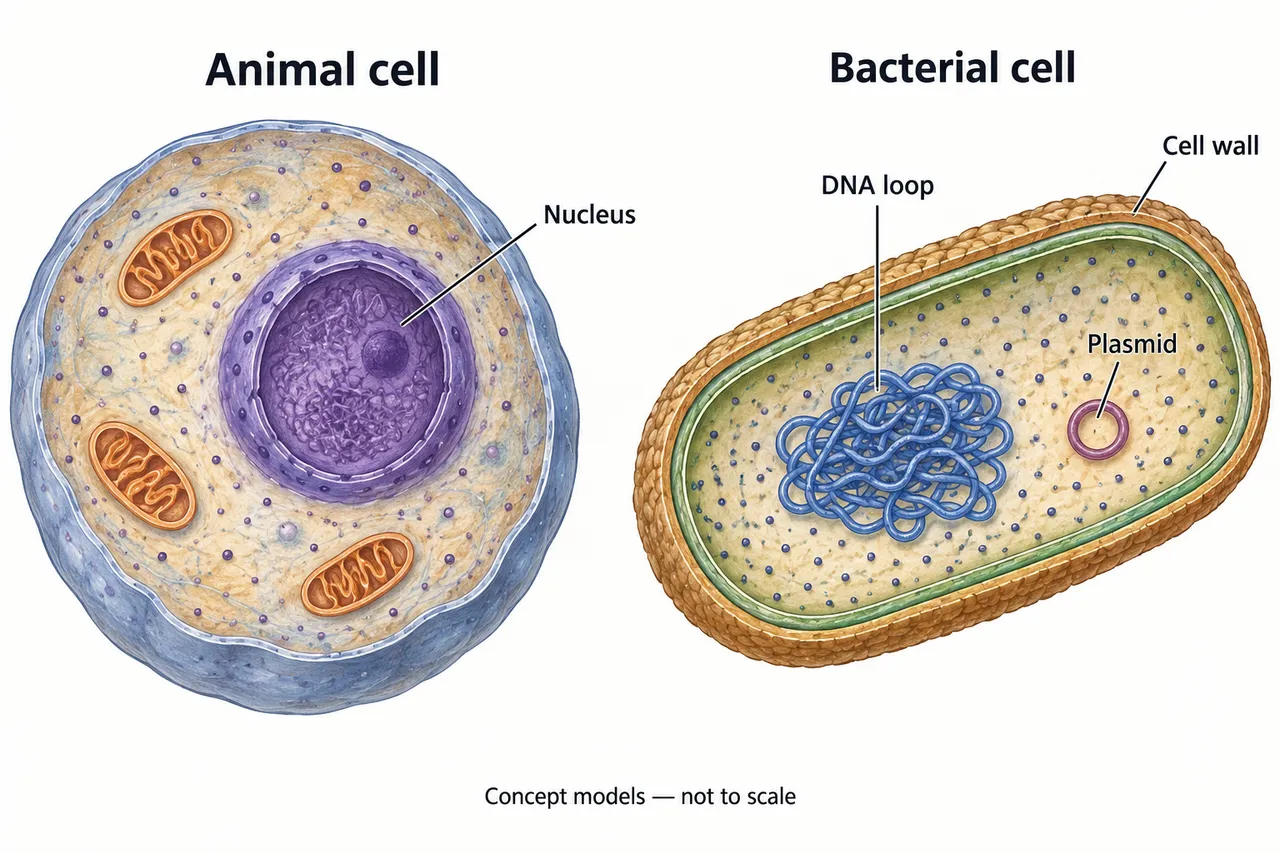
Original AI-generated myAudience scientific concept illustration; not a micrograph or measured specimen. · Original generated project artwork; no source textbook figures reused. Reference links support subject review, not a copied-art license.
Cells with and without nuclei
A cell separates its contents from its surroundings with a membrane. Both bacteria and eukaryotic cells contain cytoplasm, ribosomes and DNA. In eukaryotes, most DNA is enclosed by a nucleus; bacteria have no nucleus, and their main chromosome occupies the cytoplasm. A bacterial cell has a wall outside its membrane; some also carry plasmids, smaller DNA rings.
Scale comparisons need consistent units. A 2 µm bacterium is one tenth the length of a 20 µm animal cell in an illustrative comparison. That length ratio is not a direct volume ratio: for similar shapes, changing every linear dimension by ten changes volume by a thousand. The stated dimensions describe the example, not every cell of each type.
Write units before comparing sizes: 1 mm = 1,000 µm and 1 µm = 1,000 nm. A 2 µm length is 2 × 10⁻⁶ m. Compared with a 20 µm length, it is smaller by one order of magnitude. Standard form separates a number between 1 and 10 from its power of ten; count powers only after both values use the same unit.
Worked example: A cell has ribosomes, a wall and a DNA loop but no nucleus. How would you classify it?
Identify the absence of a nucleus
Combine this with the DNA loop and other cellular structures
Answer: The evidence fits a bacterial prokaryotic cell.
Check your understanding: Do bacteria lack genetic material?
Answer: No; they contain DNA.
Why: No nucleus means DNA is not enclosed by a nuclear membrane, not that DNA is absent.