Structures inside living cells
By UK GCSE Biology · independent study · myAudience
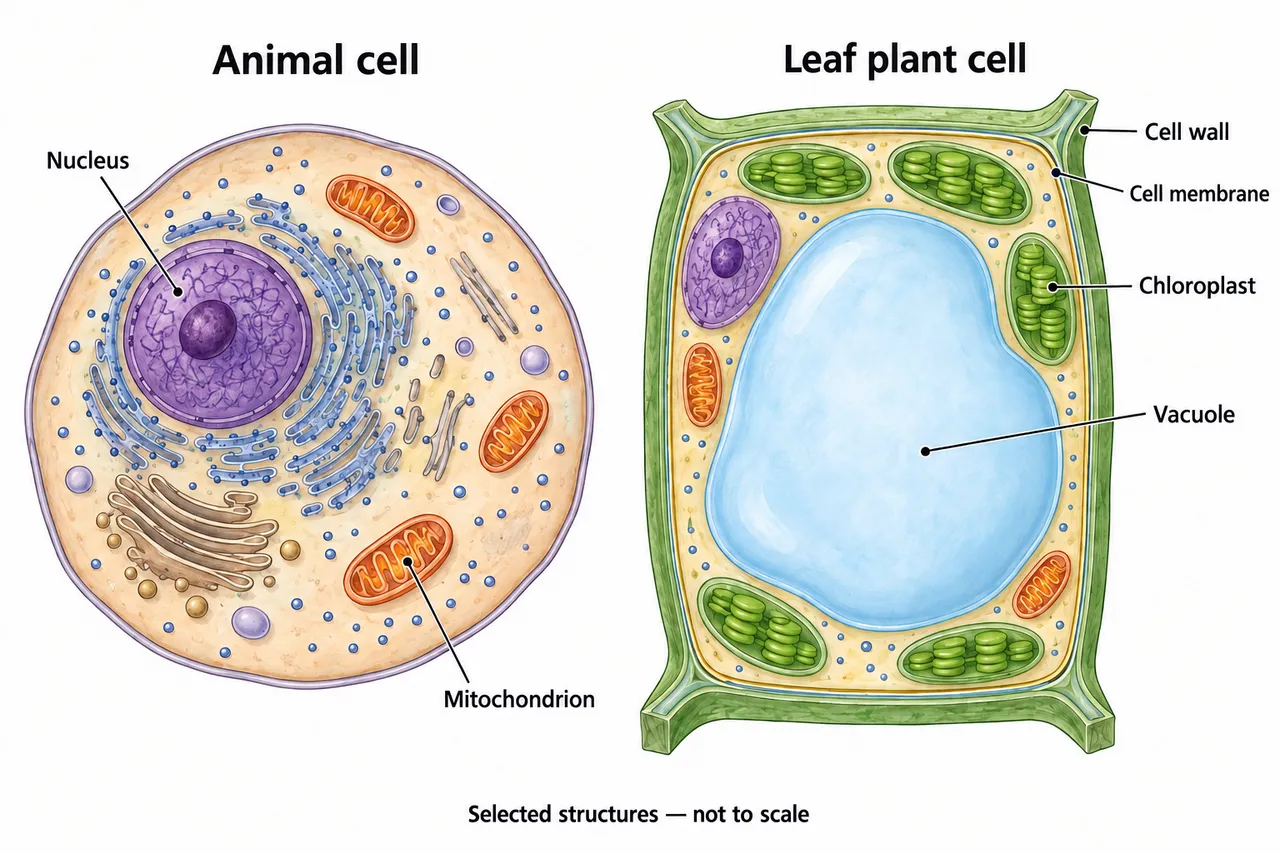
Original AI-generated myAudience scientific concept illustration; not a micrograph or measured specimen. · Original generated project artwork; no source textbook figures reused. Reference links support subject review, not a copied-art license.
Structures inside living cells
The nucleus houses genetic information; ribosomes build proteins. Many reactions occur in the cytoplasm. Mitochondria support aerobic respiration, and the membrane controls exchange with the surroundings. These structures have different jobs rather than acting as interchangeable parts.
Relate a structure to a process rather than memorizing its name alone. A cell producing many proteins needs protein-synthesis machinery; a cell with high energy-transfer demands often has many mitochondria. A root cell can be a plant cell without chloroplasts because it does not normally receive light for photosynthesis. Drawings are representative models, not checklists that every cell must satisfy.
A simple cell drawing identifies structures without implying that all are visible through a light microscope. Separate an observation from a model: a scale bar describes a length in the specimen, while labels name the structures you can justify. Estimating a nucleus as a fraction of cell diameter helps compare sizes, but a two-dimensional area estimate is not the same as a volume estimate.
Worked example: Why would an illuminated leaf cell have chloroplasts but a buried root hair cell usually not?
Link chloroplasts with photosynthesis
Compare access to light and each cell’s role
Answer: Leaf cells photosynthesize; root hair cells specialize in uptake from soil.
Check your understanding: Which structure makes proteins?
Answer: Ribosomes.
Why: Mitochondria supply usable energy through respiration; they are not the protein-building structures.