Cells adapted for jobs
By UK GCSE Biology · independent study · myAudience
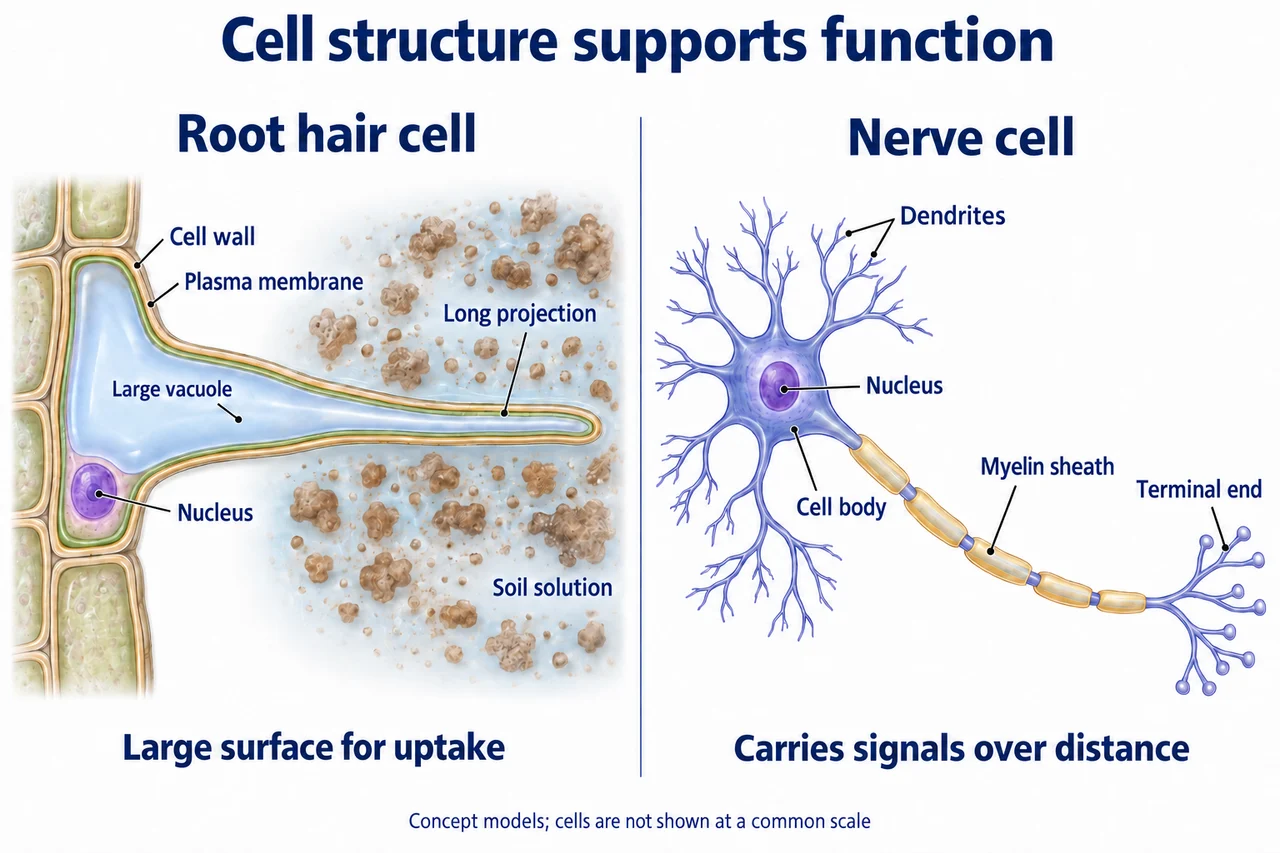
Original AI-generated myAudience scientific concept illustration; not a micrograph or measured specimen. · Original generated project artwork; no source textbook figures reused. Reference links support subject review, not a copied-art license.
Cells adapted for jobs
Specialized cells have features suited to particular tasks. A sperm cell has a flagellum for movement and mitochondria supporting that movement. A nerve cell has a long extension for carrying signals. Muscle cells contain structures that contract and require energy.
Root hair cells increase the surface available for water and mineral-ion uptake. Xylem vessels form supported transport pathways, while phloem contains living transport tissue associated with movement of sugars. A larger surface is useful only in context: ask which material moves, which route it follows and whether diffusion, osmosis or active transport explains the movement.
Xylem vessels have no living contents at maturity and form a continuous route for water, with strengthened walls that resist collapse. Phloem includes living sieve tubes supported by companion cells and carries dissolved sugars. Those tissues differ from a root hair, which is one living cell with a projection into soil. Name the transported substance before explaining the adaptation.
Worked example: Explain one advantage of a root hair’s long projection.
The projection increases surface area
More membrane contacts the soil solution
Answer: This supports uptake of water and mineral ions.
Check your understanding: Why do active muscle cells contain many mitochondria?
Answer: To support the energy demands of contraction.
Why: Aerobic respiration in mitochondria transfers energy to usable cellular carriers.