How cells acquire roles
By UK GCSE Biology · independent study · myAudience
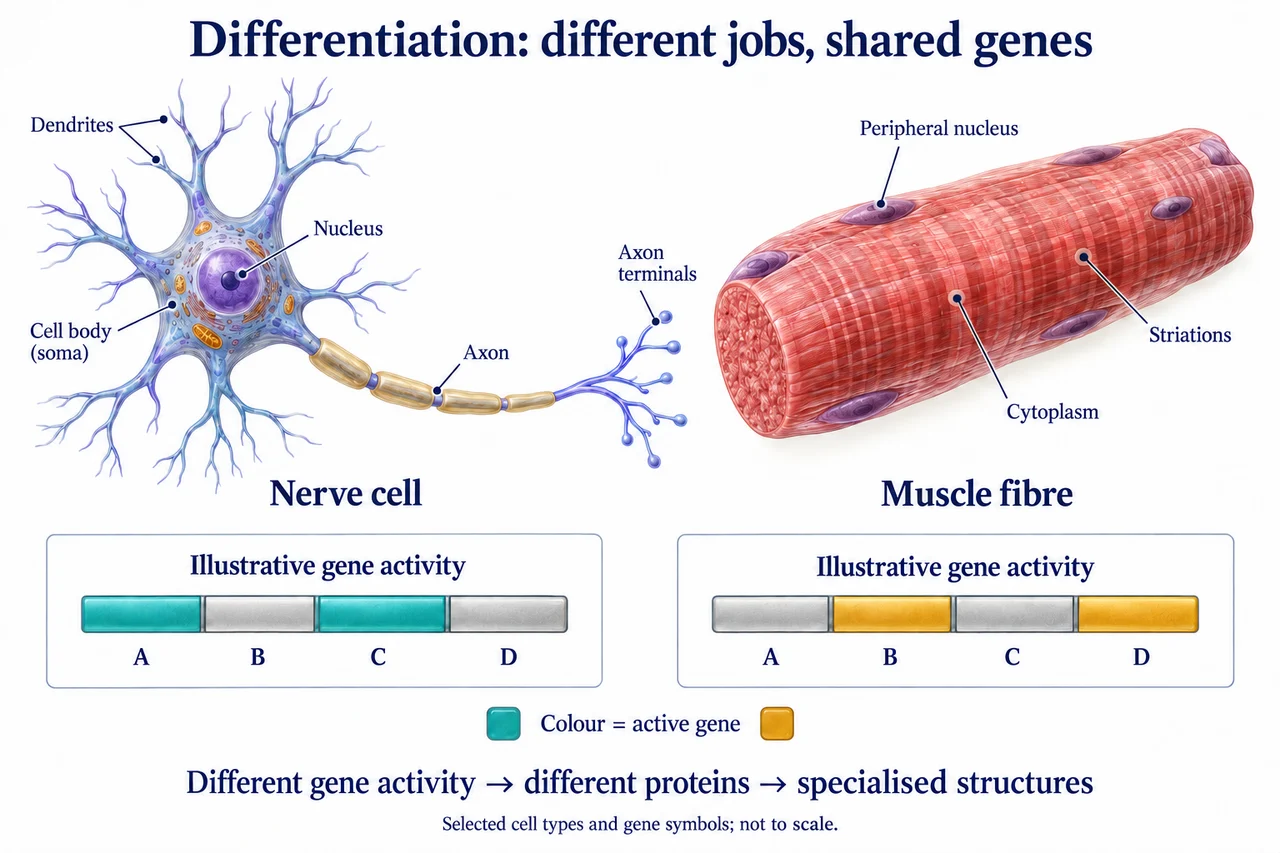
Original AI-generated myAudience scientific concept illustration; not a micrograph or measured specimen. · Original generated project artwork; no source textbook figures reused. Reference links support subject review, not a copied-art license.
How cells acquire roles
Differentiation is the development of a cell’s specialized features. Cells in one organism can share most of their DNA but use different genes, producing different proteins and structures. A developing nerve cell and a muscle cell therefore need not perform the same job.
A tissue must maintain the cell types needed for its function. Replacement cells may arise from less-specialized cells, while mature specialized cells can have limited developmental potential. Many plant regions retain cells capable of continued differentiation. This helps explain how a plant can form new roots or shoots without treating differentiation as an irreversible event in every organism.
Different gene activity explains specialization without requiring each cell to discard the genes it is not currently using. This is a useful general model, not a claim that every mature cell retains a nucleus. For example, mature human red blood cells lose theirs. In mature animals, much ordinary cell division replaces or repairs tissues; growth and continued differentiation in plant meristems follow a different pattern.
Worked example: Two cells carry the same genes but make different proteins. Must one have lost its DNA?
Distinguish possession of a gene from use of that gene
Different genes can be active in different cells
Answer: No; different gene activity can produce different specializations.
Check your understanding: Does differentiation always increase cell number?
Answer: No.
Why: A cell can acquire a specialized role without dividing.