Seeing beyond unaided eyesight
By UK GCSE Biology · independent study · myAudience
Original AI-generated myAudience scientific concept illustration; not a micrograph or measured specimen. · Original generated project artwork; no source textbook figures reused. Reference links support subject review, not a copied-art license.
Seeing beyond unaided eyesight
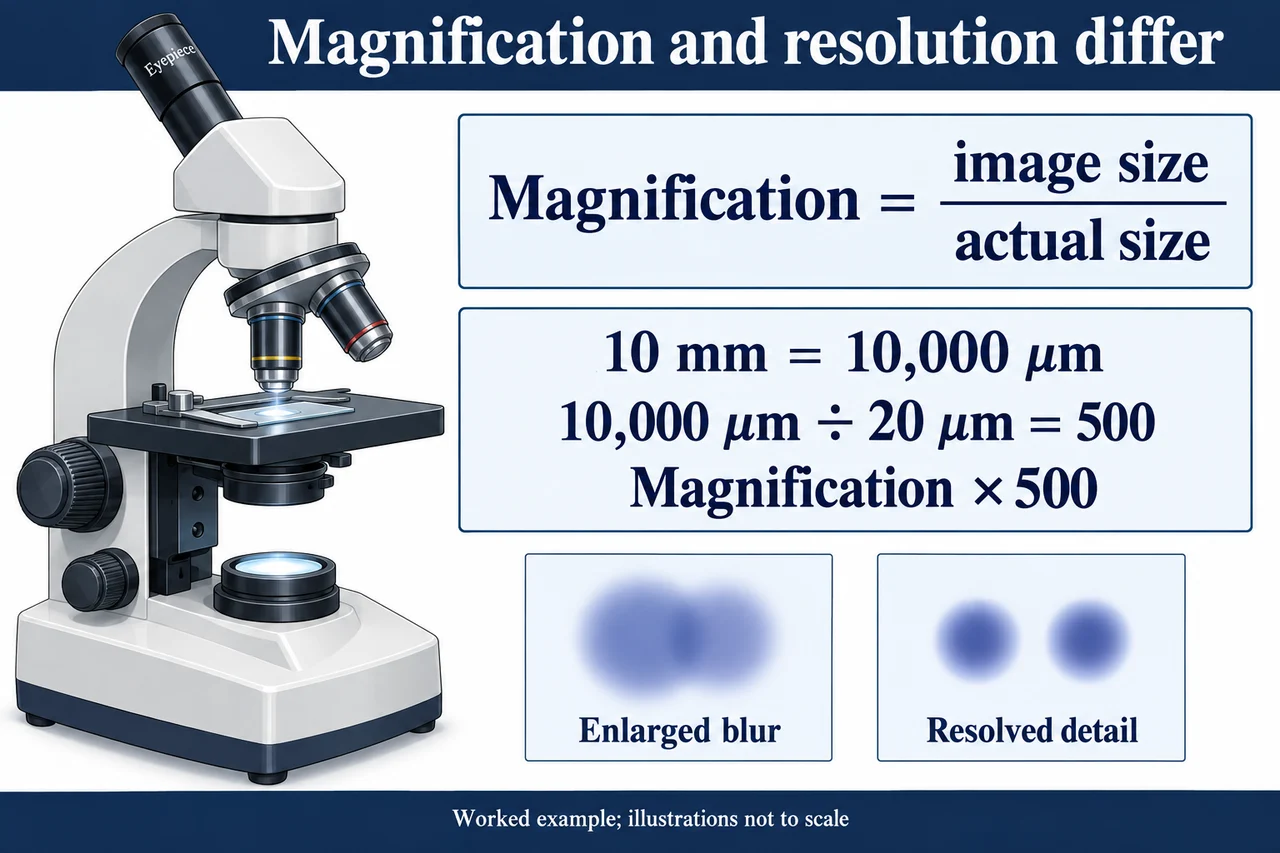
Magnification compares image size with actual size. Use magnification = image size ÷ actual size, with both sizes expressed in the same unit. Resolution is the ability to distinguish nearby details; enlarging a blurred picture does not create additional detail.
For a calculation, convert image size and actual size to the same unit before dividing. An image length of 12 mm is 12,000 µm; if the cell is 30 µm long, magnification is 12,000/30 = 400. A magnification has no length unit. An image displayed at a different size may need a scale bar rather than its original magnification label.
A light microscope forms an image using visible light; electron imaging can distinguish much finer features. Compare resolving power as well as magnification when deciding which image answers a question. When an image is resized on a screen, its printed magnification changes; a scale bar resized with the image remains useful because both lengths change in the same proportion.
Worked example: A cell is 20 µm across and its image is 10 mm across. Find magnification.
Convert 10 mm to 10000 µm
Divide 10000 by 20
Answer: Magnification is × 500.
Check your understanding: Would digital enlargement necessarily improve resolution?
Answer: No.
Why: It enlarges existing pixels without revealing structures that were not resolved originally.