Growing microbes safely
By UK GCSE Biology · independent study · myAudience
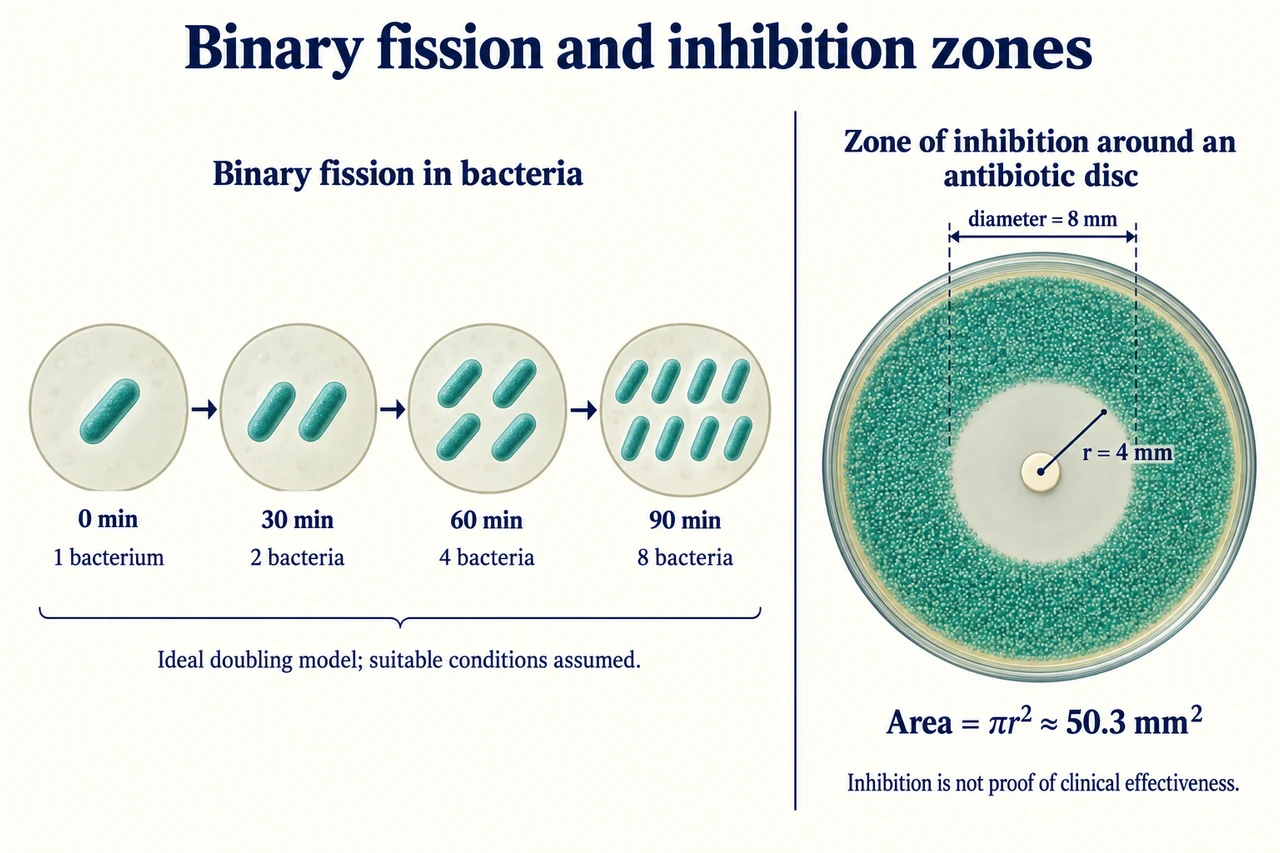
Original myAudience scientific illustration; not a documentary photograph or measured specimen. · Original generated project artwork; source concepts reviewed, no textbook figures copied.
Growing microbes safely
Bacteria can reproduce by binary fission: one cell produces two. If conditions remain favorable, repeated divisions can cause rapid population growth. A model that doubles at fixed intervals assumes adequate nutrients and suitable conditions; real populations eventually encounter limits.
In an approved supervised investigation, a clear zone around a treatment can indicate inhibited growth. Its area is πr², so doubling zone radius quadruples area. A large zone does not by itself establish how a medicine performs in a patient: diffusion through agar, dose and organism sensitivity also matter. School culture handling requires approved aseptic procedures, temperature limits and disposal protocols.
An original data example separates area from diameter. A circular inhibition zone with radius 4 mm has area π × 4², about 50.3 mm². If the measured diameter is 8 mm, halve it before applying the formula. Comparisons need the same organism and consistent conditions. The clear area records a laboratory response; it is not a recommended antibiotic dose or evidence of clinical effectiveness.
Worked example: A model population starts with 50 cells and doubles every 30 minutes. How many after 90 minutes?
There are three doubling intervals
Calculate 50×2×2×2
Answer: The model predicts 400 cells. As a higher-tier standard-form extension, this is 4.0 × 10² cells.
Check your understanding: Why include an untreated comparison disc?
Answer: To distinguish the treatment’s effect from other influences.
Why: Without a control, lack of growth might reflect the medium or handling rather than the tested substance.