Packaging inherited information
By UK GCSE Biology · independent study · myAudience
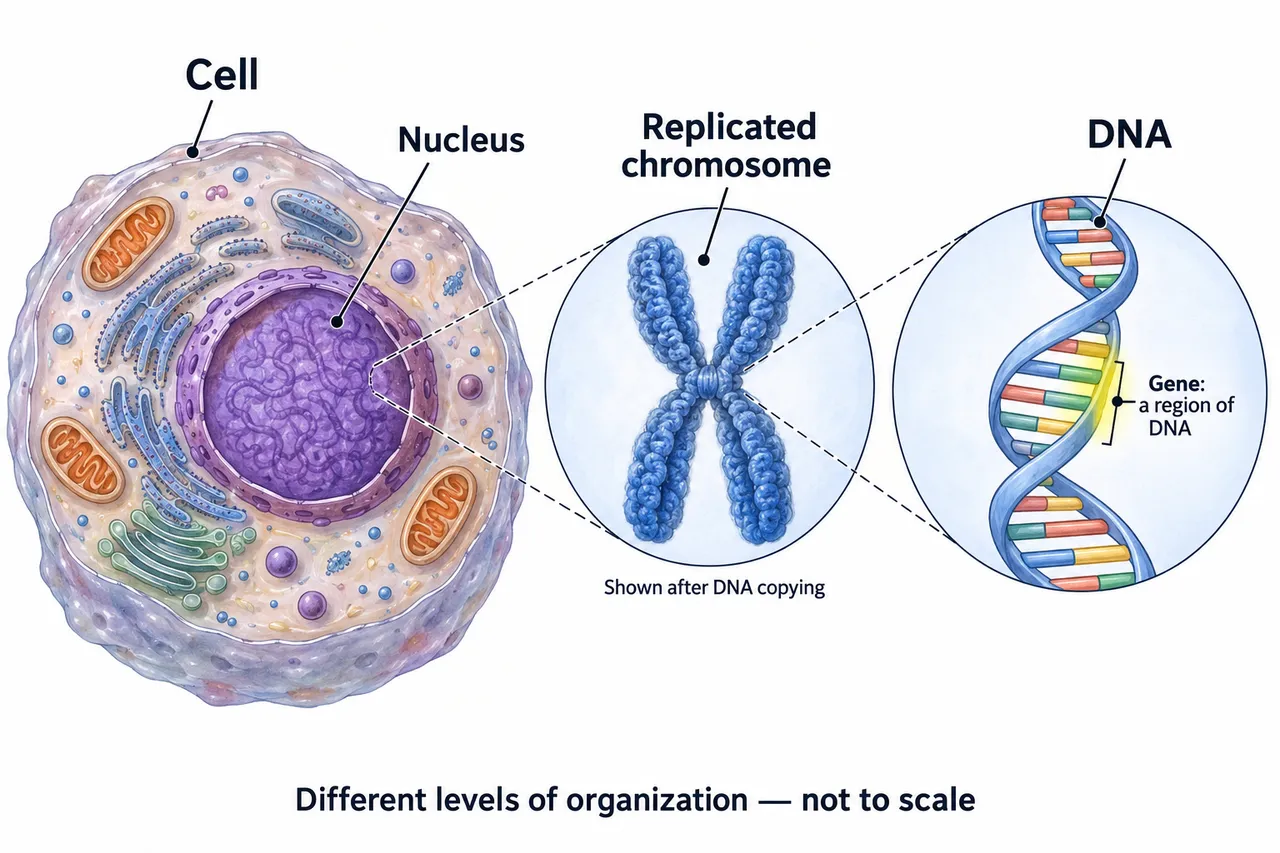
Original AI-generated myAudience scientific concept illustration; not a micrograph or measured specimen. · Original generated project artwork; no source textbook figures reused. Reference links support subject review, not a copied-art license.
Packaging inherited information
Chromosomes are long DNA molecules associated with proteins. A gene is a region of DNA carrying information used to make a functional product, often a protein. One chromosome contains many genes; a gene and a chromosome are different scales of organization.
Distinguish levels of organization: a gene is a region of DNA, a chromosome packages a large DNA molecule, and the genome is the organism’s full genetic information. Drawing a chromosome as an X represents a replicated stage; it does not mean chromosomes permanently have that shape. Label the stage and model before interpreting a diagram.
Chromosomes normally occur in pairs in the human body-cell model, with one inherited member of each pair from each parent. A chromosome carries many genes; paired chromosomes can carry different versions of a gene. An X-shaped drawing represents a chromosome after its DNA has been copied, when two sister copies remain attached. It is not the permanent shape of every chromosome throughout the cell cycle.
Worked example: Is “one chromosome equals one gene” a useful model?
A chromosome contains a long DNA molecule
Many separate gene regions occur along it
Answer: No; one chromosome carries many genes.
Check your understanding: What is an allele?
Answer: A version of a gene.
Why: Alleles occupy corresponding gene positions and can differ in their DNA sequence.