Making matching body cells
By UK GCSE Biology · independent study · myAudience
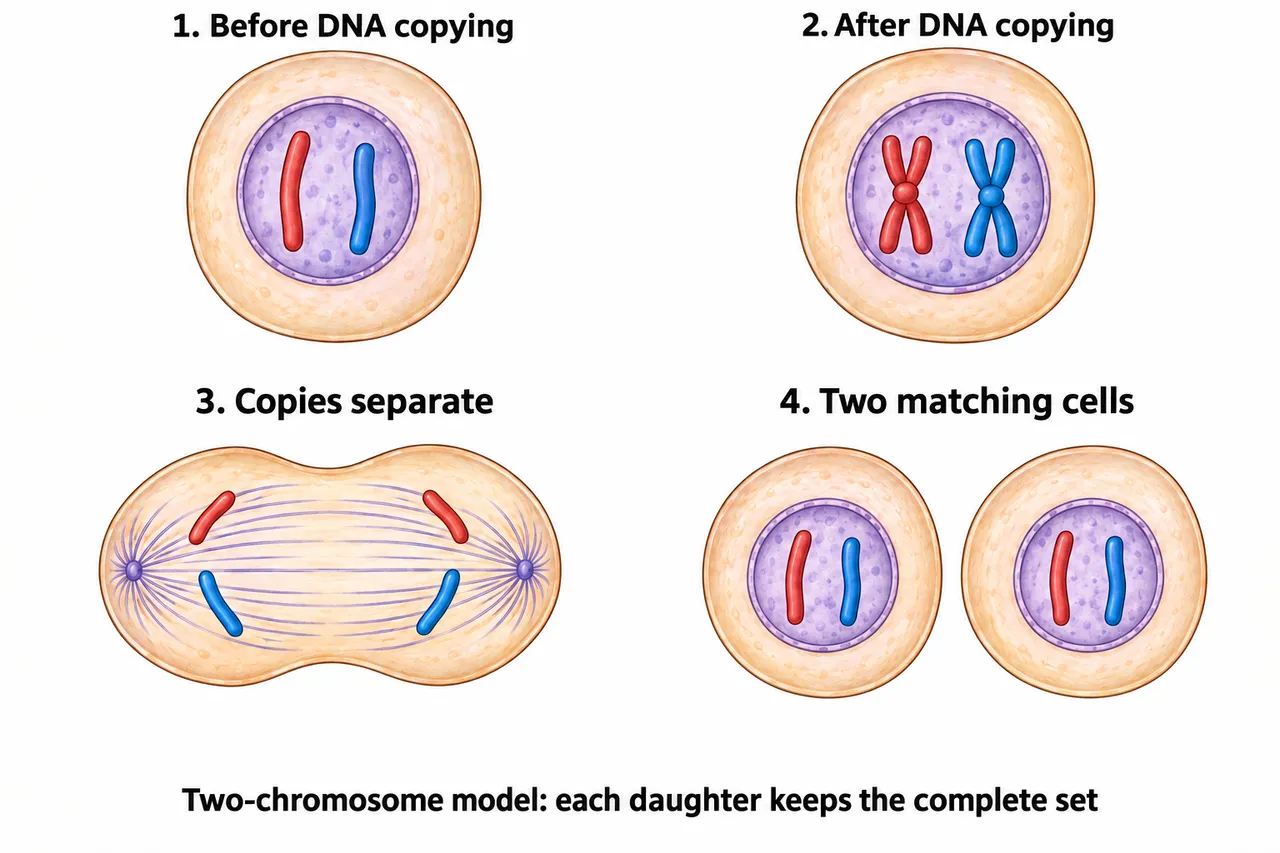
Original AI-generated myAudience scientific concept illustration; not a micrograph or measured specimen. · Original generated project artwork; no source textbook figures reused. Reference links support subject review, not a copied-art license.
Making matching body cells
Before a body cell divides, it grows and copies its DNA. During mitosis, copied chromosomes are separated so each new nucleus receives a complete set. Division of the cytoplasm and cell membrane then produces two daughter cells.
Mitosis is different from simply increasing the size of one cell. Growth of a multicellular organism can involve both increased cell number and changes in cell size. Replacing damaged cells also requires regulated division. If the starting body-cell model has 46 chromosomes, each daughter cell normally retains 46; the purpose is not to halve the chromosome set.
Follow the overall sequence: growth and DNA copying, separation of copied chromosomes into new nuclei, then division of the cell. A drawing with two original chromosomes should show two in each daughter cell, not one. Chromosome number is distinct from the amount of copied DNA and from the number of cells. This GCSE explanation does not require memorizing every named mitotic phase.
Worked example: A cell with 46 chromosomes undergoes ordinary mitotic division. What is the expected result?
DNA is copied before separation
Each daughter nucleus receives the complete set
Answer: Two cells, each normally with 46 chromosomes.
Check your understanding: Why must DNA be copied before mitosis?
Answer: So both daughter cells can receive the genetic information.
Why: Separating one uncopied set would not provide a complete set to each new cell.