Cells with developmental potential
By UK GCSE Biology · independent study · myAudience
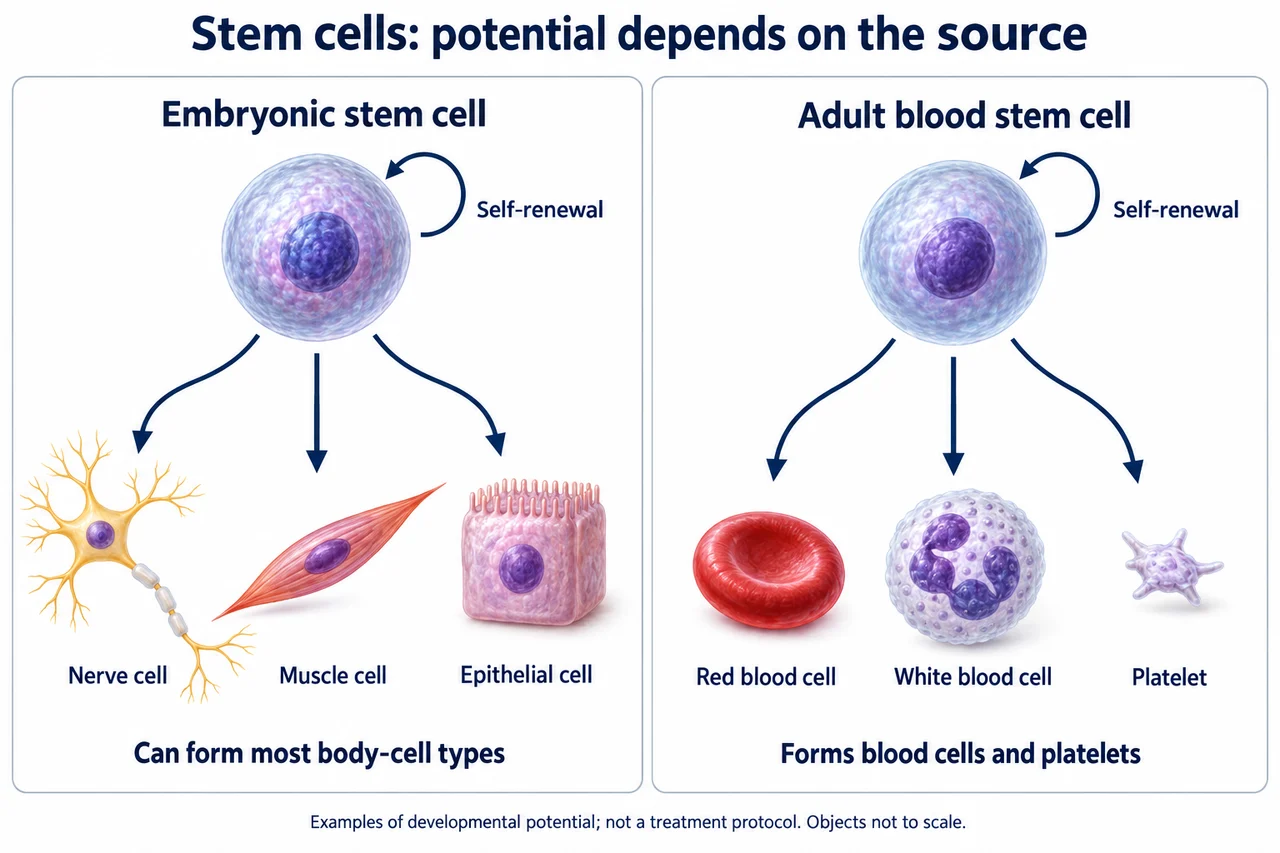
Original AI-generated myAudience scientific concept illustration; not a micrograph or measured specimen. · Original generated project artwork; no source textbook figures reused. Reference links support subject review, not a copied-art license.
Cells with developmental potential
Stem cells can divide while retaining the capacity to produce more specialized cells. Embryonic stem cells have broad developmental potential; adult stem cells generally produce a more limited range. Plant meristems supply cells for growth and can support propagation of genetically matching plants.
A proposed treatment must produce the appropriate cells, avoid uncontrolled growth and consider immune compatibility and infection risk. Potential benefit is not the same as an established cure. Ethical evaluation also distinguishes the source of the cells and the views of affected people. Plant cloning can preserve a useful genotype, but identical plants may share vulnerability to the same disease.
A matching genetic background can reduce immune mismatch in a proposed cell replacement. Therapeutic cloning uses that principle, but compatibility alone does not establish that a treatment works or is safe. Plant cloning can preserve valuable disease-resistance traits or help conserve rare plants. Producing many identical plants also limits genetic diversity, so the same vulnerability may affect the whole crop.
Worked example: Why might a meristem be useful when propagating a valuable plant?
Meristem cells can divide and differentiate
New plants can be grown from suitable material
Answer: Propagation can produce genetically matching plants with the desired traits.
Check your understanding: Are all stem cells equally able to form every cell type?
Answer: No.
Why: Developmental potential varies with the source and state of the stem cells.