Particles spreading across gradients
By UK GCSE Biology · independent study · myAudience
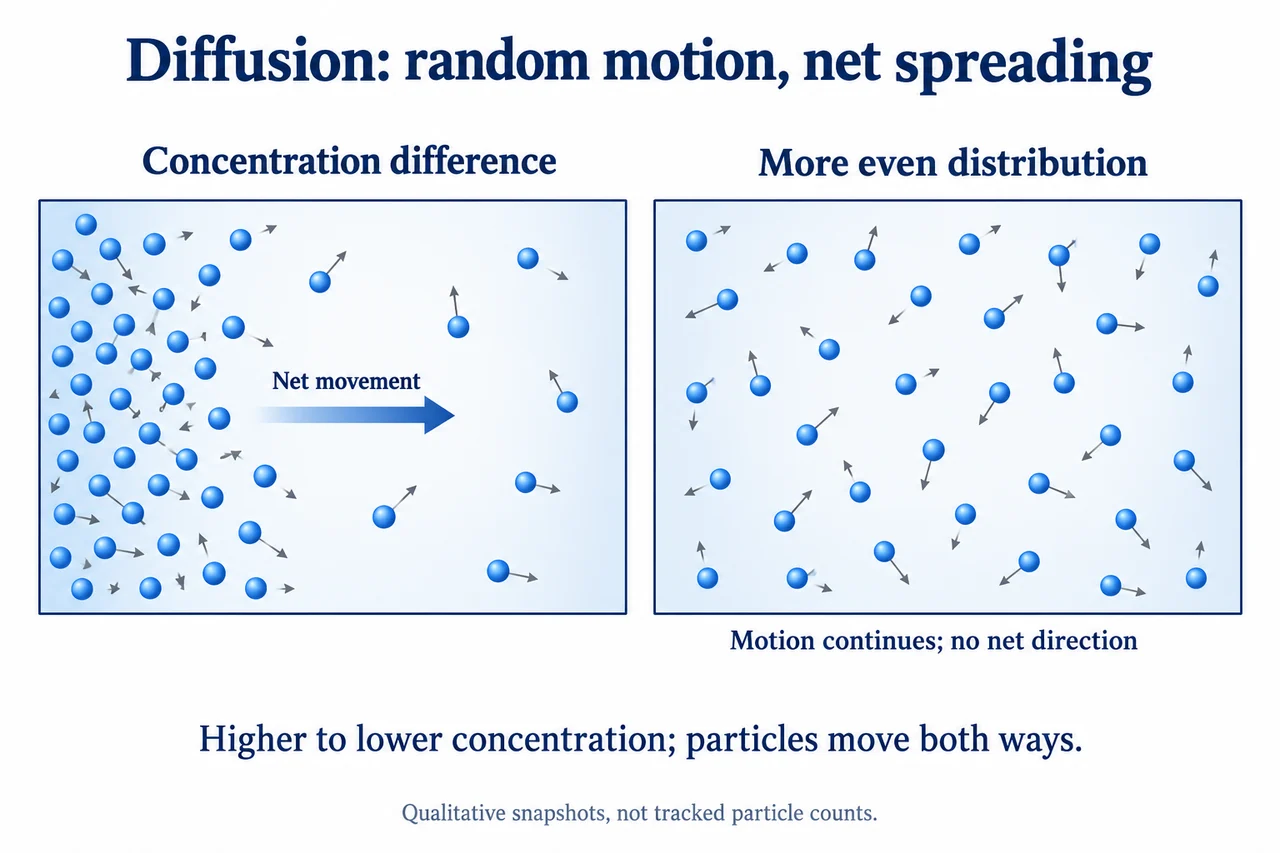
Original AI-generated myAudience scientific concept illustration; not a micrograph or measured specimen. · Original generated project artwork; no source textbook figures reused. Reference links support subject review, not a copied-art license.
Particles spreading across gradients
Diffusion is the net movement of particles from a region of higher concentration to one of lower concentration through random motion. Particles continue moving at equilibrium, but there is no net movement in one direction. A steeper gradient, larger exchange area and shorter distance can increase exchange rate.
Ventilation and blood flow help maintain gradients in lungs: fresh air supplies oxygen, while blood carries absorbed oxygen away. A thin exchange barrier shortens the route. Larger organisms cannot meet every cellular need through their outer surface alone because volume grows faster than surface area, so specialized exchange surfaces and transport systems become important.
Temperature matters because higher temperature usually increases particle motion and can increase diffusion rate in a simple comparison. In the body, carbon dioxide and oxygen cross exchange surfaces; urea can move from cells into blood plasma. Fish gills provide a broad exchange area and water flow, roots branch through soil, and leaves have extensive internal surfaces. Adaptations help maintain exchange rather than giving particles a purpose.
Worked example: Compare cubes of side 1 cm and 2 cm using surface-area: volume ratios.
For 1 cm, area=6 cm² and volume=1 cm³
For 2 cm, area=24 cm² and volume=8 cm³
Answer: Ratios are 6: 1 and 3: 1; the larger cube has less area per unit volume.
Check your understanding: Do particles stop moving when concentrations become equal?
Answer: No.
Why: Random motion continues, but equal movements cancel in the net result.