Water crossing selective membranes
By UK GCSE Biology · independent study · myAudience
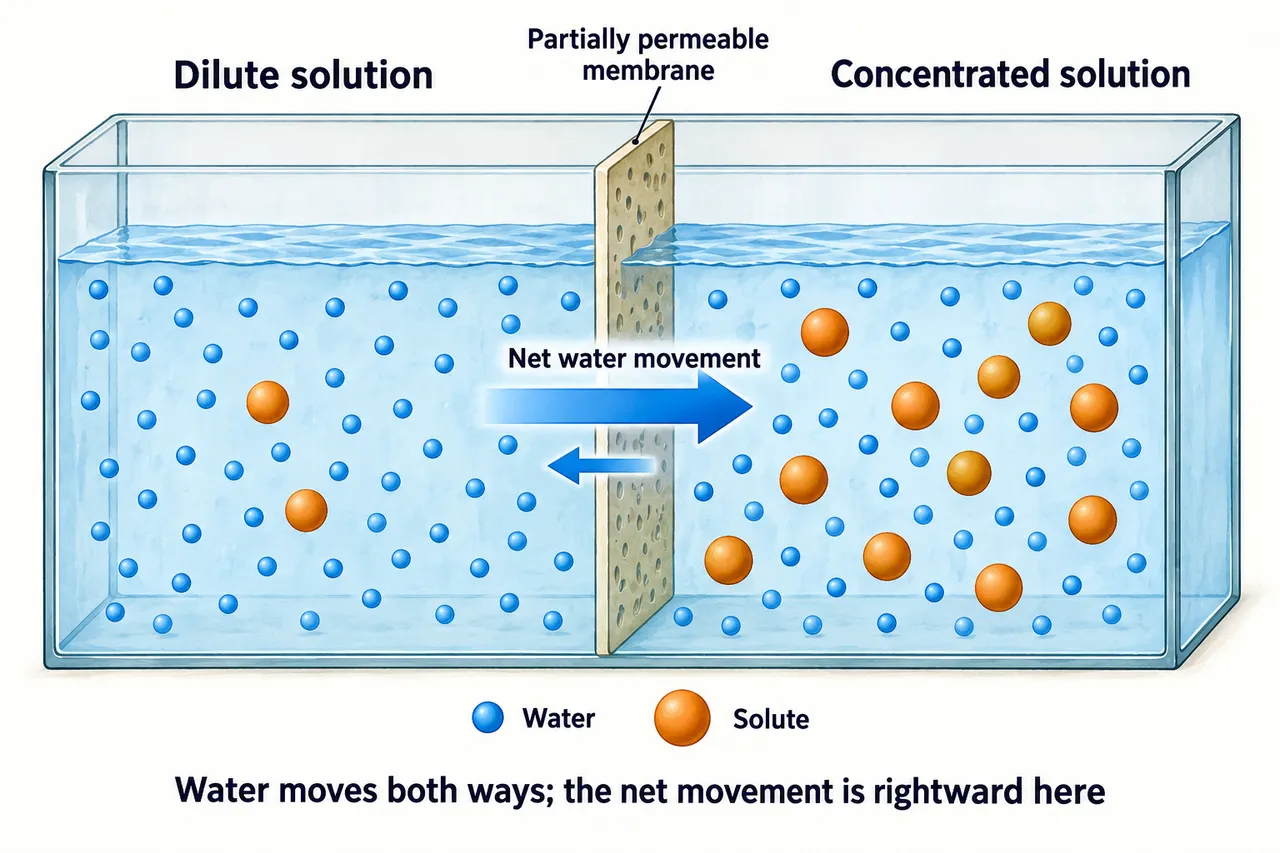
Original AI-generated myAudience scientific concept illustration; not a micrograph or measured specimen. · Original generated project artwork; no source textbook figures reused. Reference links support subject review, not a copied-art license.
Water crossing selective membranes
Osmosis is the net movement of water through a partially permeable membrane from a more dilute solution toward a more concentrated solution. Solute concentration describes dissolved substances; the membrane permits water but may restrict some solutes. Water moves both ways, with one direction giving the net result.
A plant cell gaining water can become turgid as its contents press against the supporting wall. Losing water reduces that pressure. Animal cells lack the same cellulose wall, so their responses can differ. In a supervised tissue investigation, comparable sample size, time and solution concentration help isolate the factor being tested; percentage change allows comparison from different initial masses.
Percentage change equals (final mass − initial mass) ÷ initial mass × 100. If tissue falls from 2.0 g to 1.8 g, the result is −10%; the minus sign records a loss. A graph crossing zero change can help estimate a solution concentration associated with no net tissue-mass change under the test conditions. It is an estimate, and biological variation and measurement uncertainty still matter.
Worked example: A potato sample changes from 2.0 g to 2.3 g. Find percentage mass change.
Mass change is 0.3 g
Divide 0.3 by 2.0 and multiply by 100
Answer: Percentage change is +15%.
Check your understanding: Why use percentage change when starting masses differ?
Answer: It compares change relative to each starting mass.
Why: An absolute change of 0.3 g has a different significance for a 2 g and a 10 g sample.