Transport requiring cellular energy
By UK GCSE Biology · independent study · myAudience
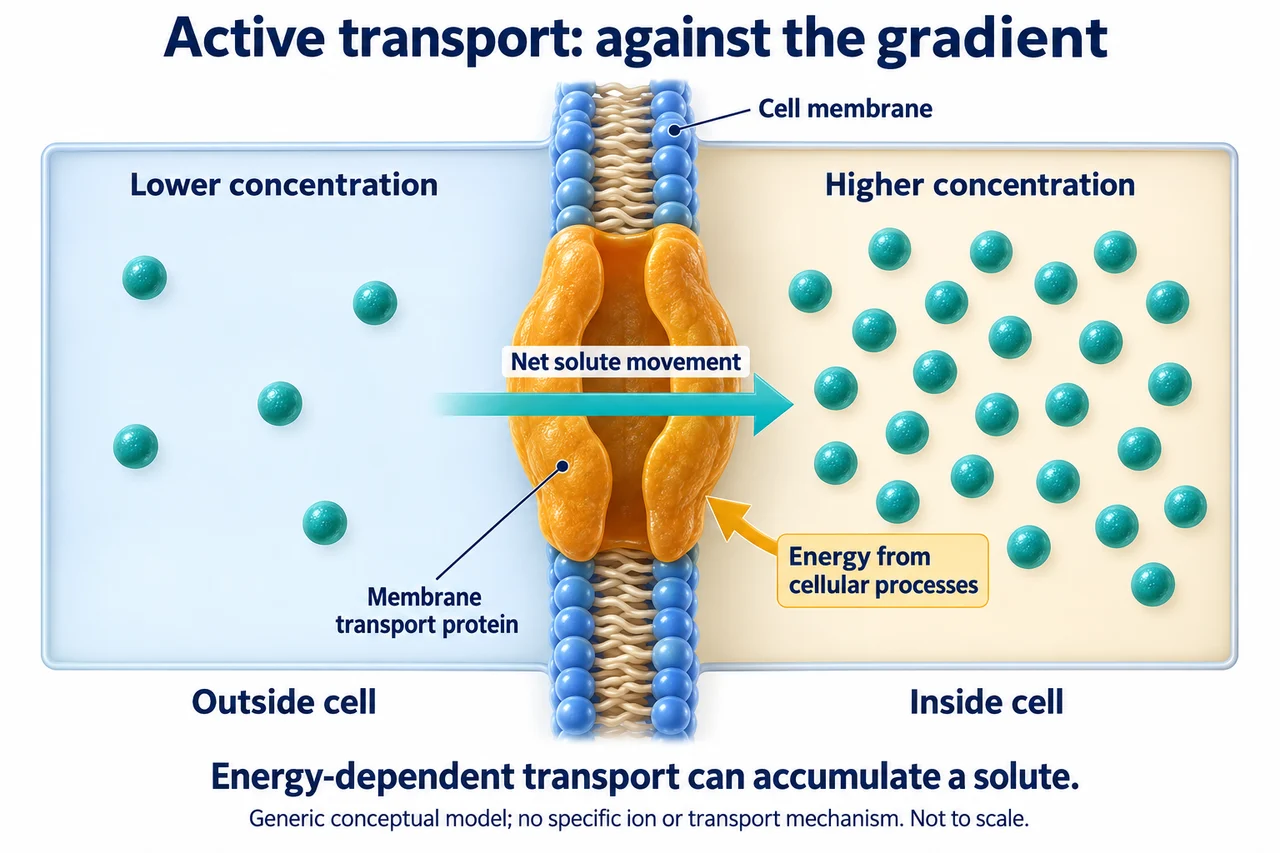
Original AI-generated myAudience scientific concept illustration; not a micrograph or measured specimen. · Original generated project artwork; no source textbook figures reused. Reference links support subject review, not a copied-art license.
Transport requiring cellular energy
Active transport moves substances against a concentration gradient using energy supplied by cellular processes. Membrane proteins participate in the transport. Unlike diffusion, it can move a substance into a region where that substance is already more concentrated.
Absorption of some substances in the small intestine also uses active transport. Distinguish the process from osmosis, which concerns water, and diffusion, which gives net movement down a gradient. If respiration is impaired, active uptake may decline, but a reduced transport rate alone does not prove which component failed; consider the membrane, energy supply and available substance.
A cell must obtain a supply of energy to keep transporting against a gradient. Mineral-ion uptake by root cells and absorption of some nutrients by intestinal cells illustrate why a passive pathway alone may be insufficient. The energy requirement distinguishes the process, but it does not mean that every nutrient or every membrane movement follows exactly the same route.
Worked example: Mineral-ion concentration is lower in soil than inside a root cell. Explain continued uptake.
Uptake runs against the concentration gradient
The cell uses energy-dependent membrane transport
Answer: Active transport can accumulate the ions.
Check your understanding: Which process can move particles against their concentration gradient?
Answer: Active transport.
Why: Energy-dependent transport distinguishes it from passive net diffusion.