From cells to organisms
By UK GCSE Biology · independent study · myAudience
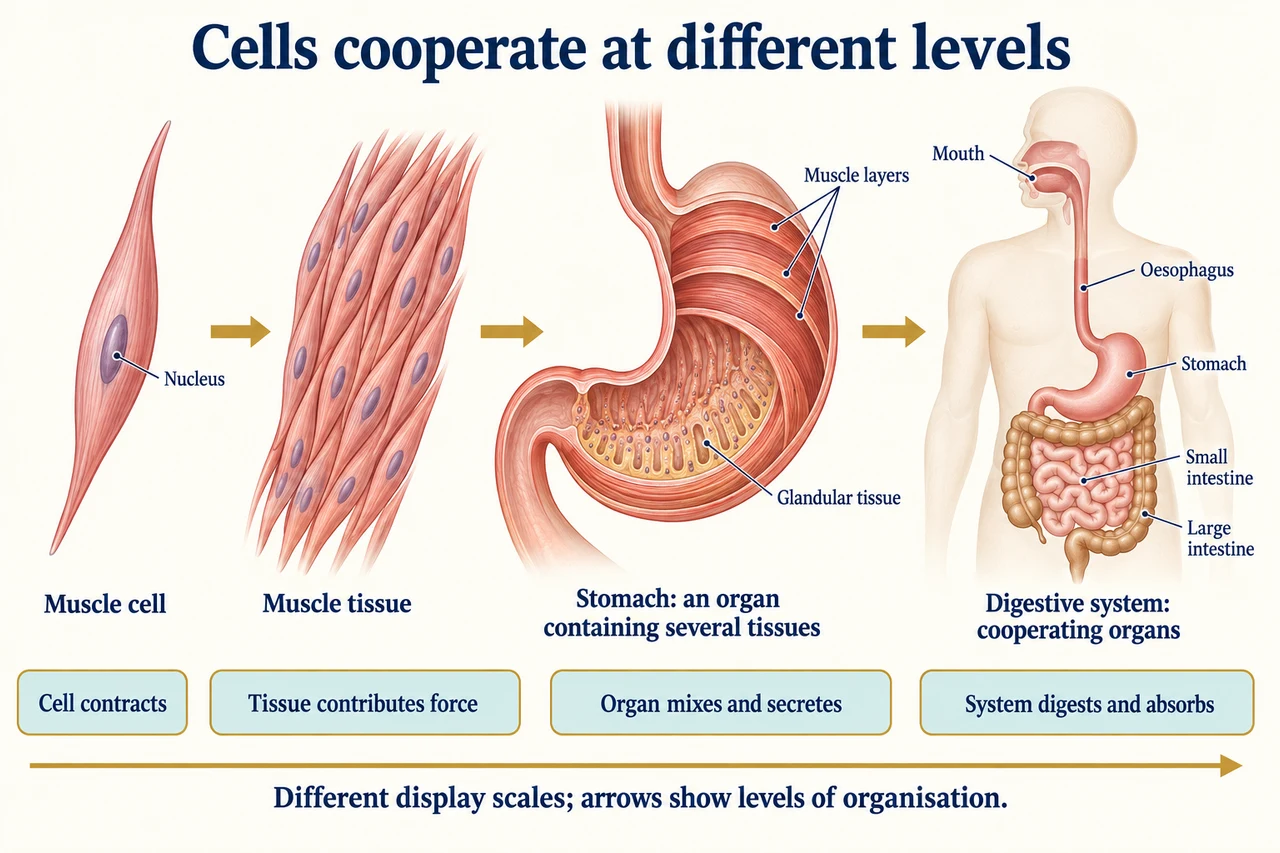
Original myAudience scientific illustration; not a documentary photograph or measured specimen. · Original generated project artwork; source concepts reviewed, no textbook figures copied.
From cells to organisms
A tissue contains cells organized for a related function. Different tissues work together in an organ; organs cooperate in an organ system. For example, muscle and glandular tissues contribute different jobs within the stomach, while the stomach is part of the digestive system.
Trace one process across levels. A muscle cell contracts, muscle tissue contributes force, an organ such as the heart pumps, and the circulatory system distributes blood. An explanation becomes stronger when it names the contribution at each level rather than listing cell, tissue, organ and system as unrelated vocabulary.
The organizational levels describe cooperation, not only size. A stomach contains muscle that moves food and glandular tissue that supplies digestive secretions. Different organs then pass materials along the digestive tract. Compare scale using dimensions in the same unit: the width of a cell and the length of a whole organ are measurements of different structures, not interchangeable definitions of tissue.
Worked example: Place a muscle cell, stomach, digestive system and muscle tissue in increasing organizational order.
A cell is the smallest listed unit
Related cells form tissue, and tissues contribute to organs
Answer: Muscle cell → muscle tissue → stomach → digestive system.
Check your understanding: Can one organ contain several tissues?
Answer: Yes.
Why: Different tissues provide different functions that cooperate within the organ.