Breaking down food
By UK GCSE Biology · independent study · myAudience
Original myAudience generated scientific illustration; not a documentary photograph or measured specimen. · Original generated project artwork; no source textbook figures reused. Sources support concept review, not copied-art licensing.
Breaking down food
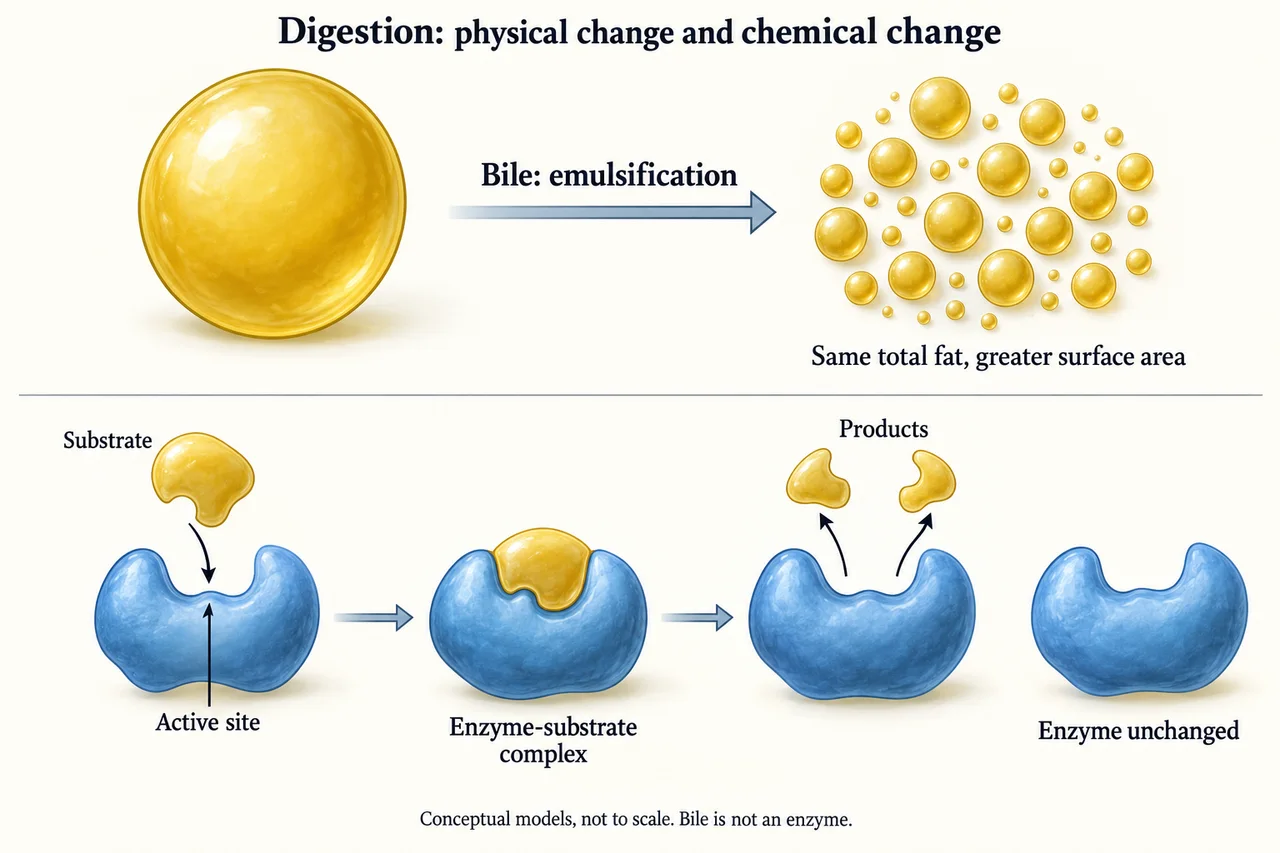
Digestion breaks large food molecules into smaller molecules that can be absorbed. Enzymes speed particular reactions: amylase helps digest starch, proteases digest proteins, and lipases digest fats. Their active sites fit particular substrates, and temperature or pH changes can alter enzyme activity.
Bile is produced by the liver and stored in the gall bladder. It helps neutralize acidic material entering the small intestine and emulsifies fats into smaller droplets, increasing the surface available to lipase. Bile is not a digestive enzyme. A reaction-rate comparison should control conditions and distinguish an enzyme’s activity from simple disappearance of visible food.
Enzymes are proteins with active sites. The lock-and-key model represents substrate specificity, while extreme conditions can alter that site and reduce catalysis. Salivary glands, pancreas and small intestine supply amylase; proteases act in the stomach and small intestine, and lipase acts in the small intestine. Compare rates as amount changed per unit time. Absorbed molecules can supply respiration or be assembled into larger molecules needed by cells.
Worked example: Why can emulsifying fat increase the rate of lipase action?
Small droplets expose more surface area
More substrate surface is accessible to the enzyme
Answer: Lipase can act faster when other conditions are suitable.
Check your understanding: Is bile an enzyme?
Answer: No.
Why: Emulsification and neutralization assist digestion without bile catalyzing the hydrolysis reaction itself.