Blood components and jobs
By UK GCSE Biology · independent study · myAudience
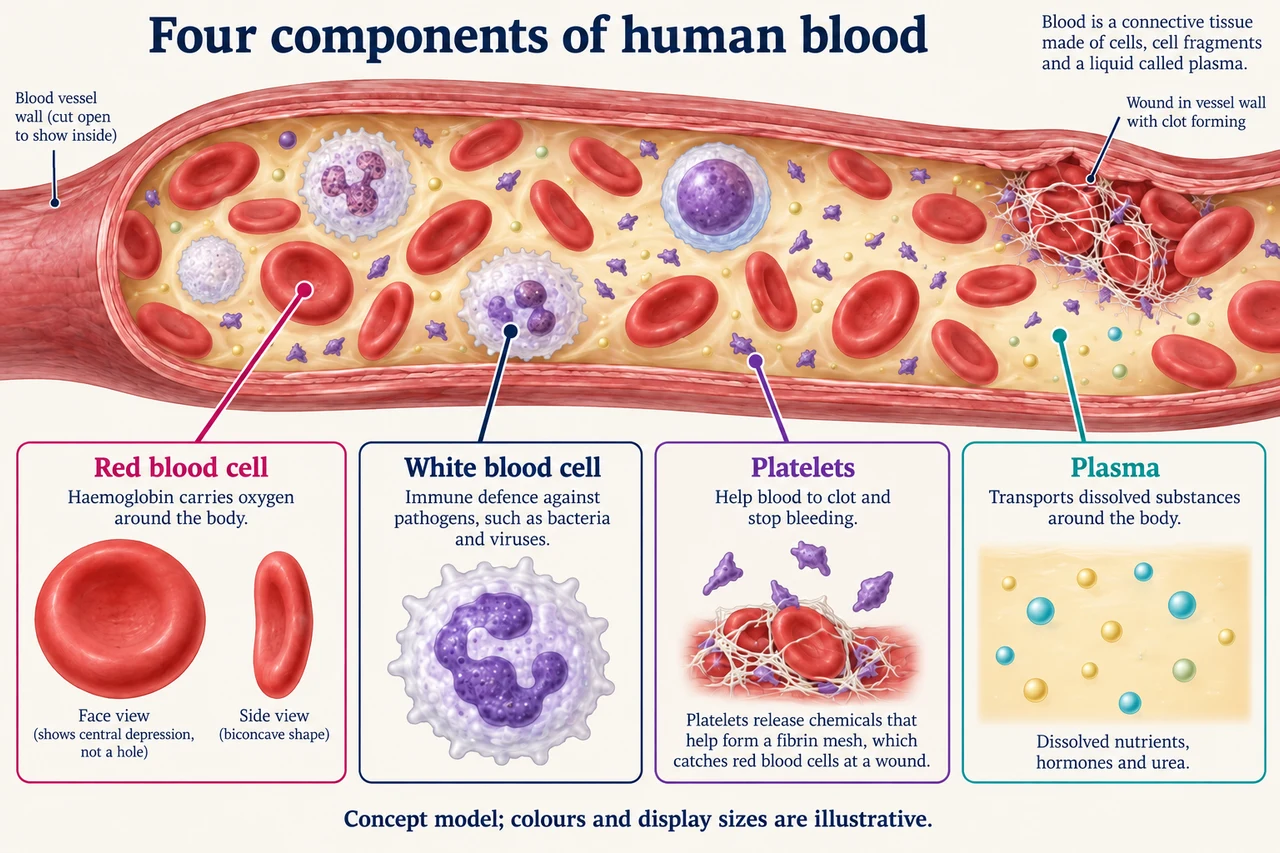
Original myAudience scientific illustration; not a documentary photograph or measured specimen. · Original generated project artwork; source concepts reviewed, no textbook figures copied.
Blood components and jobs
Plasma transports blood cells and dissolved substances, including nutrients, hormones, carbon dioxide and urea. Red blood cells contain haemoglobin for oxygen transport and normally lack a nucleus when mature. Their shape gives a large surface relative to volume.
Mature human red blood cells have a biconcave form and no nucleus, contributing to their gas-transport role. A clot can reduce blood loss from a wound, while an unwanted clot within a vessel can obstruct circulation. Explain whether a process is protective or harmful in its location; the same word, clotting, does not determine its effect in every context.
A blood-cell image should be read using visible features, not color alone. A red cell in the human model has a biconcave shape and lacks a mature nucleus, whereas many white cells have a conspicuous nucleus. Platelets are much smaller cell fragments. Plasma supplies the fluid transport medium. A drawn model cannot establish a real person's blood count, and overlapping cells or stain differences can complicate identification.
Worked example: A sample contains normal red cells but too few platelets. Which function could be affected?
Distinguish oxygen transport from clotting
Platelets contribute to clot formation
Answer: Stopping bleeding through clot formation could be affected.
Check your understanding: Which blood component carries urea dissolved in water?
Answer: Plasma.
Why: Urea travels in the liquid part of blood toward organs involved in excretion.