When coronary vessels narrow
By UK GCSE Biology · independent study · myAudience
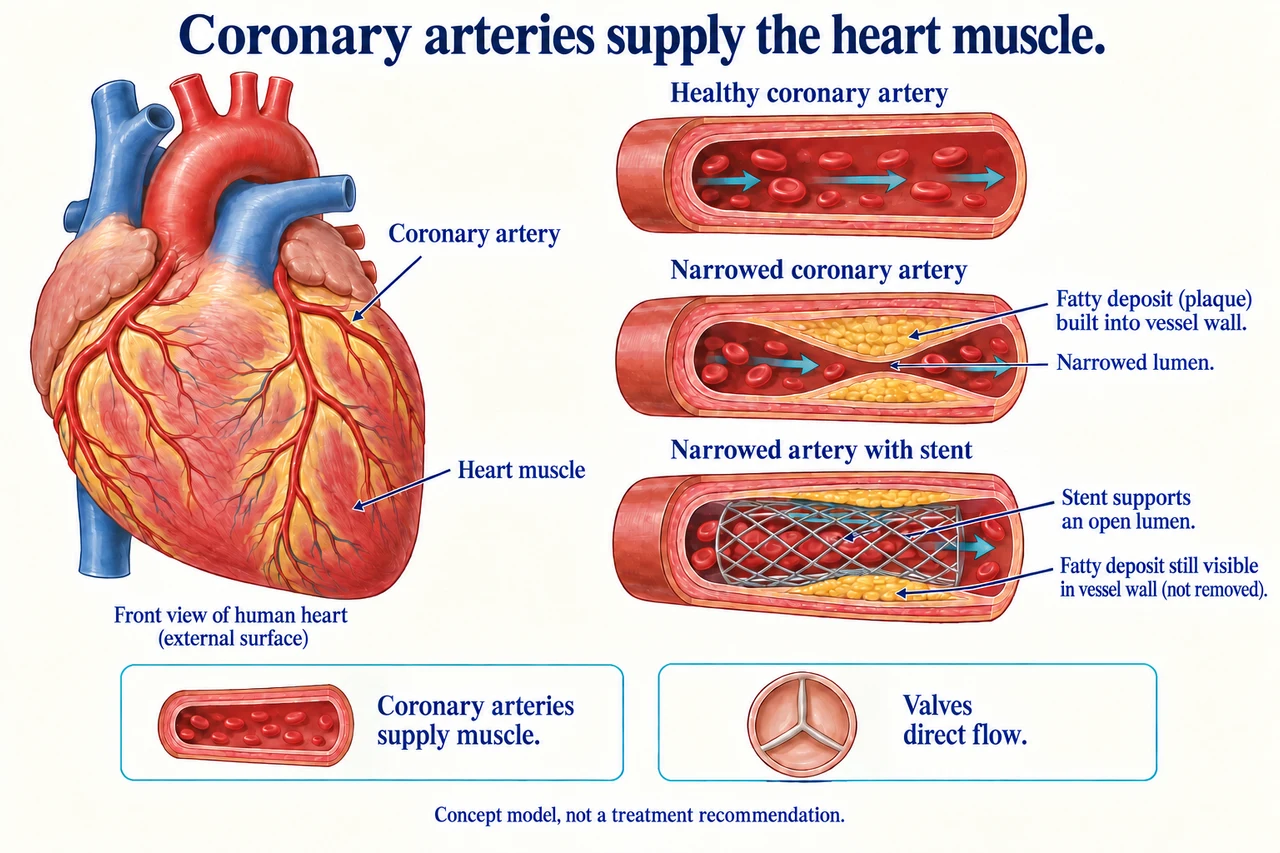
Original myAudience scientific illustration; not a documentary photograph or measured specimen. · Original generated project artwork; source concepts reviewed, no textbook figures copied.
When coronary vessels narrow
Coronary arteries supply heart muscle with blood. Fatty deposits can narrow these vessels, reducing oxygen delivery needed for aerobic respiration. The problem concerns the heart muscle’s own supply, not just the blood passing through its chambers.
Treatments address different parts of the problem. A stent can help keep a narrowed vessel open; medicines such as statins can reduce cholesterol-related risk in appropriate clinical contexts. Surgery or replacement devices involve further considerations. Compare potential benefit with risks and suitability rather than assuming one intervention is best for every person.
A leaking valve allows backward flow; a valve that opens poorly restricts forward flow. Mechanical and biological replacements have different durability and care considerations. Donor transplantation can restore pumping but depends on suitable organs and clinical management, while an artificial heart can provide temporary support in some circumstances. These interventions address different problems. An educational comparison weighs benefits, complications and limitations; it cannot select treatment for an individual.
Worked example: Why can a narrowed coronary artery impair the heart even when its chambers contain blood?
The muscle receives oxygen through its own vessels
Narrowing can reduce this oxygen supply
Answer: Insufficient aerobic energy transfer can impair muscle function.
Check your understanding: Are coronary arteries the same as heart valves?
Answer: No.
Why: Arteries supply tissues; valves help direct flow through the heart.