Understanding illness and wellbeing
By UK GCSE Biology · independent study · myAudience
Original myAudience scientific illustration; not a documentary photograph or measured specimen. · Original generated project artwork; source concepts reviewed, no textbook figures copied.
Understanding illness and wellbeing
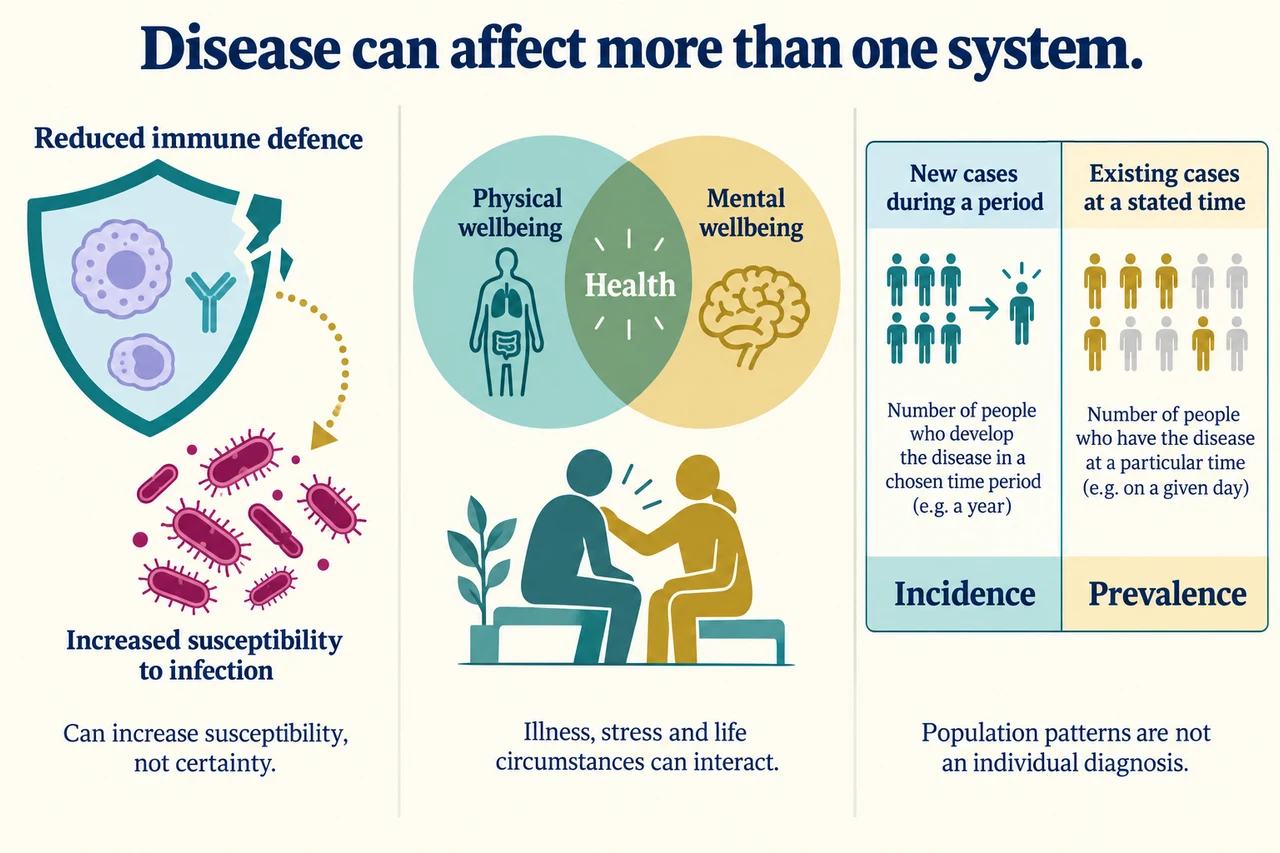
Health includes physical and mental wellbeing, while disease describes a disorder that affects normal function. Diseases may be infectious or noninfectious. Their effects can interact: weakened immune function can increase vulnerability to infection, and long-term illness can affect wellbeing.
Data can report prevalence, the proportion affected at a time, or incidence, new cases over a stated period. They answer different questions. Compare rates with the same denominator and time frame before concluding that one group has a greater risk. Educational population comparisons are not a diagnosis of an individual person.
Illness can affect several systems at once. A weaker immune response can increase susceptibility to infection; some infections influence later cancer risk; severe or persistent illness can also affect mental wellbeing. A health study needs a clear population and consistent measurement. A frequency table summarizes counts, a bar chart compares categories, and a scatter plot examines association between two measurements. None turns a group pattern into a diagnosis.
Worked example: A survey links poor sleep with more reported illness. Does it prove poor sleep caused every illness?
The study reports an association
Other influences and the direction of cause must be considered
Answer: No; the observation alone does not establish that causal claim.
Check your understanding: Can infectious and noninfectious diseases interact?
Answer: Yes.
Why: One condition can alter susceptibility or the consequences of another.