Uncontrolled growth of cells
By UK GCSE Biology · independent study · myAudience
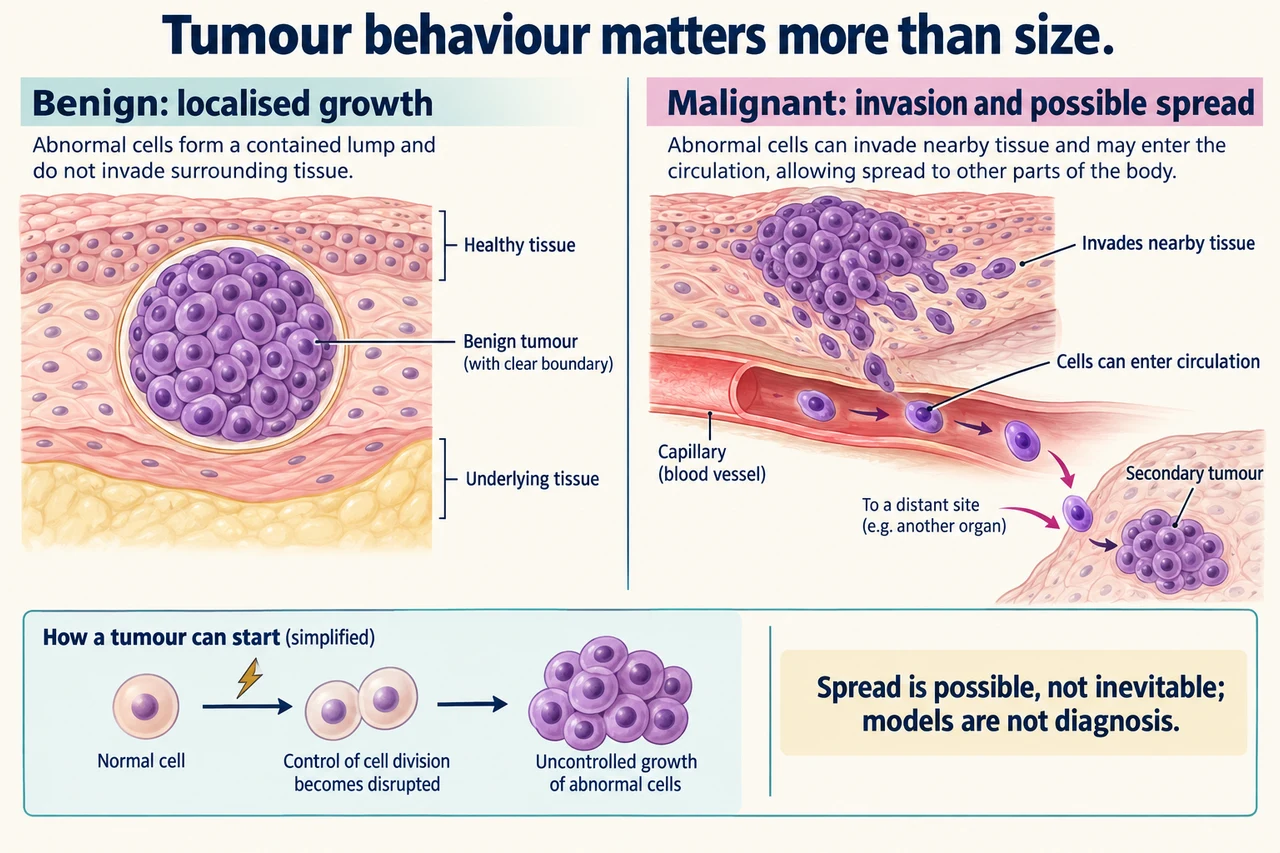
Original myAudience scientific illustration; not a documentary photograph or measured specimen. · Original generated project artwork; source concepts reviewed, no textbook figures copied.
Uncontrolled growth of cells
Cancer involves abnormal cell division that escapes normal controls. A benign tumor remains localized, while a malignant tumor can invade surrounding tissue and spread to other sites. These distinctions describe behavior, not simply whether a lump is large.
Genetic changes can disrupt normal controls of cell division. Inherited factors and environmental exposures can influence risk, but not every exposure produces cancer in every person. Explaining a mechanism is different from making an individual prediction. Early detection, diagnosis and treatment decisions require qualified medical assessment rather than a social-media description.
A benign tumor can still cause harm by its location or pressure on nearby tissue; benign does not mean irrelevant. Malignant cells can enter blood or lymph pathways and establish a secondary tumor elsewhere. The disease keeps the identity of its original cancer type rather than becoming the normal tissue of its new site. Cell behavior and microscopic evidence matter more than a lump's size alone.
Worked example: How does invasion distinguish a malignant tumor from a benign one?
Both involve abnormal cell growth
Malignant cells can invade and may spread
Answer: Invasion and spread are key distinguishing behaviors.
Check your understanding: Is cancer an example of uncontrolled cell division?
Answer: Yes.
Why: The normal regulation of cell growth and division has been disrupted.