Different tissues in plants
By UK GCSE Biology · independent study · myAudience
Original myAudience scientific illustration; not a documentary photograph or measured specimen. · Original generated project artwork; source concepts reviewed, no textbook figures copied.
Different tissues in plants
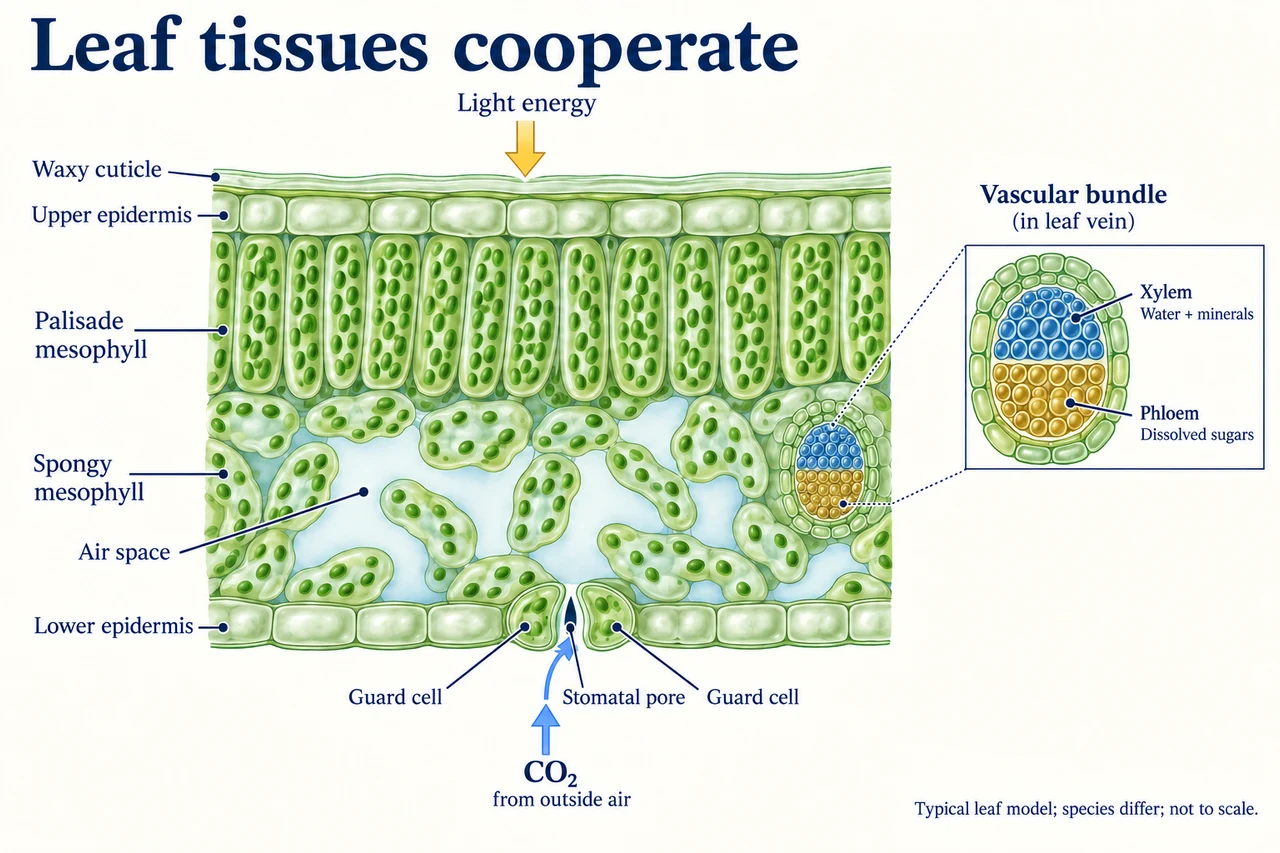
A leaf contains several tissues with different roles. The epidermis protects the surface; palisade tissue contains many chloroplasts; spongy tissue has air spaces that support gas movement. Guard cells change the opening of stomata, linking gas exchange with water loss.
In a typical leaf model, palisade cells contain many chloroplasts, while spaces in spongy tissue support gas movement. The arrangement links light capture with carbon dioxide supply. Use the model to explain a process, while recognizing that real species can differ in leaf thickness, tissue arrangement and adaptations to their environment.
Tissue arrangement helps link an organ with its function. In a typical leaf, the epidermis covers the outside, palisade tissue absorbs light, spongy tissue provides internal air spaces, and veins bring transport tissues together. Guard cells surround a stomatal pore. Meristems at growing regions produce new cells. A cross-section model explains these relationships; it does not predict an identical leaf structure in every species.
Worked example: Why are air spaces useful in spongy mesophyll?
Gases must reach photosynthetic cells
Internal spaces provide routes for gas movement
Answer: They support diffusion between stomata and the cells.
Check your understanding: Which cells regulate stomatal openings?
Answer: Guard cells.
Why: Changes in their shape alter the pore opening, affecting gas exchange and water loss.