How infections spread
By UK GCSE Biology · independent study · myAudience
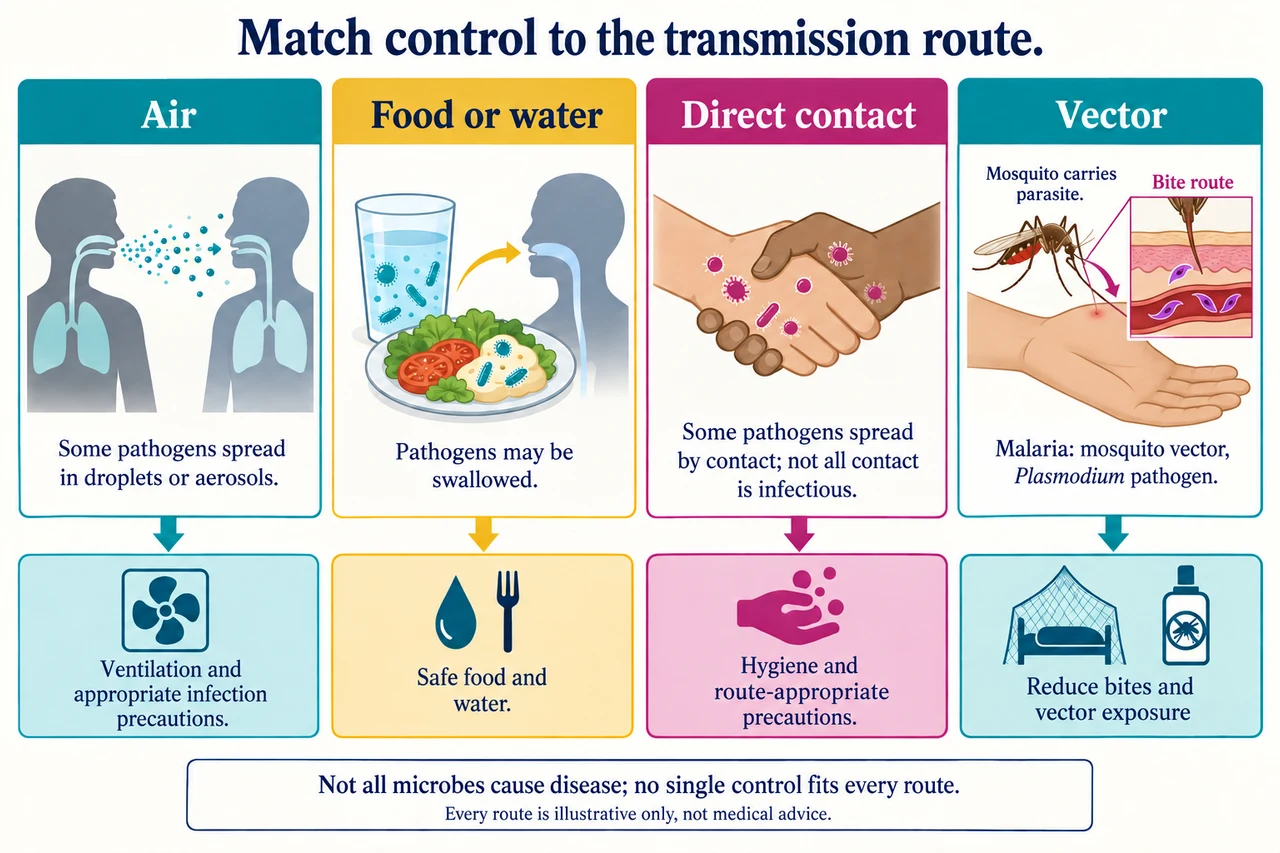
Original myAudience scientific illustration; not a documentary photograph or measured specimen. · Original generated project artwork; source concepts reviewed, no textbook figures copied.
How infections spread
A pathogen causes disease. Different pathogens may spread through air, direct contact, contaminated food or water, or vectors such as insects. The route matters because it identifies opportunities to interrupt transmission rather than assuming one measure works equally for every disease.
The same defense is not equally effective against every pathogen. Hygiene, isolation when appropriate and vaccination have different roles. An investigation should identify the organism, transmission route and outcome being measured. Counting cases before and after a measure also requires consideration of changing exposure and other interventions before assigning the whole change to one cause.
Four pathogen groups are compared at GCSE: bacteria, viruses, fungi and protists. Some spread through air or water, others through contact or a vector. The word pathogen describes a disease-causing role rather than a universal property of every microbe. Bacteria reproduce as cells; viruses depend on host cells. Transmission control therefore needs a named route and a suitable intervention, with evidence about what actually changed.
Worked example: Would a measure targeting mosquito bites address the route of malaria transmission?
Malaria parasites can be transmitted by mosquito vectors
Reducing contact with the vector targets that route
Answer: Yes, it addresses vector-mediated transmission rather than all possible infections.
Check your understanding: Are all bacteria pathogens?
Answer: No.
Why: Many bacteria do not cause disease and some contribute useful biological processes.