Illness caused by protists
By UK GCSE Biology · independent study · myAudience
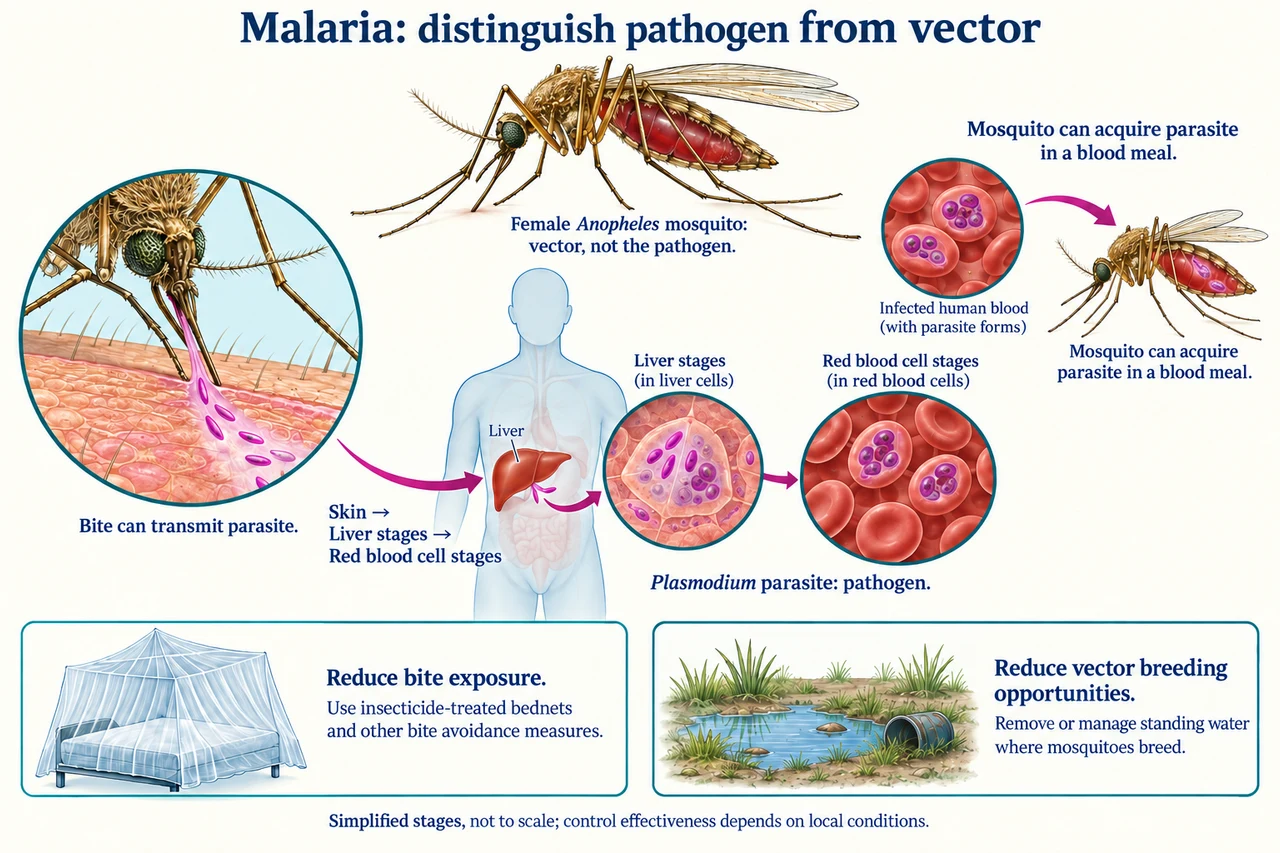
Original myAudience scientific illustration; not a documentary photograph or measured specimen. · Original generated project artwork; source concepts reviewed, no textbook figures copied.
Illness caused by protists
Protists are diverse eukaryotic organisms, many of them microscopic. Malaria is caused by Plasmodium parasites, not by the mosquito itself. Mosquitoes can carry the parasite between hosts and act as vectors.
Measures such as reducing mosquito breeding opportunities or preventing bites can interrupt transmission, but effectiveness depends on local conditions and use. A vector-control measure does not directly prove elimination of the pathogen from every host. When comparing disease rates, consider exposure, season and the population being measured rather than drawing a universal conclusion from one count.
Malaria parasites pass through stages in people and mosquitoes. Their effects can include recurring fever and serious illness. A mosquito net acts on the exposure route, whereas reducing breeding sites targets the vector population. Neither means that a mosquito is itself the disease-causing protist. A control study should compare suitable populations over time because rainfall, season and exposure can change mosquito numbers.
Worked example: Identify the pathogen and vector in malaria transmission.
Plasmodium causes the disease
A mosquito can carry it between hosts
Answer: The parasite is the pathogen; the mosquito is the vector.
Check your understanding: Does a vector necessarily cause the disease itself?
Answer: No.
Why: A vector transports a pathogen; the pathogen is the disease-causing organism.