Barriers and immune protection
By UK GCSE Biology · independent study · myAudience
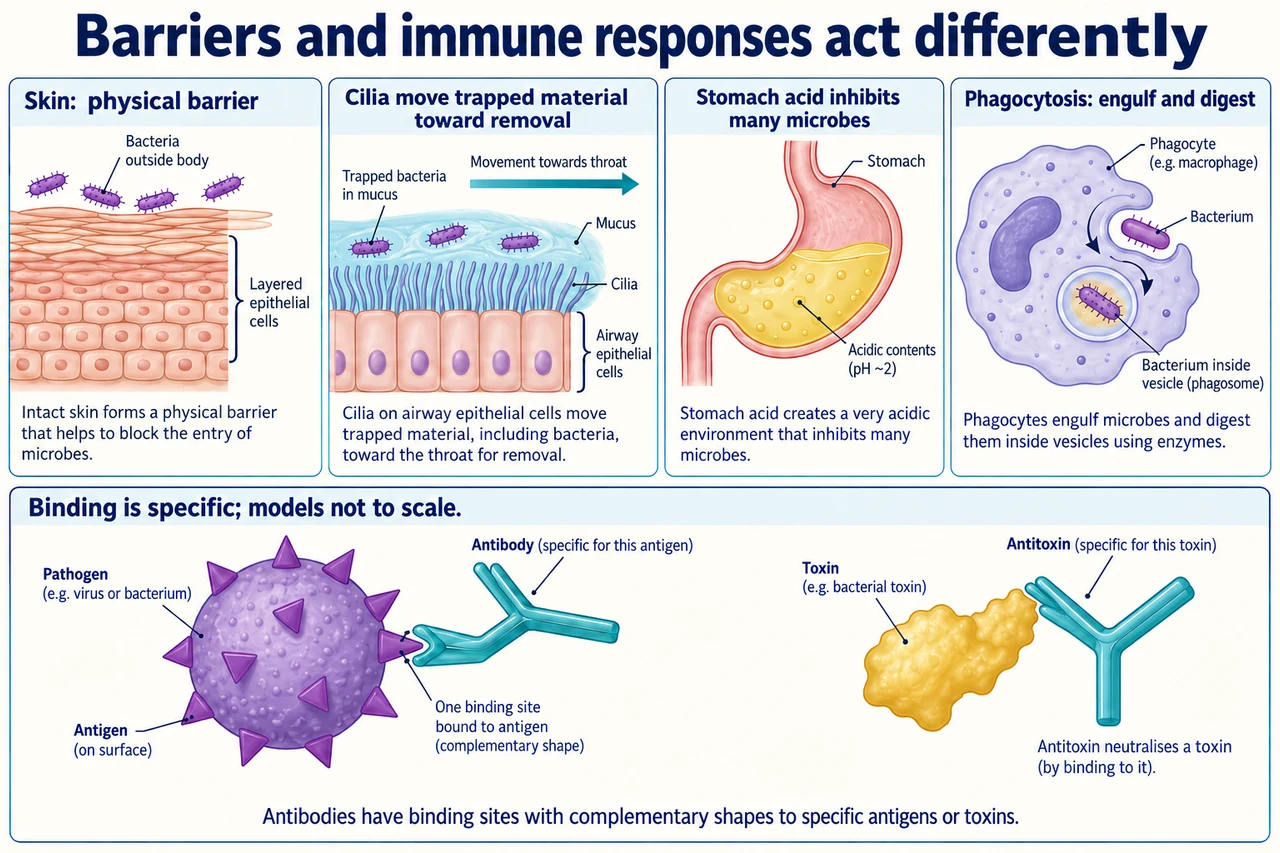
Original myAudience scientific illustration; not a documentary photograph or measured specimen. · Original generated project artwork; source concepts reviewed, no textbook figures copied.
Barriers and immune protection
The body has barriers that limit pathogen entry. Skin provides a physical barrier; mucus traps particles, and cilia help move mucus from airways. Stomach acid can destroy many ingested microorganisms. These defenses reduce entry but do not make infection impossible.
An antibody recognizes a particular antigen shape, helping target an immune response. An antitoxin counteracts a toxin; it is not the same as an antibiotic. Explain which substance or organism a defense acts upon. Immune responses can take time and differ between individuals, so the presence of defenses does not mean infection can never occur.
Non-specific barriers work before identifying one particular pathogen. Nose hairs and mucus trap material, while cilia in the trachea and bronchi move mucus for removal. Once an invader enters tissues, phagocytes can engulf it. Other immune cells produce antibodies with particular binding specificity. The same immune vocabulary should not be collapsed into one action: a barrier, an engulfing cell and a toxin-neutralizing antibody act at different stages.
Worked example: Why are mucus and cilia useful together in an airway?
Mucus traps particles and microorganisms
Cilia move the mucus toward removal
Answer: Their cooperation helps reduce material reaching deeper airways.
Check your understanding: Do antibodies bind all pathogens equally?
Answer: No.
Why: Binding depends on a fit with particular antigens, rather than one universal target.