Treating infection and symptoms
By UK GCSE Biology · independent study · myAudience
Original myAudience scientific illustration; not a documentary photograph or measured specimen. · Original generated project artwork; source concepts reviewed, no textbook figures copied.
Treating infection and symptoms
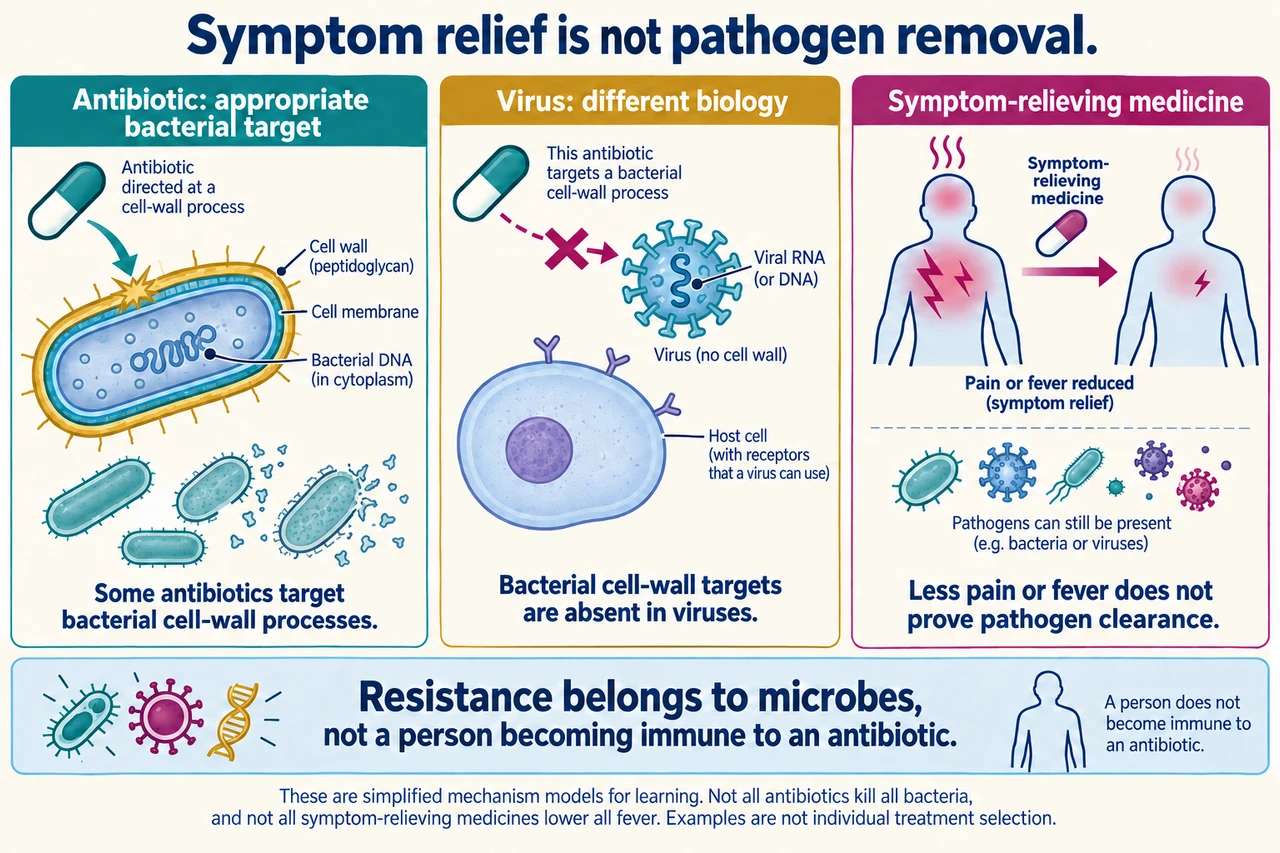
Antibiotics target bacterial processes or structures, while painkillers can reduce symptoms without removing the cause of an infection. These roles should not be confused. A medicine that eases pain does not thereby demonstrate that a pathogen has been destroyed.
Resistance means that some bacteria survive exposure to an antibiotic that previously controlled them. Appropriate prescribing and use help reduce unnecessary selection pressure, but treatment choices also depend on the infection and patient. Follow a clinician’s directions rather than adapting a classroom explanation into personal dosing advice or using another person’s medicines.
Selection can change a bacterial population: susceptible cells are inhibited while resistant survivors can reproduce. Resistance belongs to the organism, not to a person becoming immune to the antibiotic. Medicines target specific bacterial processes, so matching infection and drug matters. Pain relief records a change in symptoms rather than proof of pathogen removal. Viral targets are different and may be harder to affect without also affecting the host cell.
Worked example: A person’s fever improves after a symptom-relieving medicine. Has the pathogen necessarily disappeared?
The observed outcome is symptom improvement
Symptom relief and pathogen removal are different effects
Answer: No; improvement alone does not show eradication.
Check your understanding: Why are antibiotics not a general treatment for viral infections?
Answer: Their bacterial targets do not provide the same targets in viruses.
Why: The action of a medicine depends on the biology of what it targets.