Testing medicines before use
By UK GCSE Biology · independent study · myAudience
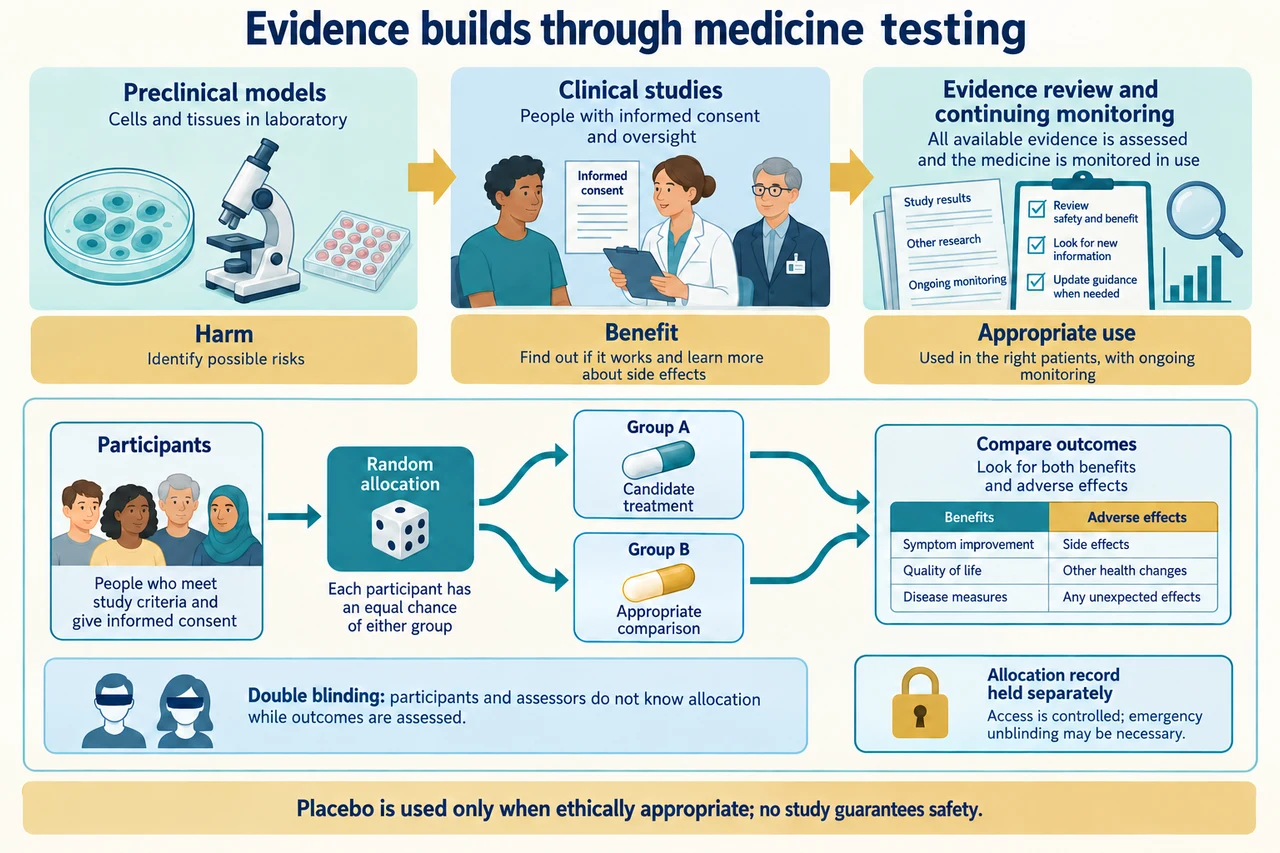
Original myAudience scientific illustration; not a documentary photograph or measured specimen. · Original generated project artwork; source concepts reviewed, no textbook figures copied.
Testing medicines before use
A potential medicine must be investigated for effectiveness, harmful effects and appropriate use. Preclinical work can investigate cells, tissues and animal models; clinical research evaluates people under regulated oversight. Results from one model cannot automatically establish safety or benefit in humans.
A randomized trial can reduce systematic differences between treatment groups, and blinding can reduce expectation or observer effects. A placebo is appropriate only where ethical and scientific conditions allow it. Compare meaningful outcomes and adverse effects, not just whether participants received a substance. No trial design removes the need for careful interpretation and safety oversight.
A candidate can start from a natural compound or laboratory synthesis. Familiar historical examples include penicillin from a mold, digitalis from foxgloves and aspirin developed from plant-associated salicylate chemistry. Clinical studies then ask distinct questions about harm, benefit and dose. Very early trials usually begin cautiously, and later designs can compare groups and limit bias. Peer review scrutinizes methods and evidence; it does not convert one positive result into certainty.
Worked example: Why might a blinded comparison reduce bias in reported symptoms?
Knowing the treatment can affect expectations
Blinding limits that influence on reporting and assessment
Answer: It helps separate treatment effects from expectation-related bias.
Check your understanding: Does successful testing in cultured cells prove benefit in patients?
Answer: No.
Why: An isolated system cannot establish all effects, risks or clinical outcomes in humans.