Making targeted antibody tools
By UK GCSE Biology · independent study · myAudience
Original myAudience scientific illustration; not a documentary photograph or measured specimen. · Original generated project artwork; no source textbook figures reused. Sources support factual review, not copied-art licensing.
Making targeted antibody tools
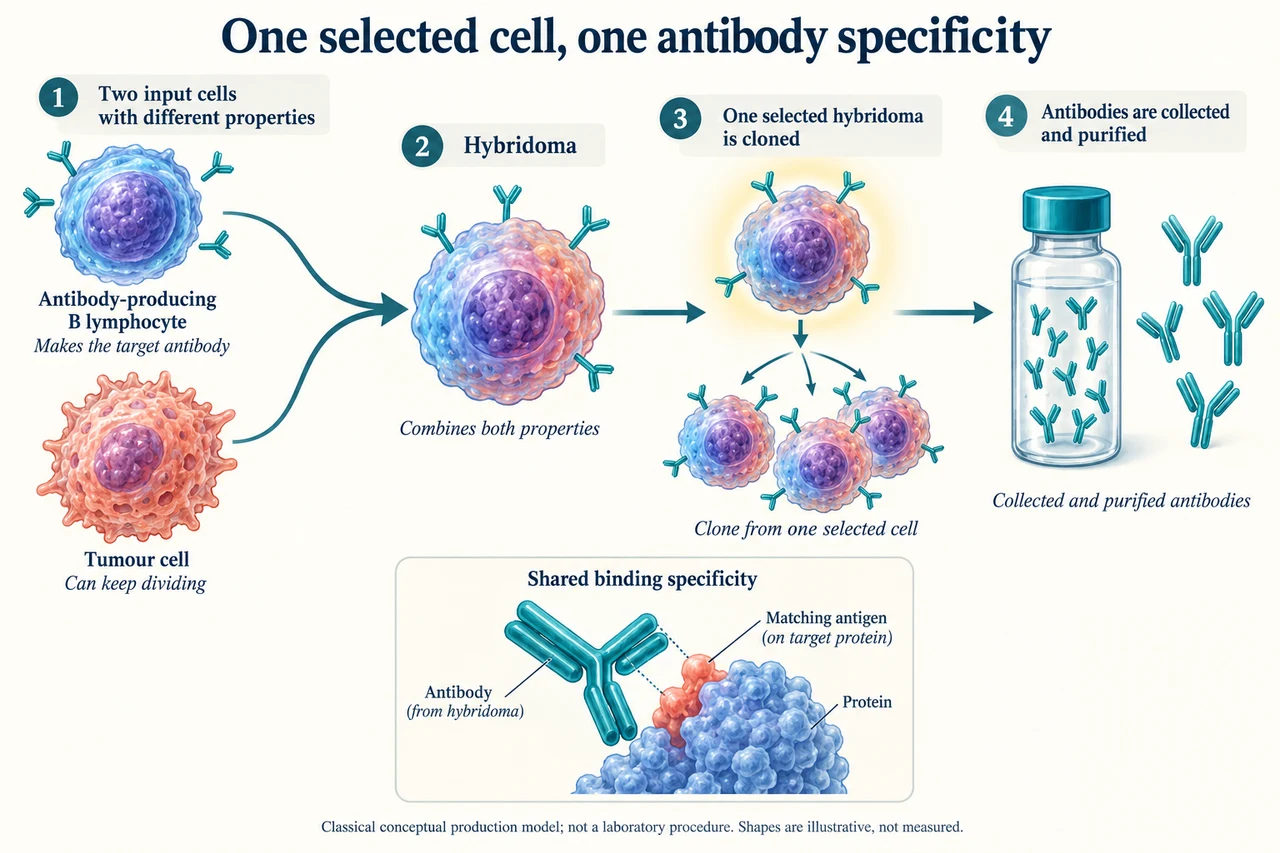
A monoclonal antibody preparation contains antibodies recognizing one particular antigen target. The classical production method combines an antibody-producing lymphocyte with a cell capable of continued division, forming a hybridoma. Selected cells can then produce repeated supplies of the antibody.
The antibody’s binding site must match the target sufficiently well for the intended use. Specificity is useful but not absolute proof of clinical safety: a target can occur in an unwanted tissue too. Distinguish how an antibody is produced from what it later detects or delivers, and keep this higher-tier mechanism separate from general vaccination.
A selected hybridoma combines sustained division with production of one antibody specificity. A clone is a cell lineage descended from one selected cell; its shared origin helps produce a consistent reagent. Collection and purification yield an antibody preparation, while testing must establish what it binds. This is the classical conceptual production model for the higher-tier topic, not instructions for performing cell fusion or culturing cells.
Worked example: Why combine antibody production with continued cell division?
One cell contributes the desired antibody-producing ability
The other contributes sustained proliferation
Answer: A selected hybridoma can provide a continuing supply of that antibody.
Check your understanding: What does monoclonal describe here?
Answer: Antibodies derived from one selected cell lineage with the same target specificity.
Why: It describes the shared origin and binding specificity, not a mixture aimed at unrelated targets.