Applications of targeted antibodies
By UK GCSE Biology · independent study · myAudience
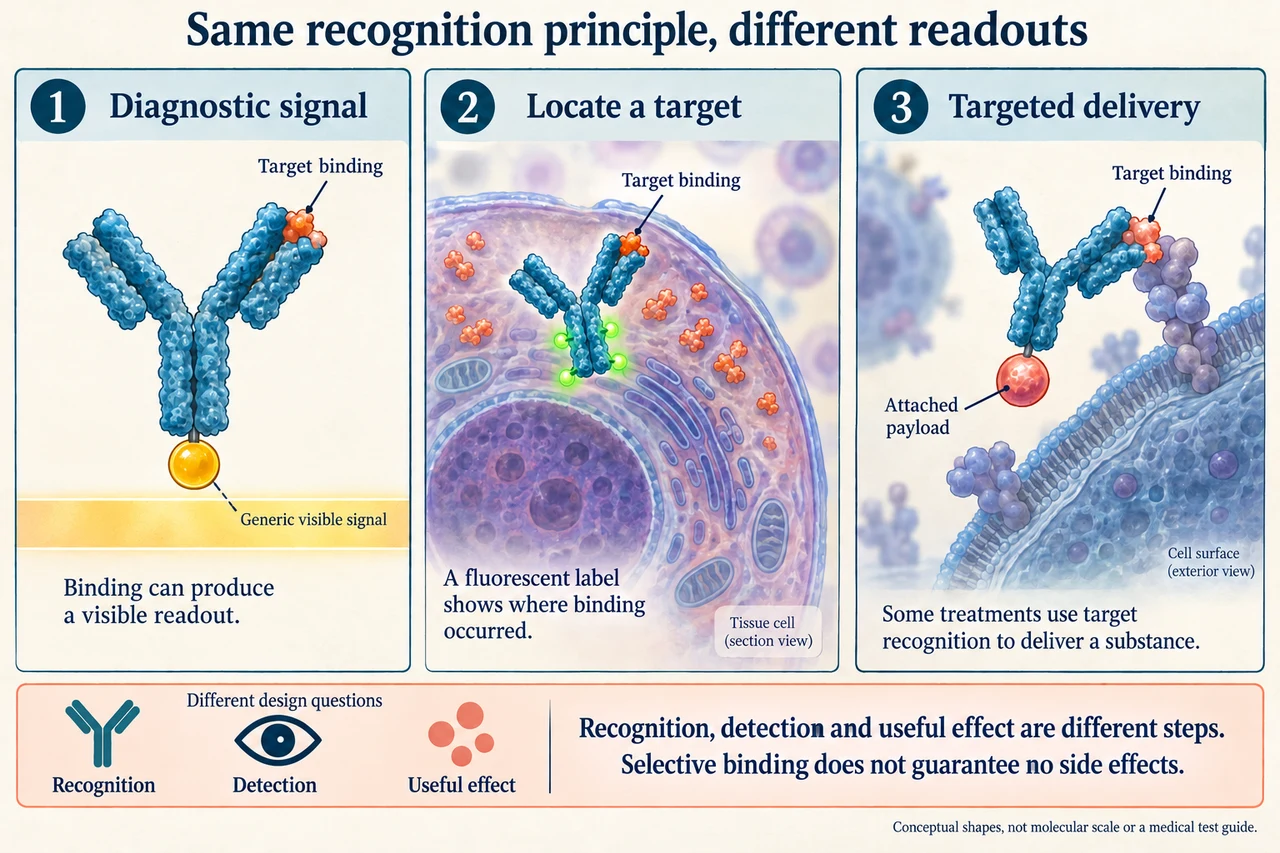
Original myAudience scientific illustration; not a documentary photograph or measured specimen. · Original generated project artwork; no source textbook figures reused. Sources support factual review, not copied-art licensing.
Applications of targeted antibodies
Monoclonal antibodies recognise particular targets. Linking the antibody to a readout gives different applications: a diagnostic test can produce a visible signal, while a fluorescent label can locate a target in tissue. Some cancer treatments interfere with growth signals or attach a substance intended to damage selected cells. Recognition, signal and useful effect are separate parts of the design.
A positive result needs interpretation within the validated test context, including detection limits, timing, cross-reactivity and sample quality. Binding to a target outside the intended site can cause unwanted effects, so specificity does not guarantee a treatment without side effects. An educational test diagram does not replace approved instructions or medical interpretation of an individual result.
Worked example: How could an antibody help a test detect a hormone in a sample?
Choose an antibody that binds the hormone
Link binding with a detectable signal
Answer: A properly designed test can indicate the target’s presence.
Check your understanding: Does selective binding guarantee no side effects in treatment?
Answer: No.
Why: Targets, distribution and immune reactions can create effects beyond the intended benefit.