Recognising illness in plants
By UK GCSE Biology · independent study · myAudience
Original myAudience scientific illustration; not a documentary photograph or measured specimen. · Original generated project artwork; no source textbook figures reused. Sources support factual review, not copied-art licensing.
Recognising illness in plants
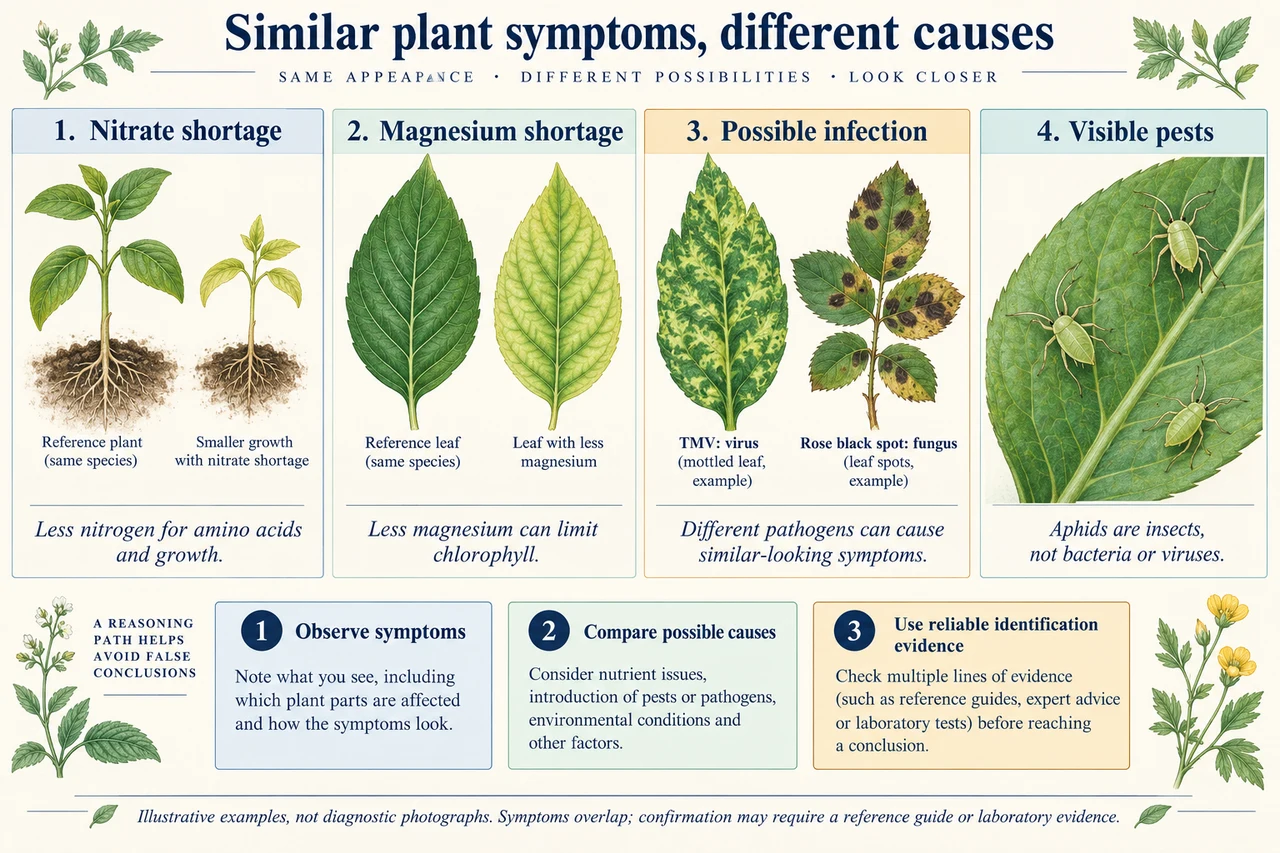
Unusual growth, discoloration, decay or visible pests can indicate a plant problem. Possible causes include pathogens, pests and deficiencies; similar symptoms can have different causes. A diagnosis combines observations with comparison to reliable information and, where needed, laboratory tests.
Nitrate deficiency can limit the amino acids and proteins required for growth, while magnesium deficiency can impair chlorophyll production. These mechanisms differ from viral or fungal damage. Compare affected and unaffected material under suitable conditions, and use expert guides or tests where needed; a generated image cannot reliably identify a pathogen or a mineral deficiency.
Disease investigation can compare growth, discoloration, decay, malformed parts and visible pests. Aphids are insect pests, whereas TMV and rose black spot have different pathogen types. Higher-tier identification may use a reference guide, laboratory evidence or a validated antibody-based test. Nutrient shortage is a separate explanation: nitrate supplies nitrogen for growth and magnesium is needed in chlorophyll. Similar appearances require a comparison of causes rather than one image-based guess.
Worked example: A plant has yellow leaves. Is that enough to prove a viral infection?
Yellowing can result from several causes
Mineral deficiency is one alternative
Answer: No; further evidence is needed to distinguish the causes.
Check your understanding: Why can too little nitrate restrict growth?
Answer: It limits nitrogen available for making important molecules such as proteins.
Why: Growth requires material for new cells, not only an energy supply.