How plants resist attack
By UK GCSE Biology · independent study · myAudience
Original myAudience scientific illustration; not a documentary photograph or measured specimen. · Original generated project artwork; no source textbook figures reused. Sources support factual review, not copied-art licensing.
How plants resist attack
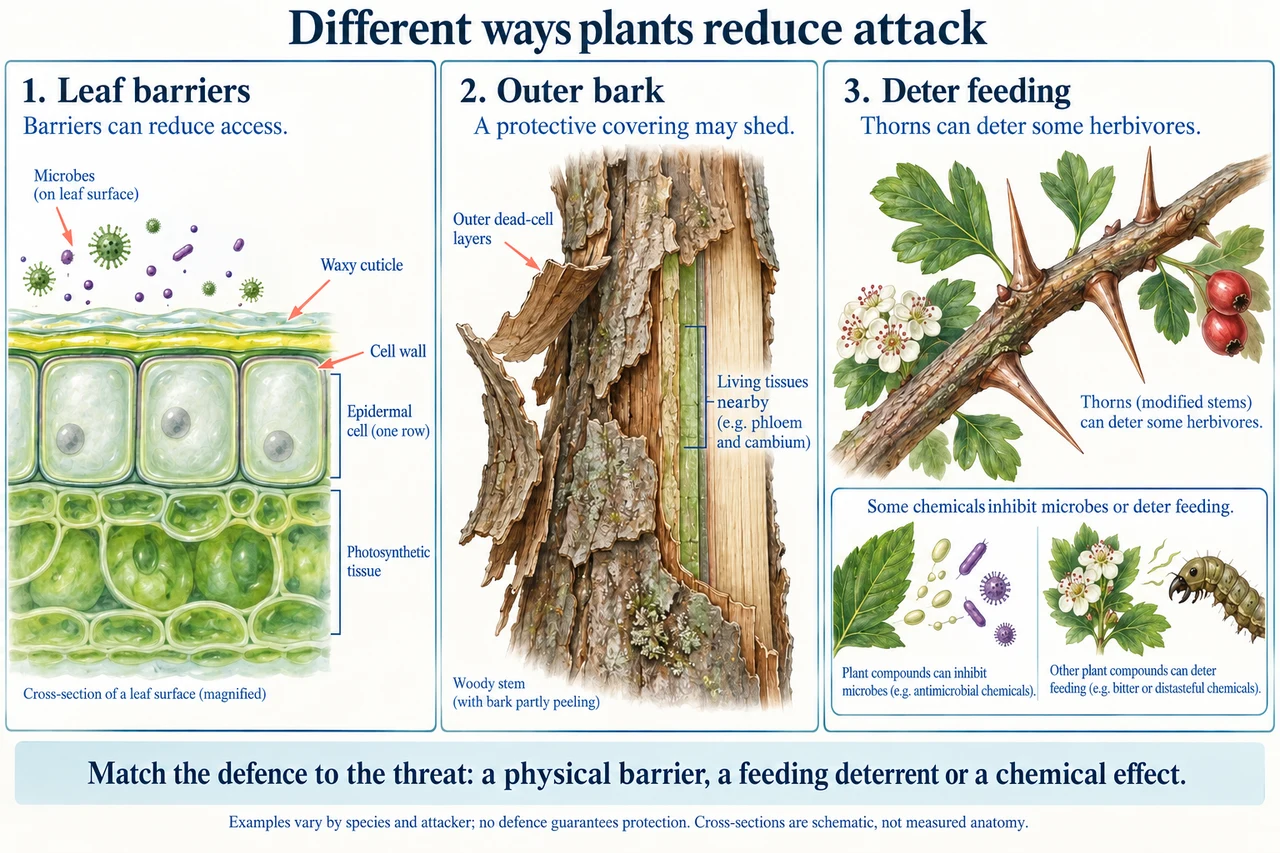
Plants resist attack through physical barriers and chemical defenses. Cell walls, a waxy cuticle and protective bark can reduce access to vulnerable tissues. Some plants produce antimicrobial chemicals or substances that deter herbivores.
Explain how a feature acts: a tough covering can make entry more difficult, whereas a toxic chemical changes the consequences of feeding. Different attackers interact with plants in different ways. Avoid assuming that every plant feature exists solely for one purpose, or that a structure observed in one species can be generalized to all plants.
A bark layer includes dead cells that can shed, reducing access to vulnerable tissue. Chemical defenses can deter feeding or inhibit microbes, while thorns discourage some herbivores. Certain plants also show touch responses or appearances that affect feeding behavior. These examples should be linked to the threat they can reduce, not treated as proof that all defenses work equally against all attackers.
Worked example: How could a waxy cuticle help limit pathogen entry?
It forms a surface barrier
It reduces direct access to underlying tissues
Answer: A pathogen must overcome that barrier to reach susceptible cells.
Check your understanding: Are all plant defenses physical?
Answer: No.
Why: Plants can also produce chemicals affecting microorganisms or herbivores.