Turning light into chemical stores
By UK GCSE Biology · independent study · myAudience
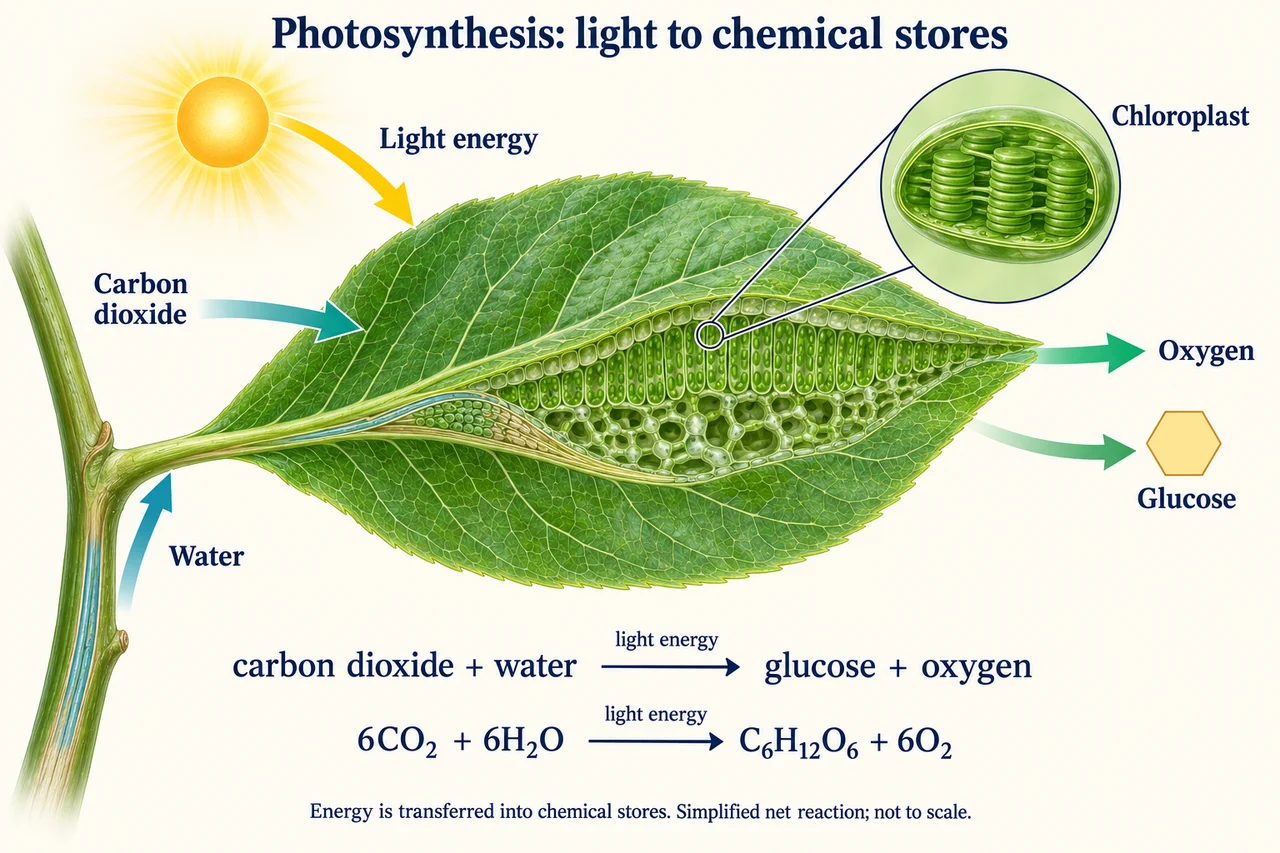
Original AI-generated myAudience scientific concept illustration; not a micrograph or measured specimen. · Original generated project artwork; no source textbook figures reused. Reference links support subject review, not a copied-art license.
Turning light into chemical stores
Photosynthesis transfers energy from light into chemical stores in organic molecules. Plants use carbon dioxide and water to make glucose, releasing oxygen. Chlorophyll in chloroplasts absorbs light; the process requires energy rather than releasing the energy stored in glucose.
A plant still respires while photosynthesizing. In adequate light, its net gas exchange reflects both processes, so oxygen release does not mean respiration stopped. Root and other nonphotosynthetic cells depend on organic materials made elsewhere or obtained from stores. Connect the leaf’s light capture with transport and use of the products across the organism.
The balanced overall model is 6CO₂ + 6H₂O → C₆H₁₂O₆ + 6O₂, with a light-energy input. Count atoms on each side to see why light belongs above the reaction arrow rather than among the atoms. Six carbon dioxide molecules provide six carbon atoms; water supplies hydrogen. The equation summarizes many reactions in a chloroplast, rather than claiming one collision produces an entire glucose molecule.
Worked example: Explain why photosynthesis is an energy-requiring process.
Light provides energy
The energy supports production of glucose from simpler inputs
Answer: Chemical energy is stored in the products rather than released as the purpose of photosynthesis.
Check your understanding: Do plants respire as well as photosynthesize?
Answer: Yes.
Why: Respiration transfers energy for cellular work, including when photosynthesis is not occurring.