What limits photosynthetic speed
By UK GCSE Biology · independent study · myAudience
Original myAudience scientific illustration; not a documentary photograph or measured specimen. · Original generated project artwork; no source textbook figures reused. Sources support factual review, not copied-art licensing.
What limits photosynthetic speed
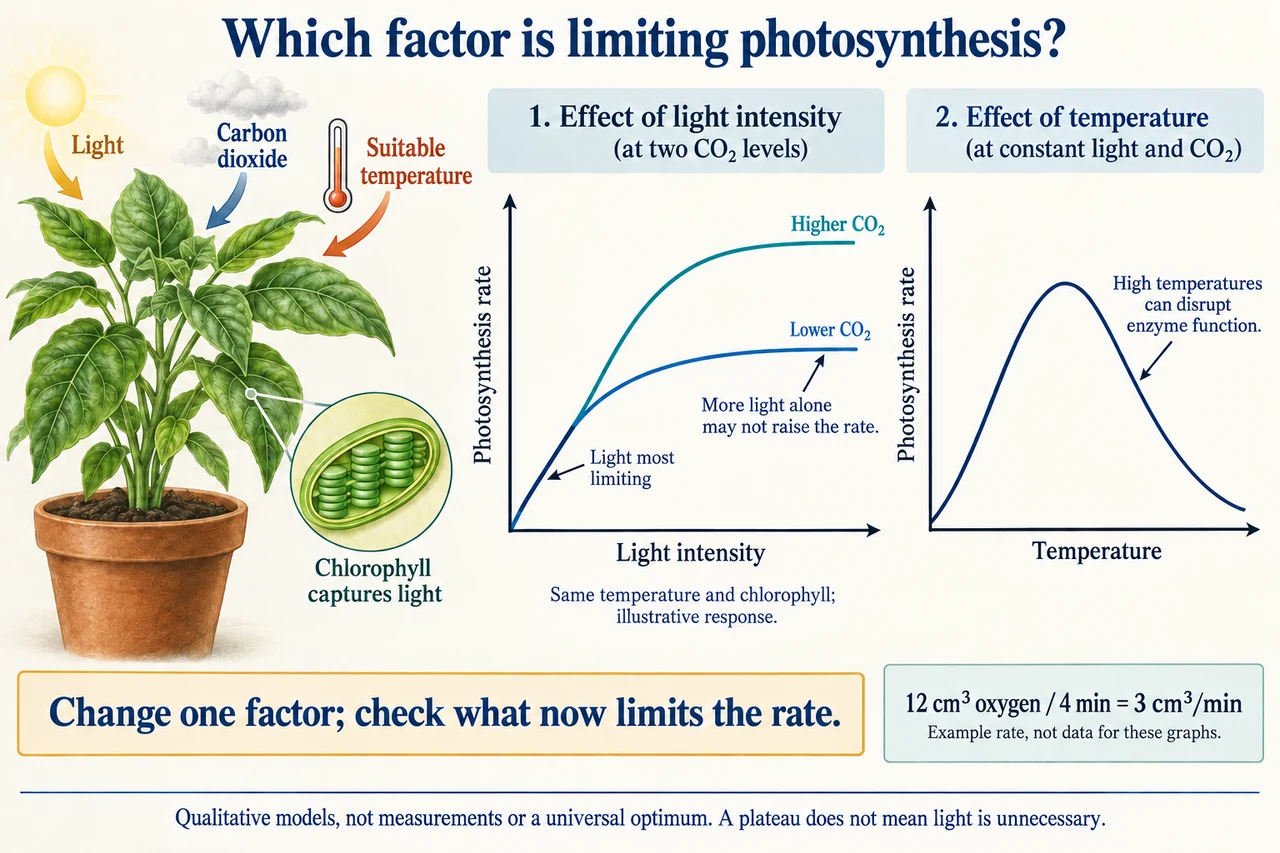
Photosynthesis can be limited by light intensity, carbon dioxide availability or temperature. Increasing one factor helps only while it constrains the rate. At high temperatures, enzyme disruption can reduce activity; a graph that plateaus does not prove that light is no longer required.
A graph that rises and then plateaus after increasing light suggests that light is no longer the main limit over that range, not that all plants share one maximum. In an aquatic-plant investigation, gas volume is generally a better quantitative measure than assuming every bubble has the same size. Control temperature and plant amount when comparing light conditions.
Chlorophyll content also matters: less light-absorbing pigment can reduce light capture even when the external light is unchanged. Rate means change per unit time, so 12 cm³ of oxygen in four minutes gives 3 cm³/min. Higher-tier extension: a greenhouse operator compares the extra crop value with the cost of added heat, lighting and carbon dioxide. Removing one limit is useful only if the benefits justify the expense; the highest biological rate need not give the highest profit.
Worked example: A model light source is moved from 10 cm to 20 cm away. What fraction of the original intensity remains?
Distance doubles
Inverse-square scaling gives 1/2²
Answer: The modeled intensity is one quarter of the original.
Check your understanding: If more light no longer raises the rate, what might explain the plateau?
Answer: Another factor, such as carbon dioxide, may now be limiting.
Why: Changing one factor cannot remove every constraint on the process.