Where plant sugars go
By UK GCSE Biology · independent study · myAudience
Original myAudience scientific illustration; not a documentary photograph or measured specimen. · Original generated project artwork; no source textbook figures reused. Sources support factual review, not copied-art licensing.
Where plant sugars go
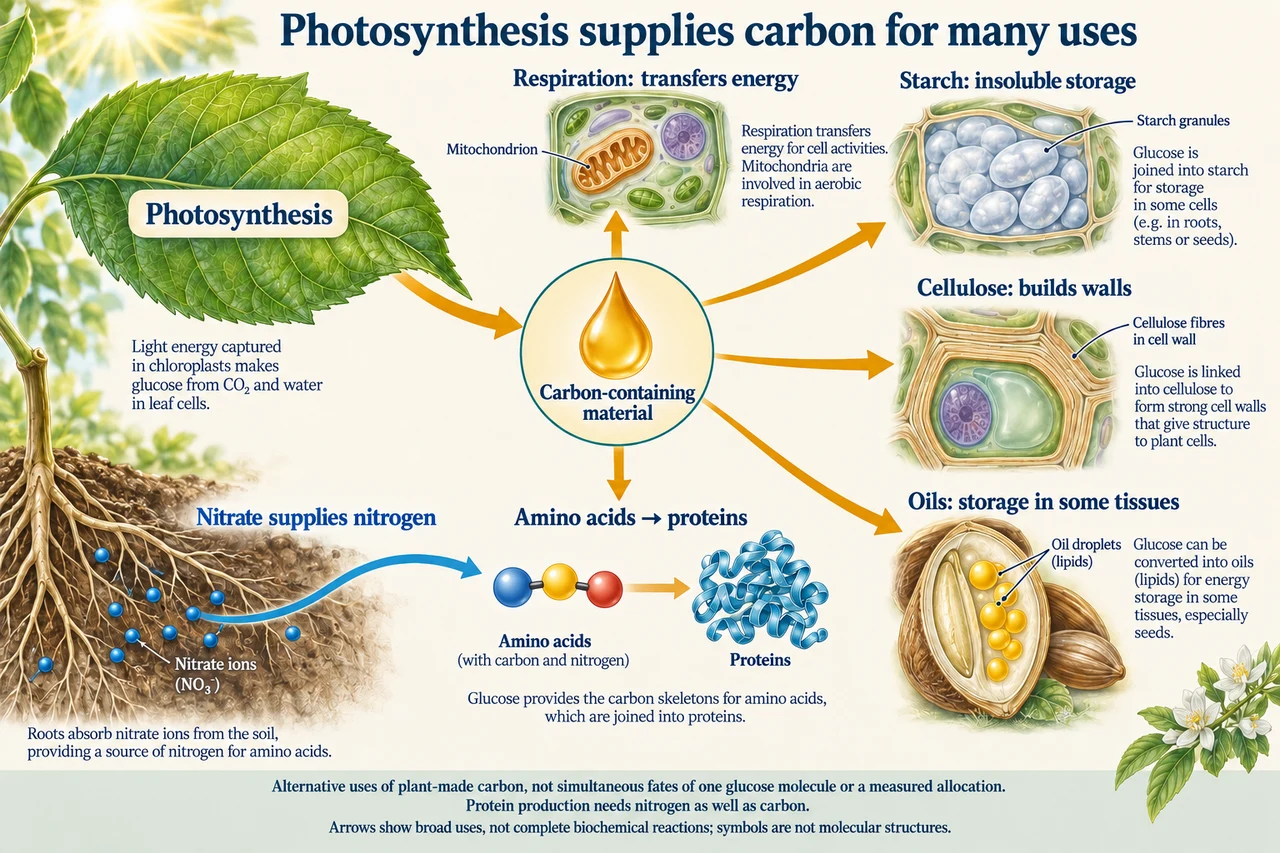
Glucose made by photosynthesis can be used in respiration, stored as starch, or incorporated into cellulose for cell walls. It can also contribute to fats and oils. To make proteins, plants additionally need a nitrogen source, commonly absorbed as nitrate ions.
A store of starch can be broken down when sugar is needed later, while cellulose serves a structural role. Sugar transport through phloem can supply tissues that do not photosynthesize. Distinguish the immediate production of organic material from its later allocation: finding starch in one leaf does not by itself quantify the whole plant’s rate of growth.
Glucose dissolved in cells affects their water relations, whereas insoluble starch provides a compact storage route without contributing in the same way to dissolved-solute concentration. Cellulose builds walls; oils store material particularly in seeds. To make amino acids, a plant needs nitrogen as well as carbon-containing starting material. Nitrate absorbed by roots is therefore a nutrient source, not a ready-made protein or an alternative to photosynthesis.
Worked example: Why does a plant need nitrate ions even if it makes plenty of glucose?
Glucose supplies carbon-containing material
Proteins also require nitrogen
Answer: Nitrate supplies nitrogen needed for molecules used in growth.
Check your understanding: Which polymer provides structural material in plant walls?
Answer: Cellulose.
Why: Starch is a storage polymer, whereas cellulose contributes to wall structure.