Linked chemical reactions in organisms
By UK GCSE Biology · independent study · myAudience
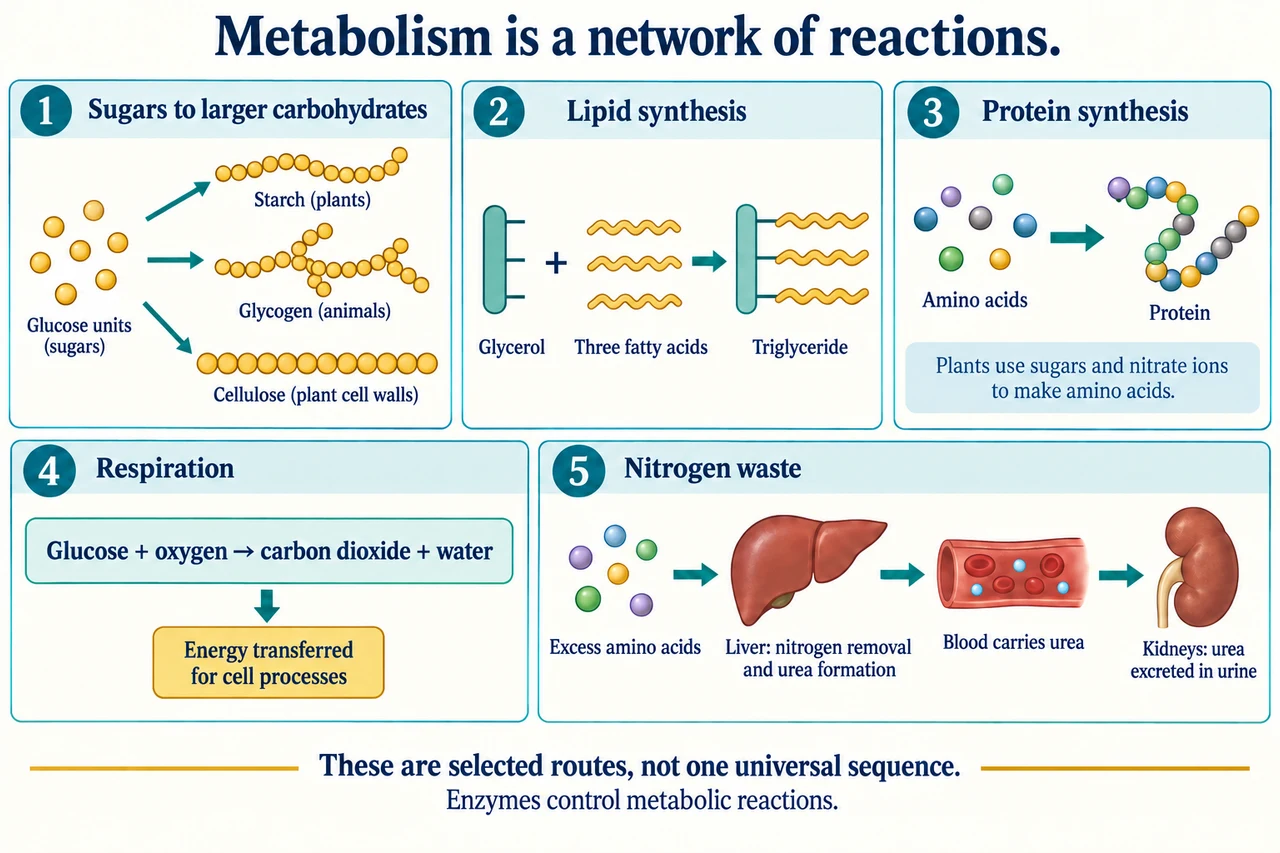
Original myAudience scientific illustration; not a documentary photograph or measured specimen. · Original generated project artwork; source concepts reviewed, no textbook figures copied.
Linked chemical reactions in organisms
Metabolism is the collection of chemical reactions in an organism. It includes breaking substances down and building others. Respiration supports energy transfer, while synthesis uses materials and energy to make proteins, lipids and carbohydrates required for cells.
Examples include forming proteins from amino acids, converting glucose into storage compounds and breaking down excess amino acids to produce urea in the liver. Materials can enter several routes depending on need. Trace the starting material, resulting products and purpose of a reaction instead of assuming that every nutrient is immediately burned for energy.
Trace atoms as well as energy: glucose can form glycogen in animals, while amino acids join into proteins. A triglyceride contains glycerol joined to three fatty acids. Excess amino acids cannot simply be stored as a separate amino-acid reserve indefinitely; removal of their nitrogen in the liver contributes to urea formation. The kidney later excretes urea. This separates the organ making a waste product from the organ removing it from the blood.
Worked example: A growing plant converts simple sugars into cellulose. Is this part of metabolism?
The plant is chemically building a larger molecule
Building reactions are included in metabolism
Answer: Yes; metabolism includes synthesis as well as breakdown.
Check your understanding: Does metabolism mean only respiration?
Answer: No.
Why: Respiration is one group of reactions within a wider network of chemical processes.