Investigating the control centre
By UK GCSE Biology · independent study · myAudience
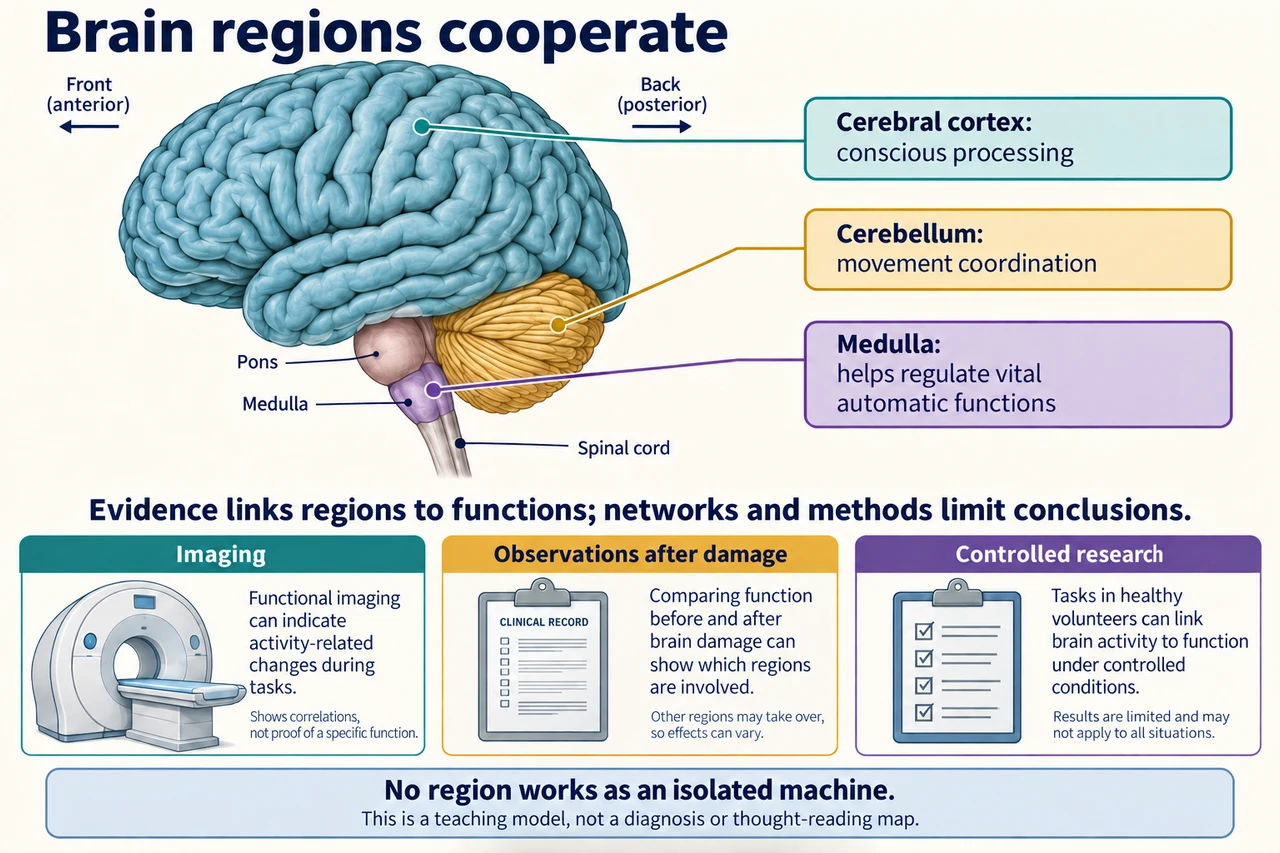
Original myAudience scientific illustration; not a documentary photograph or measured specimen. · Original generated project artwork; source concepts reviewed, no textbook figures copied.
Investigating the control centre
The brain contains many interconnected neurones with specialized regions. The cerebral cortex contributes to conscious processes, the cerebellum coordinates movement, and the medulla helps regulate automatic processes such as breathing. Regions cooperate rather than functioning as completely separate machines.
Evidence can come from imaging, observations after damage and carefully controlled research, each with limitations. An association between a region and a function does not justify unsafe intervention or a prediction of an individual personality. Brain research involves ethical and practical constraints because damage can have serious consequences and the system’s parts are interconnected.
Keep anatomical roles specific: the cerebral cortex is associated with conscious activity and higher processing, the cerebellum with coordination, and the medulla with vital automatic functions such as breathing. Higher-tier extension: a damaged region can supply evidence about function, but nearby injury and interconnected pathways complicate interpretation. MRI shows structures or activity-related patterns under suitable methods; it does not read a complete thought or justify assigning one complex behaviour to a single isolated spot.
Worked example: A study links damage in a region with impaired movement coordination. Which named region is a reasonable starting hypothesis?
Identify coordination as the affected function
Compare the named brain regions’ roles
Answer: The cerebellum is a reasonable hypothesis, not a diagnosis from the description alone.
Check your understanding: Does an imaging association prove one region works alone?
Answer: No.
Why: Complex behavior involves interacting networks, and an association may not establish a sole cause.