Keeping body temperature stable
By UK GCSE Biology · independent study · myAudience
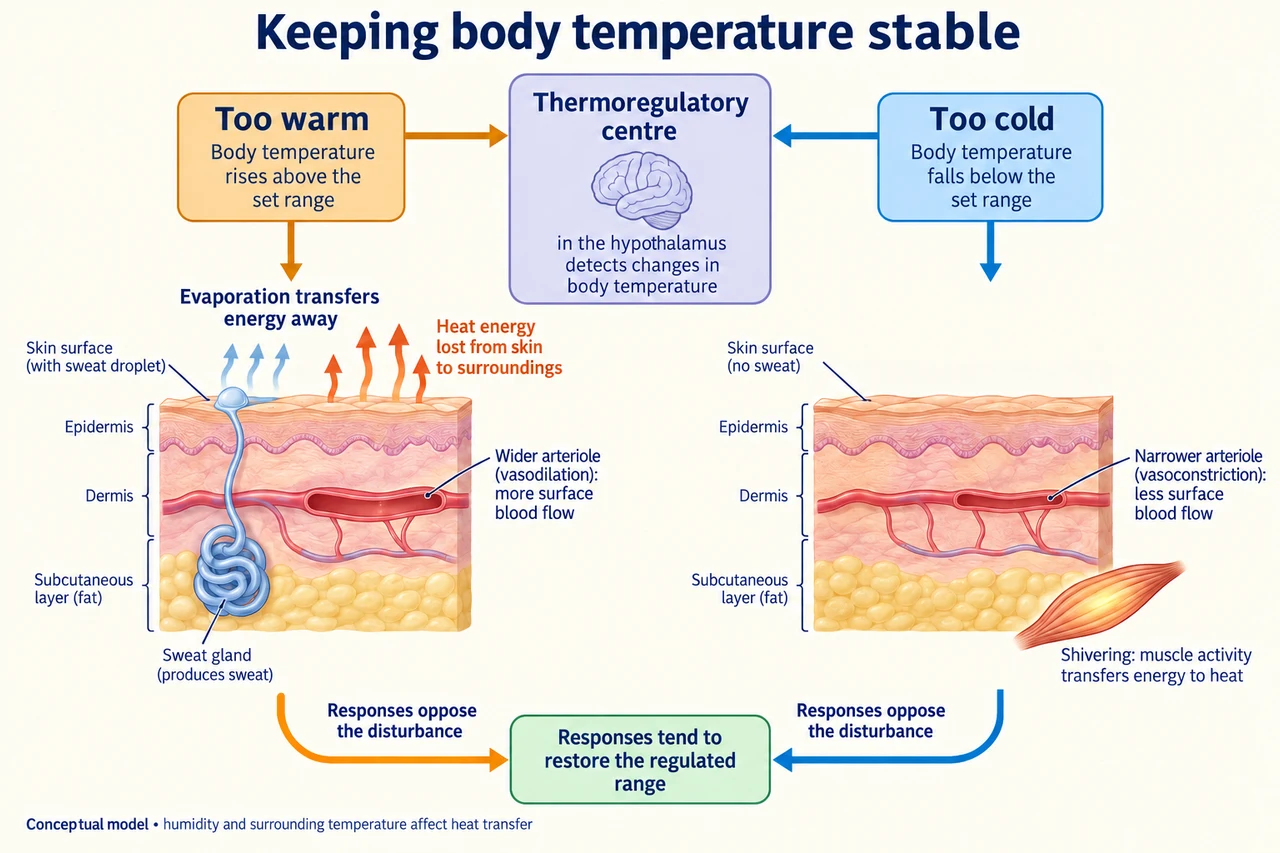
Original myAudience scientific illustration; not a documentary photograph or measured specimen. · Original generated project artwork; source concepts reviewed, no textbook figures copied.
Keeping body temperature stable
Temperature receptors and a thermoregulatory centre help monitor body temperature. When temperature rises, sweating and increased blood flow near the skin can promote energy transfer to the environment. When temperature falls, reduced skin blood flow and shivering can help retain or produce thermal energy.
Vasodilation changes the diameter of blood vessels; vessels do not physically move closer to the skin. Sweating cools through evaporation, so humidity and airflow influence its effectiveness. Environmental temperature also affects whether heat can be lost readily. Follow energy transfer and the response mechanism rather than assuming every warm person cools at the same rate.
Receptors in skin supply information about surroundings, while the thermoregulatory centre also responds to blood temperature. When a person is too cold, reduced blood flow through surface vessels lowers heat transfer at the skin; shivering supplies repeated muscle contractions. Higher-tier reasoning traces energy: evaporation transfers energy away as liquid water becomes vapour. High humidity reduces evaporation, so visible sweat alone does not establish a large cooling rate.
Worked example: Why does shivering help during a cold disturbance?
Repeated muscle contractions require metabolic activity
Some transferred energy becomes thermal energy
Answer: Shivering contributes to raising or maintaining body temperature.
Check your understanding: Does vasodilation mean blood vessels move through the skin?
Answer: No.
Why: The diameter of vessels changes, affecting blood flow rather than relocating the vessels.