Chemical signals in circulation
By UK GCSE Biology · independent study · myAudience
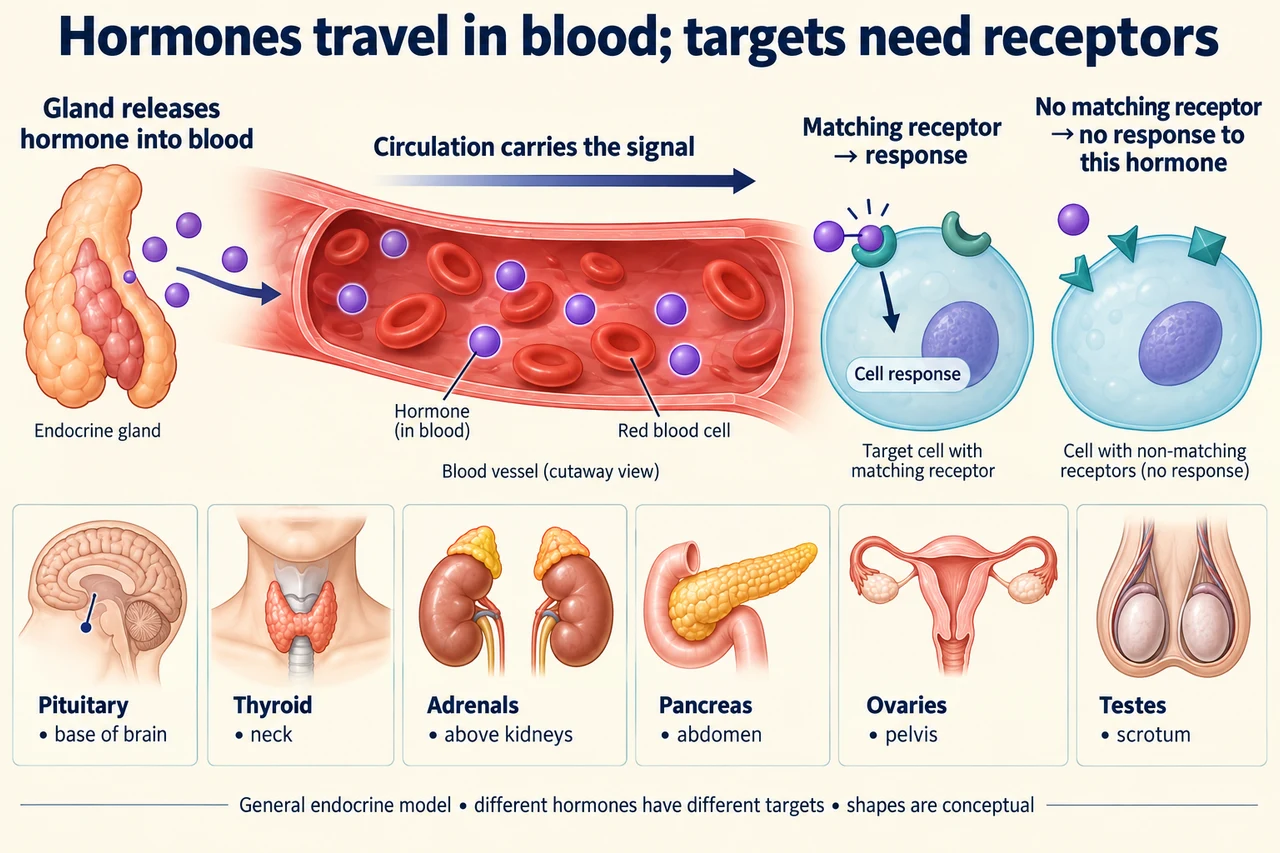
Original myAudience scientific illustration; not a documentary photograph or measured specimen. · Original generated project artwork; source concepts reviewed, no textbook figures copied.
Chemical signals in circulation
Endocrine glands release hormones into blood. The hormone travels through circulation, but cells respond only if they have suitable receptors. Compared with many nervous responses, hormonal responses are often slower and longer lasting; this is a broad comparison rather than an absolute rule.
The pituitary helps coordinate other endocrine glands through particular hormones. The thyroid, adrenal glands, pancreas and reproductive organs have different signaling roles. Trace gland, hormone, target and effect in an explanation. Naming the gland without describing what the signal changes is incomplete, and blood-borne does not mean unlimited or unregulated action.
A gland is an organ releasing a signal; the hormone is the chemical signal, and a target tissue produces a response through appropriate receptors. The pituitary is at the base of the brain; thyroid tissue is in the neck, adrenal glands sit above the kidneys, and the pancreas is in the abdomen. Ovaries and testes have endocrine as well as reproductive roles. A named location helps interpretation, but an explanation still needs the hormone’s target and effect.
Worked example: Why can a hormone circulate past many tissues but affect particular targets?
The hormone travels widely in blood
Response requires appropriate receptors
Answer: Only responsive target cells produce the relevant effect.
Check your understanding: Are hormones carried only along neurones?
Answer: No.
Why: Endocrine hormones travel through blood, unlike electrical signaling along a nerve pathway.