Managing water and nitrogen waste
By UK GCSE Biology · independent study · myAudience
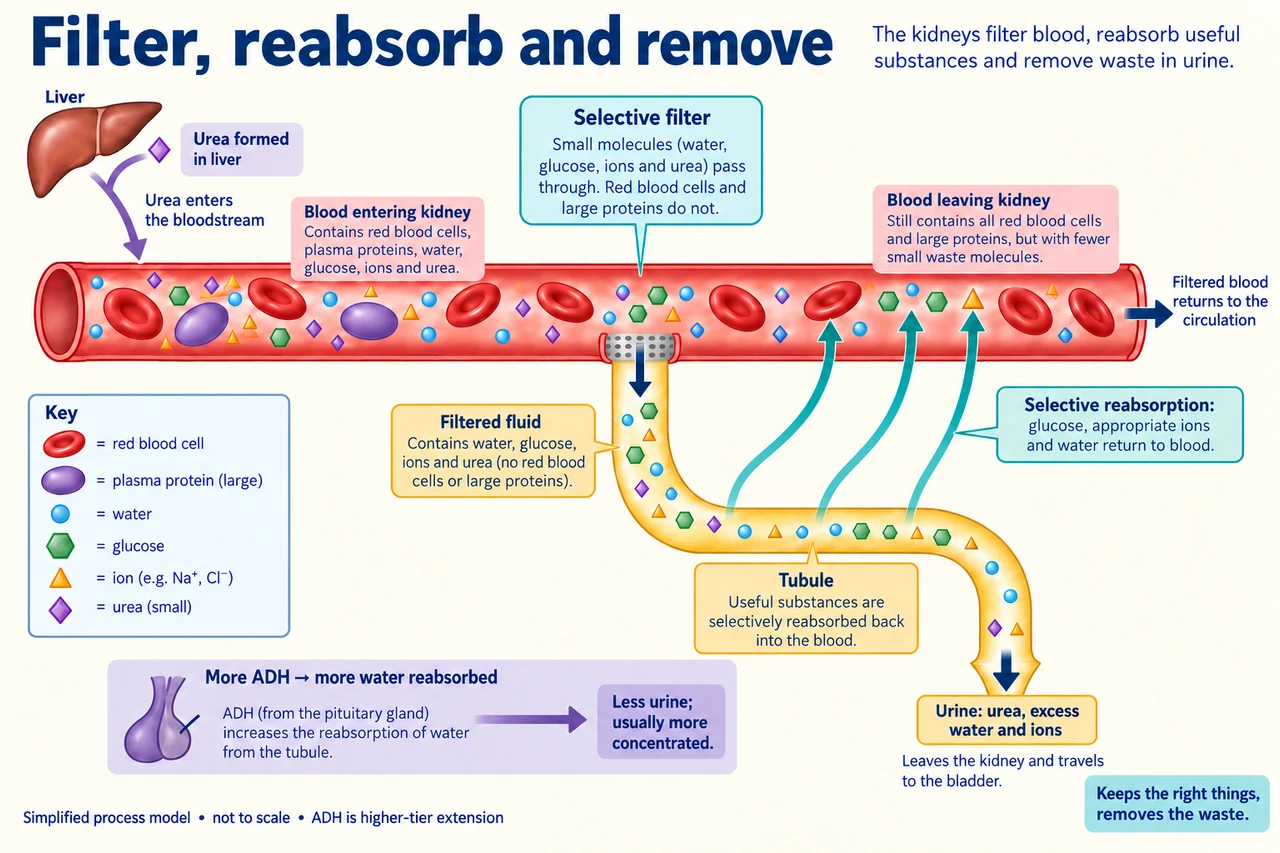
Original myAudience scientific illustration; not a documentary photograph or measured specimen. · Original generated project artwork; source concepts reviewed, no textbook figures copied.
Managing water and nitrogen waste
Kidneys filter blood and selectively reabsorb useful substances, including glucose, appropriate amounts of ions and water. Urine removes urea and excess substances. Water is also lost through lungs and skin, so kidney regulation adjusts one part of an interconnected balance.
At higher tier, ADH changes how much water is reabsorbed in the kidney’s collecting pathways. Greater water conservation can produce a smaller volume of more concentrated urine. Kidney failure can require dialysis or transplantation, with different benefits and constraints. Distinguish urea production in the liver from removal by the kidneys when tracing the process.
Filtration and selective reabsorption perform different jobs. Small dissolved substances enter the filtrate; useful glucose and appropriate quantities of water and ions return to the blood. Higher-tier extension: more ADH increases kidney-tubule water permeability and water reabsorption. Dialysis fluid is arranged to support removal of waste and suitable ion balance across a membrane, while retaining blood cells and large proteins. A transplant can restore continuous regulation but introduces surgery, compatibility and immune-rejection considerations.
Worked example: Why does more water reabsorption lead to a smaller, more concentrated urine volume?
Filtered water can return to blood
Less water remains for excretion
Answer: Urine volume falls while its dissolved substances become more concentrated.
Check your understanding: Is urea made by the kidney as its main job?
Answer: No.
Why: Urea is formed through nitrogen processing in the liver and is removed from blood by the kidneys.