Chemical control of reproduction
By UK GCSE Biology · independent study · myAudience
Original myAudience scientific illustration; not a documentary photograph or measured specimen. · Original generated project artwork; source concepts reviewed, no textbook figures copied.
Chemical control of reproduction
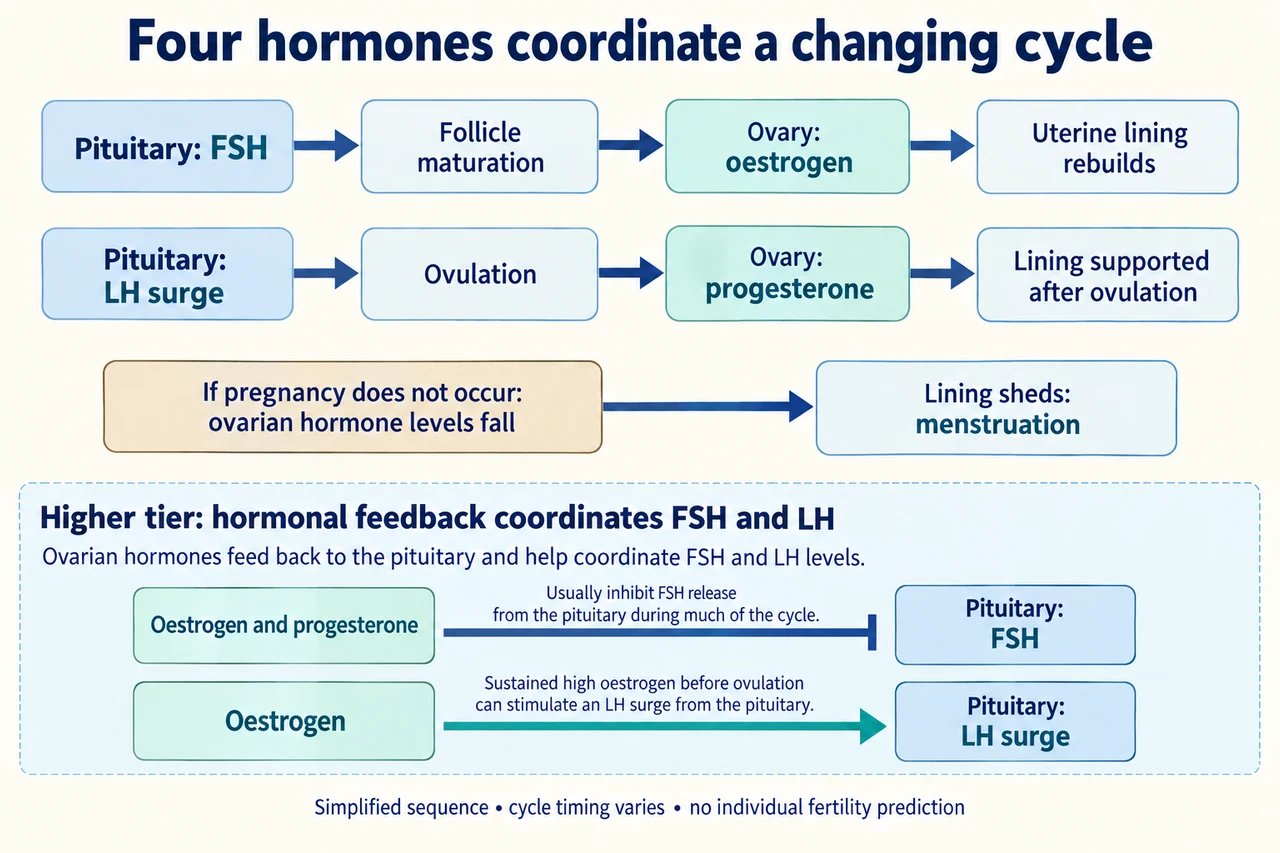
Reproductive hormones influence puberty and reproductive processes. In the menstrual cycle, FSH supports egg maturation, LH is associated with ovulation, and ovarian hormones help regulate the uterine lining. Cycle timing varies; a 28-day cycle is a teaching model, not a guarantee for every person.
If pregnancy does not occur, falling hormone support is associated with shedding of the uterine lining. A textbook 28-day cycle illustrates a sequence, not an exact timetable for everyone. Testosterone contributes to sperm production and male secondary sexual characteristics. Biological models describe processes and variation without assuming identity or individual fertility from a general diagram.
In a simplified cycle, increasing oestrogen supports rebuilding the uterine lining. Higher-tier extension: oestrogen can inhibit FSH while helping produce the LH surge associated with ovulation; progesterone supports the lining and inhibits FSH and LH afterward. If pregnancy does not occur, reduced ovarian-hormone support allows the lining to be shed. These changing relationships explain a sequence; a calendar day by itself cannot prove when a particular person ovulated.
Worked example: In a cycle model, an LH surge occurs near ovulation. What event is associated with it?
Locate the surge on the cycle timeline
Connect LH with release of an egg from the ovary
Answer: Ovulation is the associated event.
Check your understanding: Is every menstrual cycle exactly 28 days?
Answer: No.
Why: The model is useful for learning relationships, but real timing varies.