Hormonal support for fertility
By UK GCSE Biology · independent study · myAudience
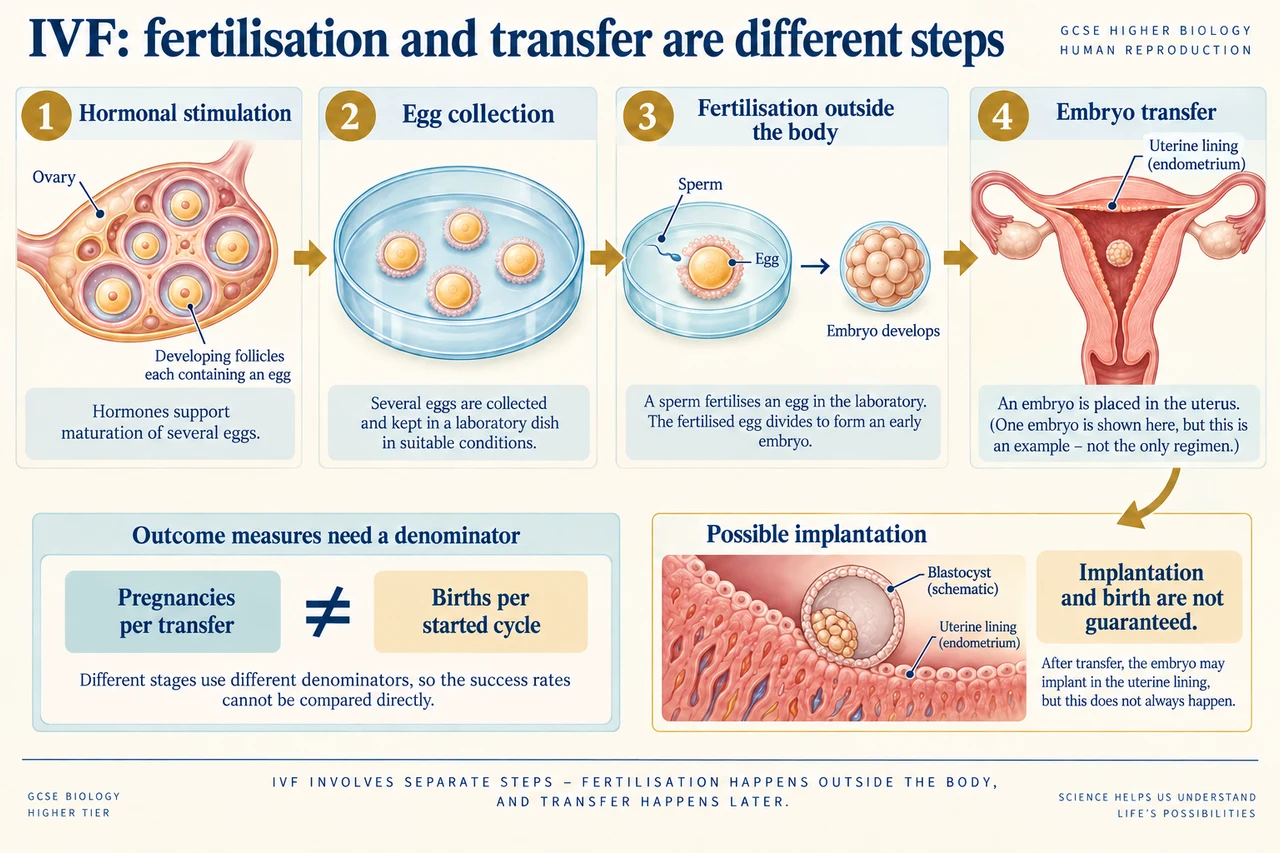
Original myAudience scientific illustration; not a documentary photograph or measured specimen. · Original generated project artwork; source concepts reviewed, no textbook figures copied.
Hormonal support for fertility
Fertility treatment can use hormones to support egg maturation and ovulation. In IVF, eggs are collected and fertilized outside the body; an embryo may then be transferred to the uterus. Fertilization and implantation are separate events, and neither step guarantees a successful pregnancy.
A treatment can offer benefit while involving physical demands, uncertainty, expense and a possibility of multiple pregnancy depending on the approach. Success rates require a clear denominator and context, including age and treatment details. Explaining the sequence is not a promise of success or a recommendation that every infertility cause should receive the same treatment.
Higher-tier extension: hormonal stimulation can support maturation of more than one egg before collection. After fertilisation outside the body, an embryo is assessed before a possible transfer; transfer and implantation are different events. To interpret success data, define the denominator: pregnancies per transfer and births per started cycle are not interchangeable. The biological mechanism can be understood while acknowledging that outcomes depend on clinical context and that a course lesson cannot predict an individual outcome.
Worked example: At what stage does fertilization happen in IVF?
Eggs and sperm are brought together outside the body
An embryo can subsequently be transferred
Answer: Fertilization occurs before transfer to the uterus.
Check your understanding: Does embryo transfer guarantee implantation?
Answer: No.
Why: Transfer places an embryo in the uterus; successful implantation is a later outcome.