Control through negative feedback
By UK GCSE Biology · independent study · myAudience
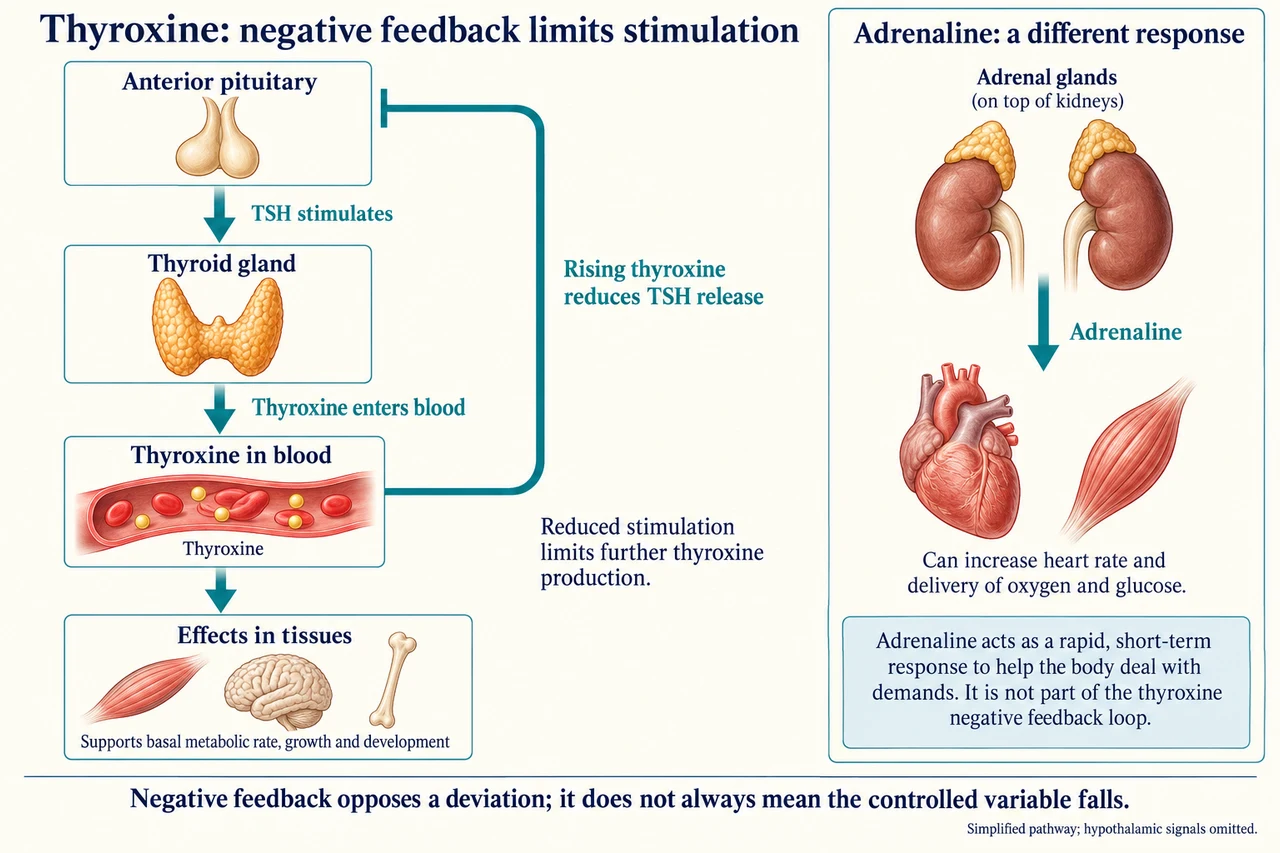
Original myAudience scientific illustration; not a documentary photograph or measured specimen. · Original generated project artwork; source concepts reviewed, no textbook figures copied.
Control through negative feedback
Negative feedback reduces a deviation from a regulated condition. A change is detected, a response opposes it, and the corrective signal falls as conditions recover. The direction of effect matters more than whether a hormone is described as “good” or “bad.”
For blood glucose, low levels can stimulate responses involving glucagon; rising levels then reduce the need for that corrective response. Adrenaline and thyroxine have additional control contexts at higher tier. A complete loop identifies the changed condition, coordinating signal, effect and reduction of the original stimulus, rather than simply drawing arrows in a circle.
Higher-tier extension: the pituitary signal TSH stimulates thyroid-hormone production; an increased thyroxine supply reduces further stimulating signals in the feedback model. Thyroxine influences metabolic rate and supports development. Adrenaline released by adrenal glands prepares rapid responses, including greater heart rate and blood flow to muscles. These hormones are examples of coordination, but a rapid adrenaline response is not itself the same loop as the pituitary–thyroid example.
Worked example: In a model, rising thyroxine reduces the pituitary signal stimulating its production. Why is this negative feedback?
Thyroxine initially rises
Its rise reduces further stimulation
Answer: The response limits the original increase.
Check your understanding: Does negative feedback always mean the controlled variable decreases?
Answer: No.
Why: A low variable can trigger a response that raises it; the response opposes the disturbance.