Chemical coordination in plants
By UK GCSE Biology · independent study · myAudience
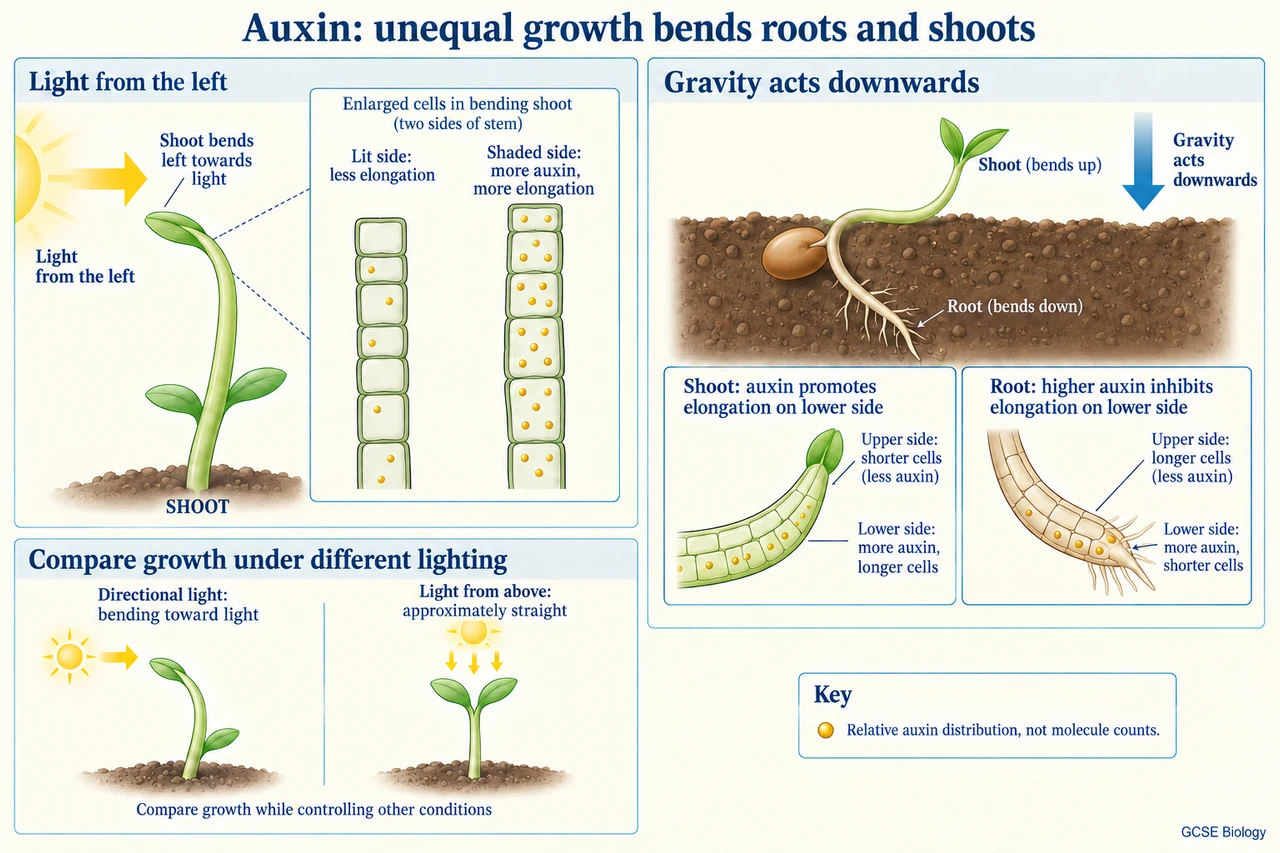
Original myAudience scientific illustration; not a documentary photograph or measured specimen. · Original generated project artwork; source concepts reviewed, no textbook figures copied.
Chemical coordination in plants
Plant hormones coordinate growth. Auxin distribution can cause unequal elongation on different sides of a shoot, bending it toward light. Responses to directional light and gravity are tropisms; a directional growth response is different from an animal moving its whole body toward a stimulus.
Responses to gravity also involve growth regulation, with roots and shoots responding differently to auxin. An investigation should control variables such as seedling age, moisture and temperature while changing the directional stimulus. Rotation or a uniform-light comparison can test an explanation, but observing one bent stem does not by itself identify every chemical step.
For a shoot illuminated from one side, more auxin on the shaded side promotes greater elongation there, producing a bend toward light. Gravity-related redistribution leads shoots and roots to grow differently: a concentration that promotes shoot elongation can inhibit elongation on one side of a root. The root consequently bends toward gravity. Comparing the tissue and direction of unequal growth avoids the mistaken rule that auxin always causes identical bending in every plant organ.
Worked example: Why can a shoot bend when cells on one side elongate more?
Compare growth on the two sides
Unequal length creates curvature
Answer: Differential elongation bends the shoot.
Check your understanding: Is phototropism a response to gravity?
Answer: No; it is a response to directional light.
Why: Gravitropism describes the directional growth response to gravity.