Reproduction with and without gametes
By UK GCSE Biology · independent study · myAudience
Original myAudience scientific illustration; not a documentary photograph or measured specimen. · Original generated project artwork; source concepts reviewed, no textbook figures copied.
Reproduction with and without gametes
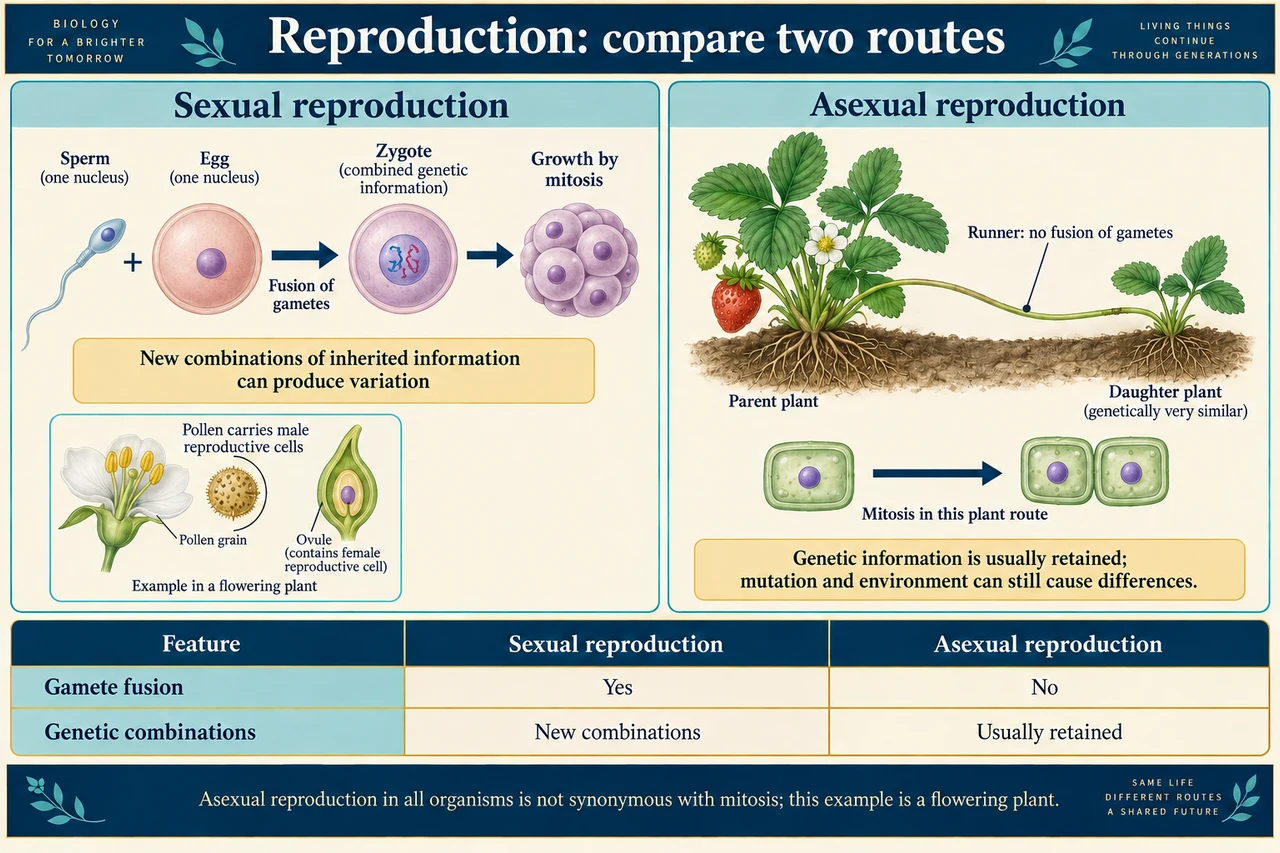
Sexual reproduction combines genetic information from gametes, generating variation among offspring. Asexual reproduction produces offspring from one parent without fusion of gametes, commonly preserving the parent’s genetic information except for changes such as mutation.
The terms do not rank one method as universally better. Asexual reproduction can preserve a successful genotype quickly, while sexual reproduction produces new combinations that can contribute to variation. Some organisms use more than one strategy. Explain the environmental conditions and reproductive process before predicting which approach might be advantageous.
Mitosis copies nuclear genetic information into new cells for many asexual routes; sexual reproduction includes fusion of gametes with new combinations of inherited information. A strawberry runner can retain a successful combination without gamete fusion, while a seed develops after a sexual process. Pollen carries the male reproductive cells in flowering plants: it is not the same structure as a whole new plant. Asexual does not mean that mutation or environmental differences become impossible.
Worked example: A plant produces a runner that develops into a new plant. Which reproductive strategy is illustrated?
No fusion of gametes is involved
The offspring comes from one parent
Answer: This is asexual reproduction.
Check your understanding: Why can sexual offspring differ from both parents?
Answer: They receive a new combination of genetic information.
Why: Gamete formation and fertilization combine parental alleles in varied combinations.