Making genetically varied gametes
By UK GCSE Biology · independent study · myAudience
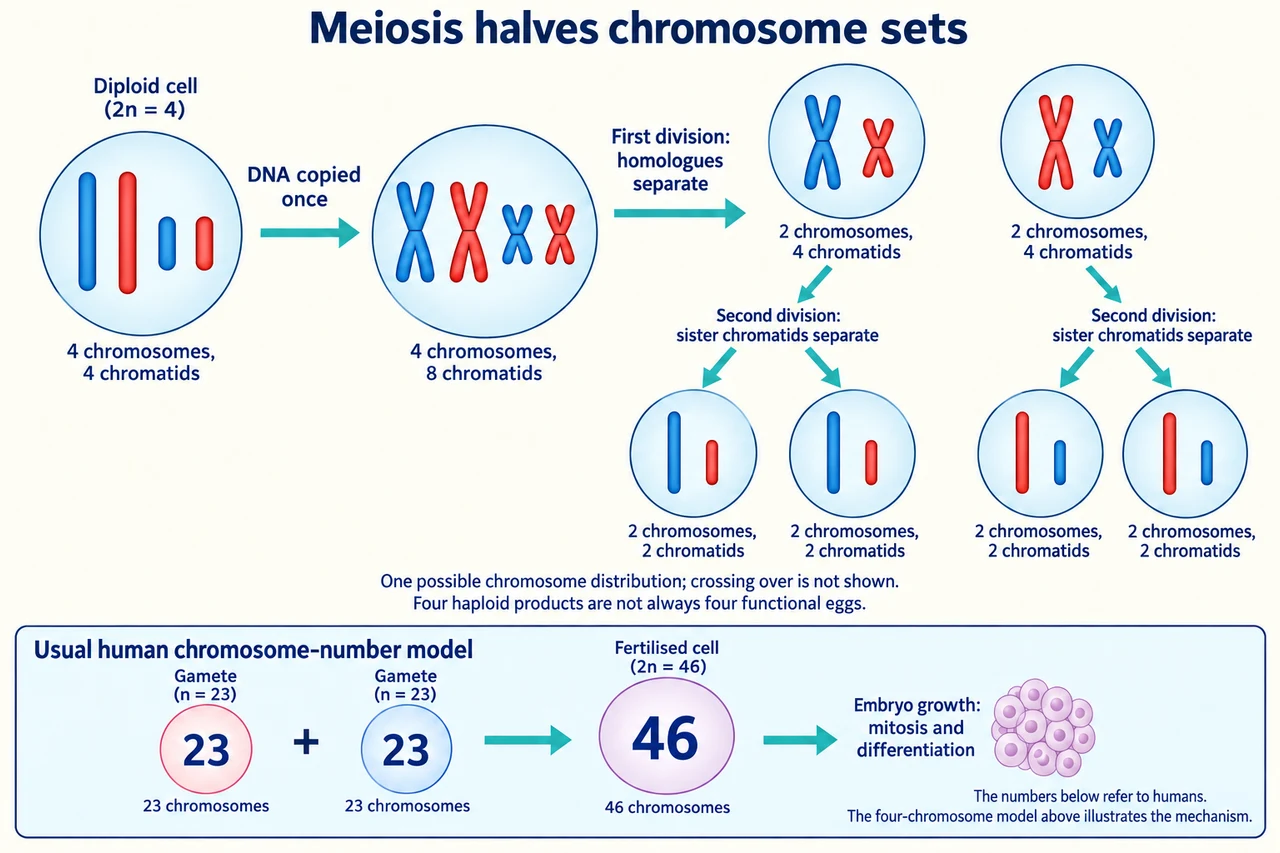
Original myAudience scientific illustration; not a documentary photograph or measured specimen. · Original generated project artwork; source concepts reviewed, no textbook figures copied.
Making genetically varied gametes
Meiosis produces gametes with half the usual chromosome number. DNA is copied before two successive divisions, and genetic information is distributed into cells that differ from one another. At fertilization, two gametes combine, restoring the paired chromosome number.
For a typical human model, a body cell has 46 chromosomes and a gamete has 23. Meiosis produces gametes rather than two matching replacement body cells. Distinguish chromosome number from the number of DNA copies during replication; an X-shaped duplicated chromosome does not automatically count as two chromosomes simply because its chromatids are visible.
Before the two divisions, DNA is copied. The outcome has one chromosome set in each gamete, rather than the two sets in the original body-cell model. Fertilisation restores a pair of sets; subsequent embryo growth uses mitosis, and differentiation changes cell function. A duplicated chromosome has two chromatids but remains one chromosome until these separate. Chromosome sets, DNA-copy number and number of cells are therefore different quantities.
Worked example: In the usual human model, how many chromosomes are in a gamete and in the fertilized cell?
A gamete has one set of 23 chromosomes
Two gametes combine their sets
Answer: The fertilized cell normally has 46 chromosomes.
Check your understanding: Does meiosis normally produce two matching body cells?
Answer: No.
Why: That description fits mitosis; meiosis produces gametes with reduced chromosome number and variation.