Comparing reproductive strategies
By UK GCSE Biology · independent study · myAudience
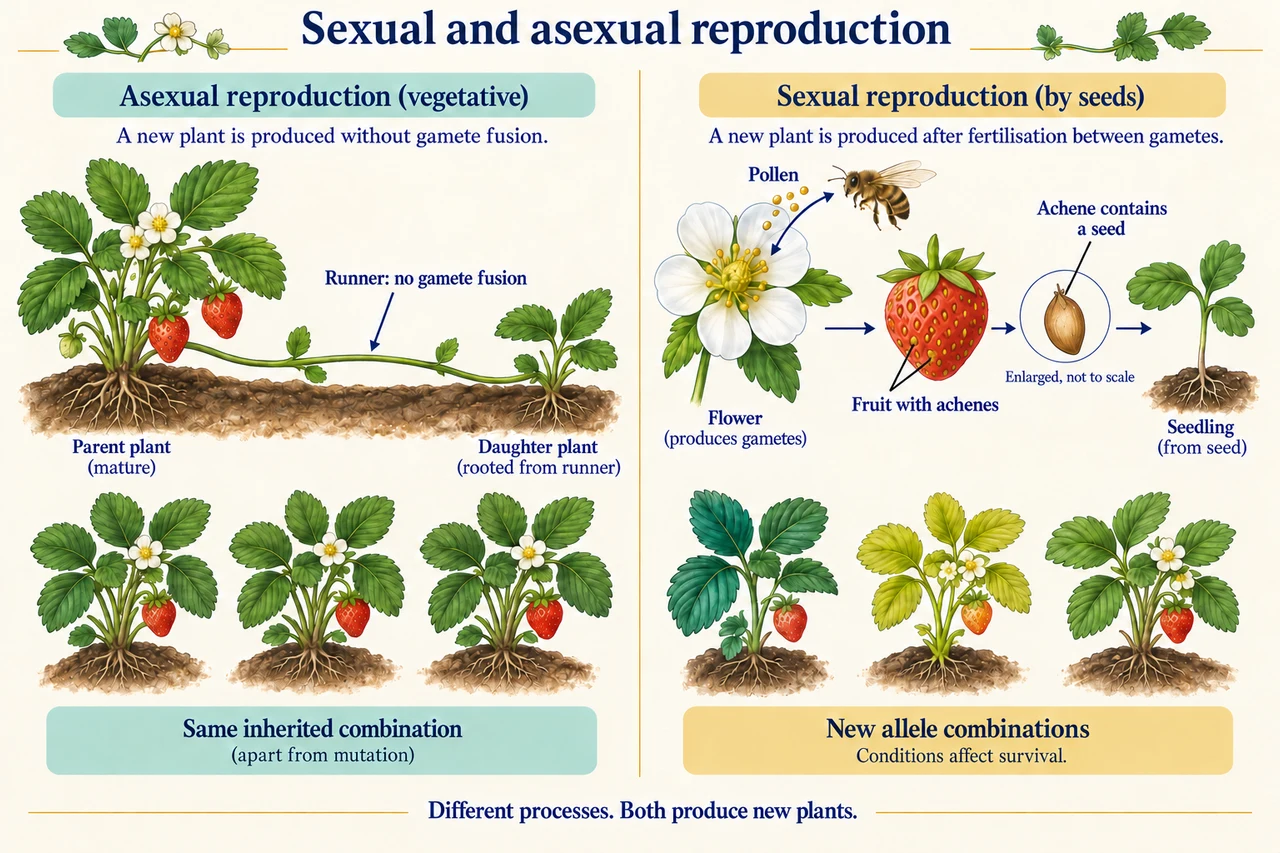
Original myAudience scientific illustration; not a documentary photograph or measured specimen. · Original generated project artwork; source concepts reviewed, no textbook figures copied.
Comparing reproductive strategies
Asexual reproduction can produce offspring quickly without requiring another individual for fertilization. Genetically similar offspring can retain a useful combination of traits, but their similarity may leave a population vulnerable to the same environmental change.
A stable favorable environment and a changing environment pose different challenges. Producing many matching plants can be useful in agriculture, while a new pathogen may expose their shared vulnerability. The explanation is conditional: variation is not a guarantee that some offspring survive, and asexual populations can still acquire variation through mutation.
Several organisms can use both strategies. Strawberry plants make runners and also reproduce through seeds; fungi can have sexual and asexual phases. The malaria parasite has different reproductive phases in its human and mosquito hosts. The question is not simply which route is faster: consider whether a mate is needed, the energy cost, offspring numbers and how inherited variation affects survival after an environmental change.
Worked example: Why could a genetically uniform crop be vulnerable to a new pathogen?
Individuals share similar inherited features
A susceptibility could be shared across the crop
Answer: Limited variation may leave few resistant plants.
Check your understanding: Does variation guarantee that every sexual offspring survives?
Answer: No.
Why: Variation provides different possibilities; survival depends on the environment and the particular traits.