Reading the genetic library
By UK GCSE Biology · independent study · myAudience
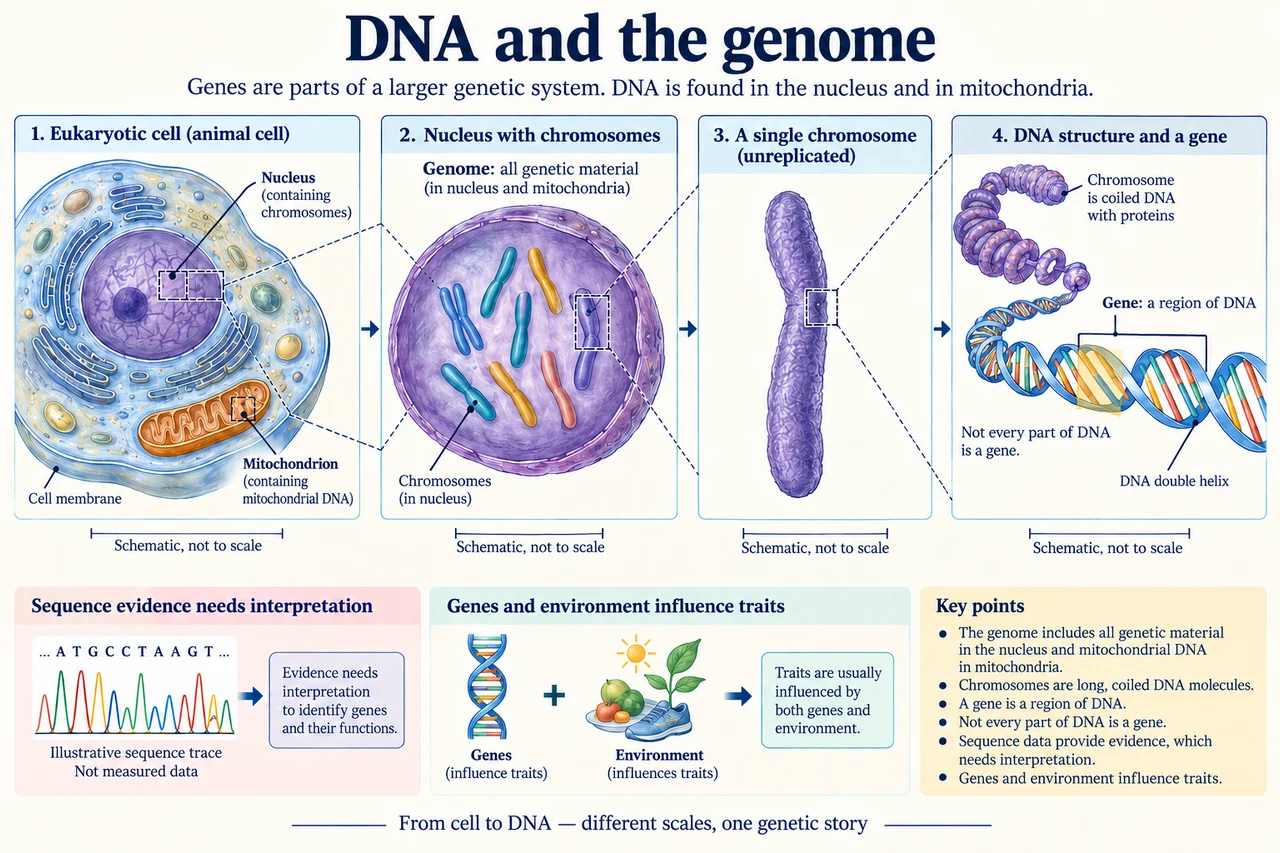
Original myAudience scientific illustration; not a documentary photograph or measured specimen. · Original generated project artwork; source concepts reviewed, no textbook figures copied.
Reading the genetic library
The genome is the full set of genetic material in an organism. DNA contains genes, but a genome includes more than a list of visible traits. Reading genetic information can help investigate inherited disorders, relationships and evolutionary history.
Environmental conditions and regulation influence how genetic information is used. A genome comparison can reveal similarities and differences, while a medical application also needs evidence about the effect of a variant. Do not equate reading a DNA sequence with predicting every trait, or assume that all observed differences are harmful.
Connect scale explicitly: a chromosome contains a long DNA molecule, a gene is a region of DNA, and the genome includes the organism’s genetic material as a whole. Studying genome differences can help trace historical migration patterns and investigate disease-related variants. Such comparisons need population evidence and careful interpretation: a sequence difference is not an automatic diagnosis, and genetic similarity cannot supply a complete account of a person’s culture or identity.
Worked example: Why is finding a DNA difference not always enough to explain a trait?
A difference may have little or no functional effect
Traits can involve several influences
Answer: Its biological significance needs evidence.
Check your understanding: Is the genome one single gene?
Answer: No.
Why: It includes the organism’s full genetic material, which contains many gene regions.