Predicting inherited traits
By UK GCSE Biology · independent study · myAudience
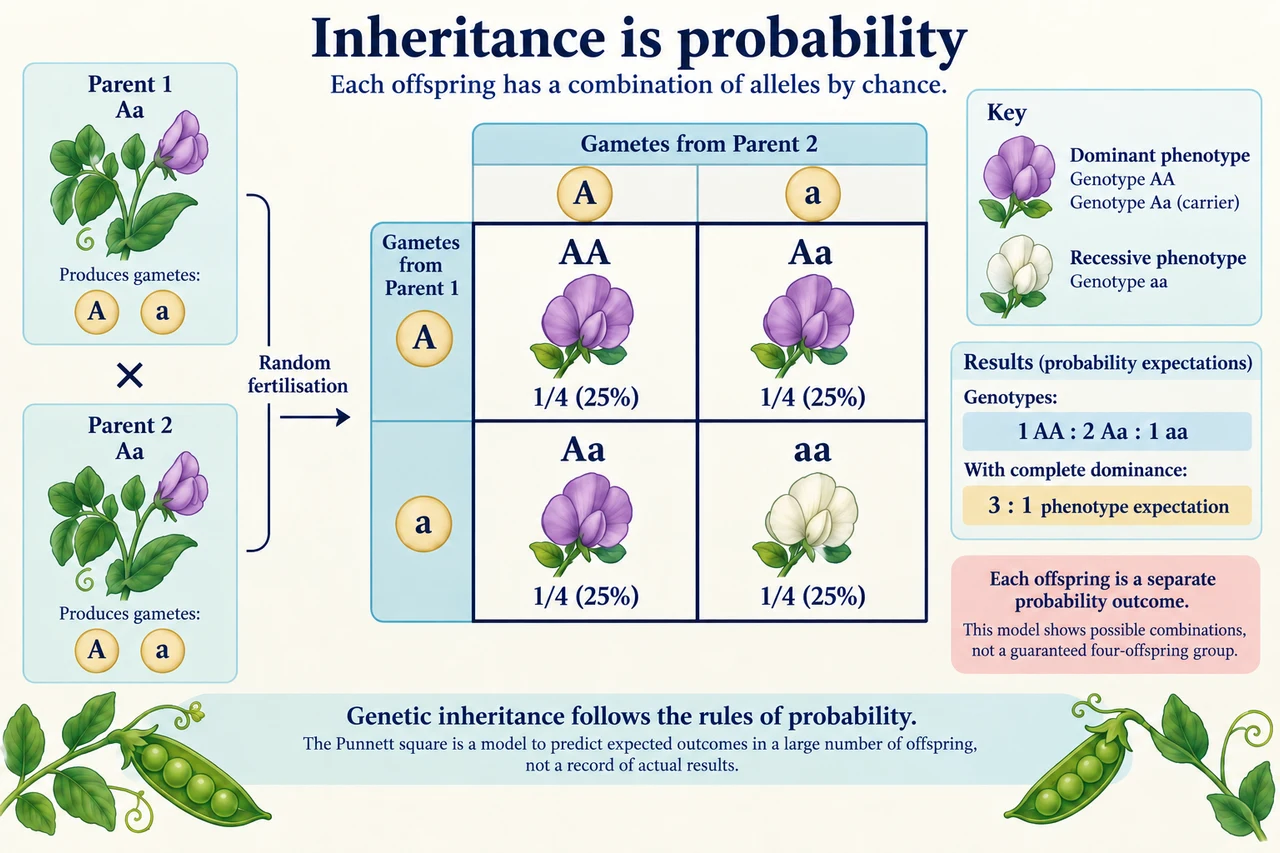
Original myAudience scientific illustration; not a documentary photograph or measured specimen. · Original generated project artwork; source concepts reviewed, no textbook figures copied.
Predicting inherited traits
An allele is a version of a gene. In a simple single-gene model, a dominant allele affects the phenotype when present with a recessive allele; a recessive phenotype usually requires two recessive copies. Genotype describes the allele combination, while phenotype describes the resulting characteristic.
A Punnett grid lists possible gamete combinations and their probabilities. It does not allocate guaranteed outcomes to a fixed sequence of children. In Aa × aa, half the combinations are Aa and half aa under the simple model. Many real traits involve several genes or environmental effects, so the single-gene grid must not be generalized to every characteristic.
Homozygous means two matching alleles in this paired-gene model; heterozygous means two different ones. In Aa × Aa, each parent contributes A or a, creating four equally likely combinations: AA, Aa, Aa and aa. The genotype ratio is 1:2:1; if A is completely dominant, the phenotype expectation is 3:1. Dominant does not mean common, stronger or healthier, and each offspring is a separate probability outcome.
Worked example: Two heterozygous parents have genotypes Aa × Aa. What is the probability of aa?
Each parent supplies A or a with equal probability in this model.
The four equally likely combinations are AA, Aa, Aa and aa.
One of the four combinations is aa: 1/4 = 0.25 = 25%.
Answer: The probability of aa for each offspring is 25%; it is not a guarantee of one in every four offspring.
Check your understanding: Must four offspring include exactly one aa individual?
Answer: No.
Why: The fraction is a probability; small groups can differ from the expected proportion.