Conditions passed through genes
By UK GCSE Biology · independent study · myAudience
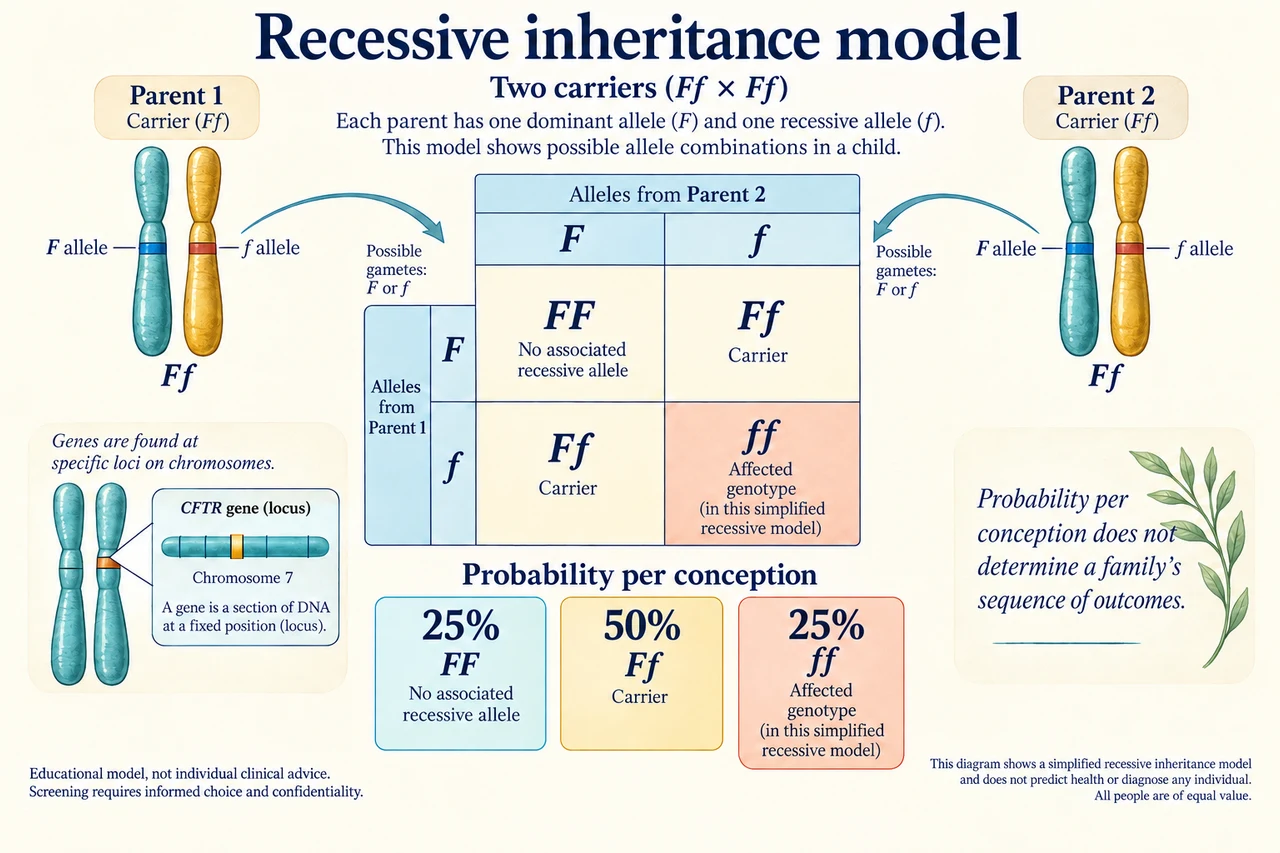
Original myAudience scientific illustration; not a documentary photograph or measured specimen. · Original generated project artwork; source concepts reviewed, no textbook figures copied.
Conditions passed through genes
Some inherited disorders can be modeled through particular alleles. Cystic fibrosis is commonly taught as a recessive example, so a person can carry one associated allele without having the disorder. Polydactyly can illustrate a dominant pattern in a simplified inheritance model.
A family tree can support an inheritance explanation but may leave uncertainty about particular genotypes. Genetic testing and screening raise questions about interpretation, privacy and informed choice. An educational probability is not a diagnosis or a statement that a particular pregnancy must have one outcome; clinical advice considers the actual variants and individual context.
In a recessive model, two carriers can each pass either allele. That gives a one-quarter chance of the affected genotype per conception in the simplified cross, rather than a promise of one affected child in every four. A family tree can identify some genotypes while leaving others unresolved. Screening decisions involve accurate interpretation, informed choice and confidentiality; the model describes inheritance, not a judgment about the value of people living with a condition.
Worked example: In a recessive model, what can two unaffected carriers pass to a child?
Each carrier can pass either allele
A child can receive the recessive allele from both
Answer: An affected recessive genotype is possible.
Check your understanding: Does carrying one recessive disease allele always mean being affected?
Answer: No.
Why: One functioning dominant allele can be sufficient in the simplified recessive model.