Inheritance of biological sex
By UK GCSE Biology · independent study · myAudience
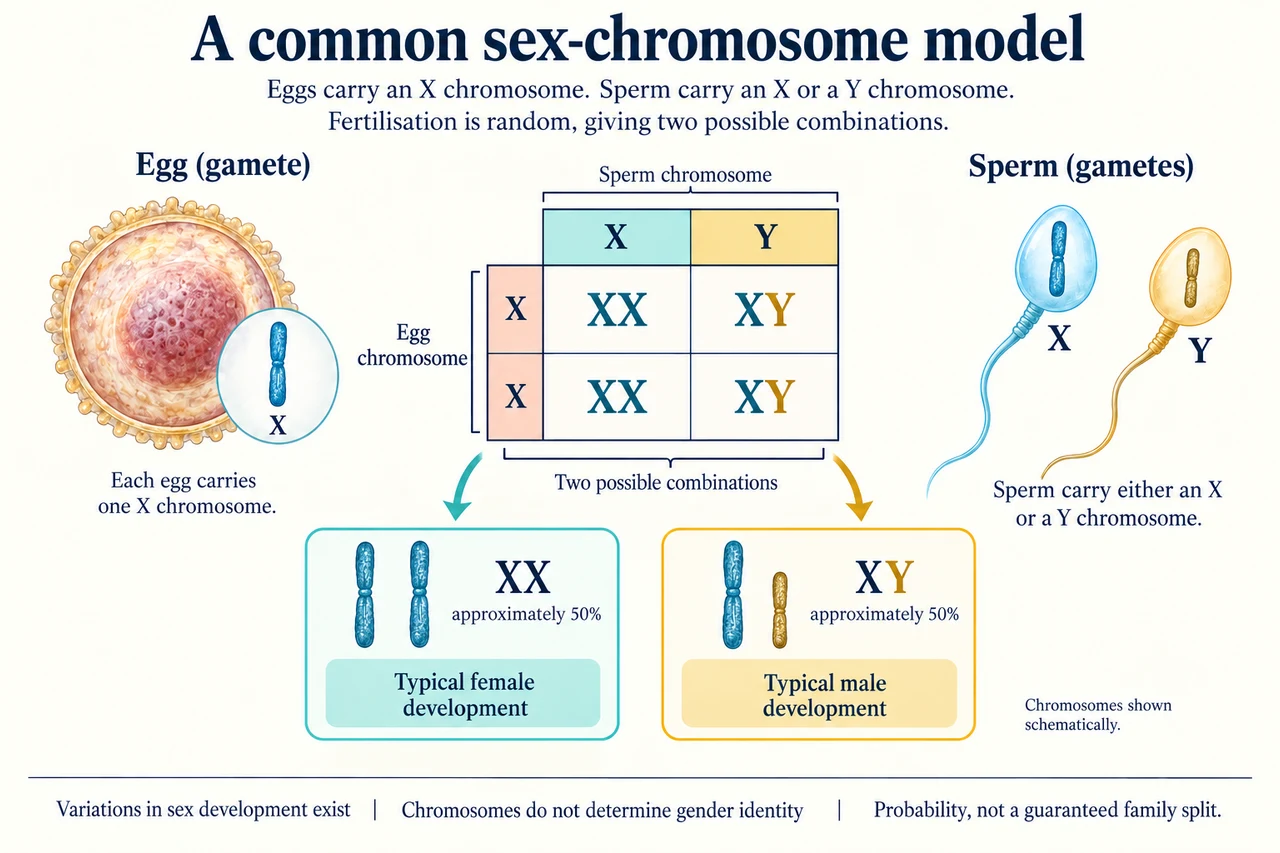
Original myAudience scientific illustration; not a documentary photograph or measured specimen. · Original generated project artwork; source concepts reviewed, no textbook figures copied.
Inheritance of biological sex
In the common simplified human chromosome model, 22 pairs are autosomes and one pair is described as sex chromosomes. XX is associated with typical female development and XY with typical male development. Eggs usually carry X; sperm can carry X or Y. An explicit cross therefore gives approximately equal XX and XY probabilities, without implying anyone chooses the outcome.
For a large number of independent outcomes, the model predicts an approximately equal proportion rather than an alternating sequence or an exact split in every small family. Chromosome variants, genes and hormone responses can lead to variations in sex development. This classroom model is not a complete account of every person’s development and cannot be used to infer gender identity.
Worked example: Using the usual XX×XY model, what combinations can fertilization produce?
The egg supplies X
The sperm can supply X or Y
Answer: The model gives XX and XY with approximately equal probability.
Check your understanding: Can this chromosome model determine a person’s gender identity?
Answer: No.
Why: Gender identity is not established by this simplified inheritance calculation.